Table of Contents
Explore the james webb telescope has discovered a lemon-shaped diamond planet.
The Dissimilar Carbon World
This planet is named PSR J2322-2650b . Unlike most other planets, its atmosphere contains no water vapor or CO2, but is dominated by helium and carbon. With a mass comparable to Jupiter, this planet is covered in thick, sooty black clouds. Under extreme pressure at its core, scientists believe that this carbon is compressed into sparkling diamonds.
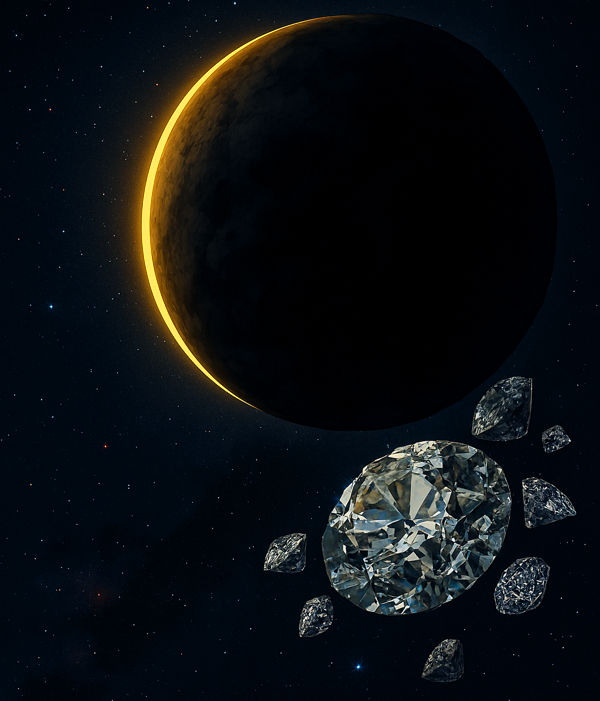
"This is a new type of planetary atmosphere that no one has ever seen before," said astrophysicist Michael Zhang from the University of Chicago. "It orbits an extremely unusual star: as massive as the Sun but only the size of a city."
The deadly "Black Widow" system

PSR J2322-2650b orbits a neutron star (also known as a pulsar) at breakneck speed. The distance between them is only 1.6 million km (compared to 150 million km for Earth and the Sun), allowing the planet to complete one orbit in just 7.8 hours .
The tremendous gravitational pull of the pulsar has stretched this Jupiter-massive planet into a bizarre, lemon-like shape. This system is classified as a "Black Widow" – where the pulsar constantly emits high-energy winds and radiation to "eat away" at and gradually erode matter from its companion planet.
Challenging the laws of physics
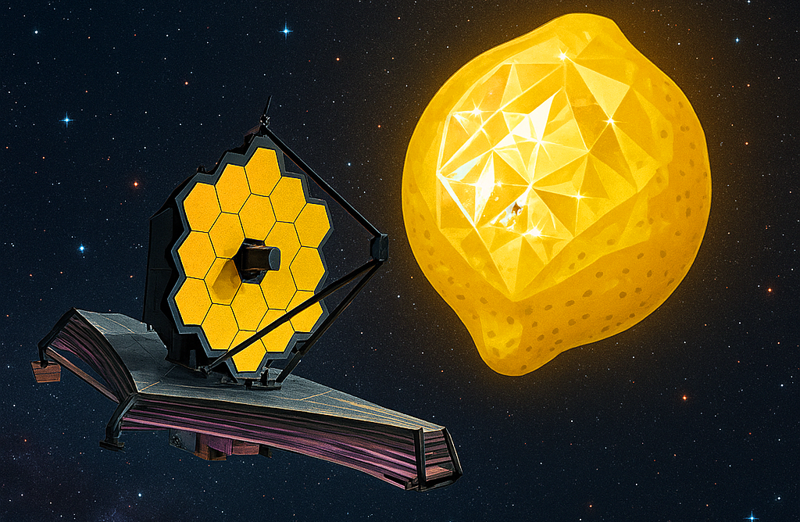
What puzzled astronomers the most was the planet's chemical composition. Instead of ordinary molecules, Webb discovered pure carbon molecules (C2 and C3).
"It's hard to imagine how a planet could have such an extremely high carbon content," Zhang shared. "It seems to defy every planet-forming mechanism we've ever known." One hypothesis suggests that as the planet cooled, the carbon and oxygen mixture inside began to crystallize, causing pure carbon crystals to rise to the surface and blend into the helium crust.
This discovery was only possible thanks to James Webb's exceptional infrared sensitivity. Because the pulse primarily emitted gamma rays and high-energy particles (which are invisible to infrared equipment), it did not blind Webb's sensors. This allowed scientists to directly observe the planet in its purest state, without being obscured by the light of its host star.
Final Thoughts
Understanding the james webb telescope has discovered a lemon-shaped diamond planet makes it easier to evaluate the information and apply the most relevant recommendations. Focus on the key points above and verify details that may change over time.
FAQ
What is the james webb telescope has discovered a lemon-shaped diamond planet?
Explore the james webb telescope has discovered a lemon-shaped diamond planet.
What key points does this article cover?
The article focuses on The Dissimilar Carbon World, The deadly "Black Widow" system, Challenging the laws of physics, with practical explanations and examples.
How can you use this information in practice?
Use the explanations to compare options, verify important details, and make a more informed decision. Apply the recommendations that best match your goals and situation.
Related Articles
 A Pair of Galaxies with Unique Question Mark Shapes Discovered4 minutes read
 James Webb Super Telescope: Complete Guide3 minutes read
 NASA Successfully Launched the James Webb Space Telescope, a5 minutes read
 Admire the Beautiful 'penguin' Against the Backdrop of Space4 minutes read
 Why NASA Gold - Plated the Mirrors of the $ 10 Billion James Webb Telescope3 minutes read
 Space: Complete Guide3 minutes read
Reader Comments 0
Sign in with email or Google to join the discussion.