Table of Contents
TOI-4465 b is a gas giant about 400 light-years away that orbits its star roughly every 102 days. NASA’s Transiting Exoplanet Survey Satellite (TESS) spotted a possible transit. Astronomers and citizen scientists then worked together to catch another one and confirm the planet.
Why it took a global campaign
During a transit, the planet crosses the face of its star from our point of view, causing a small dip in brightness. A single dip gives astronomers a candidate, while repeated observations help establish the orbit. A TOI-4465 b transit lasts about 12 hours, making it difficult for one ground telescope to follow the entire event in darkness and clear weather.
The University of New Mexico reports that the campaign spanned 14 countries and included 24 citizen scientists from 10 countries. Their brightness measurements supplemented professional observations. Measurements of the star’s motion helped constrain the planet’s mass.
How TOI-4465 b compares with Jupiter
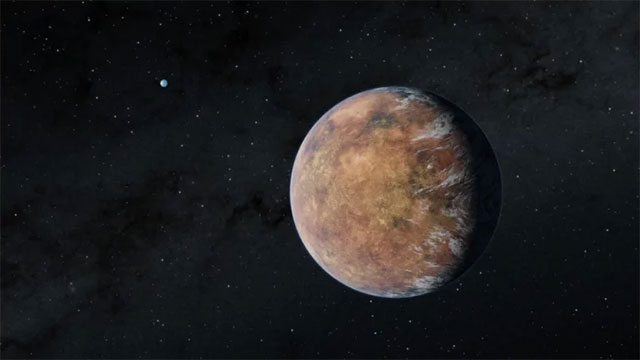
The planet is about 25% larger in radius than Jupiter and nearly six times as massive, giving it close to three times Jupiter’s average density. See the NASA Exoplanet Archive entry for measured and estimated properties. The longer orbit makes this world a useful comparison with hot Jupiters that orbit very close to their stars.
What astronomers could learn next
Future measurements could use a telescope such as James Webb to investigate its atmosphere. The confirmation established the planet and its main properties. Atmospheric composition requires separate observations, as in research on the atmosphere of K2-18 b.
Related Articles
 Largest 'super-Earth' ever discovered, 200 light years away
 Is There Life on Exoplanet K2-18b? Exciting New Results
 Detection of extremely hot exoplanet with winds of more than 8000km/h
 For the first time, toxic gas has been discovered that confuses astronomers
 Super-Earth suitable for life discovered 100 light years away
 The discovery of the 'Second Earth' can exist only 4.2 light-years away from Earth
Reader Comments 0
Sign in with email or Google to join the discussion.