Table of Contents
Explore nuclear thermal engines.
Notably, by using low-enriched uranium (HALEU) fuel, the USNC nuclear thermal propulsion (NTP) system not only offers better performance (reducing travel time to Mars by half) and greater operational sustainability, but is also significantly safer than current technologies.
"The biggest challenge is creating a nuclear reactor that is light enough and safe enough to use outside of Earth's atmosphere – especially if the spacecraft is carrying a crew," a USNC representative said.
Using nuclear thermal propulsion systems is not actually a new idea. The core element here is leveraging the immense heat generated by nuclear reactions to propel rockets at supersonic speeds, and ensuring sustained operation. USNC's technology was successfully developed just months after Elon Musk suggested that nuclear propulsion could be the key to sending astronauts to Mars. For the SpaceX CEO, the top concern in any space mission is the health and safety of the astronauts. The longer the journey to Mars, the longer the astronauts will be exposed to unusual cosmic radiation. Therefore, creating new, more efficient propulsion systems to shorten the journey time will be a crucial task.
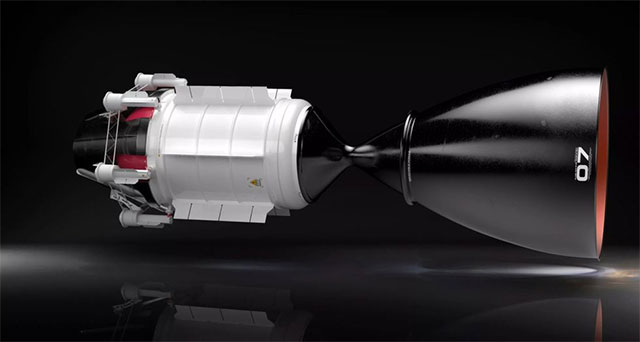
In terms of basic operation, the USNC's NTP system derives energy from nuclear fission, working by pumping liquid propellant through a nuclear reactor core, where atomic splitting occurs and heat is generated. Generally, the 'mini' reactor in the USNC's nuclear thermal propulsion system has a design quite similar to that of the micro-reactor systems currently being researched by many countries. However, the USNC reactor uses HALEU fuel and Fully Ceramic Microencapsulated (FCM) technology for superior safety at extremely high temperatures.
"The key to USNC's design is the 'conscious overlap' between land-based and space reactor technology," USNC-Tech CEO Paolo Venneri said in a statement. "This allows us to leverage advances in nuclear technology and infrastructure from ground-based systems and apply them to our space-based reactors."
The USNC says its engine provides twice the thrust of conventional chemical engines, while using less enriched fuel and operating much more stably than previous nuclear reactor thermal designs. The NTP system promises to significantly reduce space travel times and allow for carrying much larger payloads than even the most advanced chemical rockets currently available.
USNC stated that it has submitted the design concept to NASA for further validation and to move on to more in-depth real-world testing.
Final Thoughts
Understanding nuclear thermal engines makes it easier to evaluate the information and apply the most relevant recommendations. Focus on the key points above and verify details that may change over time.
FAQ
What is nuclear thermal engines?
Explore nuclear thermal engines.
What key points does this article cover?
The article explains the core concept, important considerations, and practical details readers should understand.
How can you use this information in practice?
Use the explanations to compare options, verify important details, and make a more informed decision. Apply the recommendations that best match your goals and situation.
Related Articles
 This Is Why Elon Musk Wants to Conduct a 'Nuclear Attack' on Mars6 minutes read
 How Does Human Body Change in Mars4 minutes read
 How Will the World Change in the Next 1000 Years6 minutes read
 How Terrible Is the Rocket That Will Bring People to Mars3 minutes read
 What Is Thermal Paste?4 minutes read
 Scientists Reveal How to 'renovate' Mars' Climate So Humans Can Live4 minutes read
Reader Comments 0
Sign in with email or Google to join the discussion.