Table of Contents
Quick Overview
Nuclear Fusion : Get a clear, practical overview of Nuclear Fusion.
A Canadian man named Hudzah achieved nuclear fusion at home for a total cost of just $3,000 with the help of Claude AI - a chatbot developed by Amazon. He live-streamed the interesting feat on the social media platform X and immediately attracted a lot of attention.
In his experiment, Hudzah used mostly readily available materials like hydrogen and deuterium oxide, often called heavy water. Meanwhile, the Claude AI chatbot helped him sift through documentation and debugging instructions for the project, with OpenAI's o1 pro algorithm helping him sort through confusion over wiring and assembly. The ultimate goal of the project is to build a fusion reactor to detect neutrons.
Hudzah shared that the most technically challenging part of the project was building a reactor chamber capable of maintaining extremely low air pressures, which can only be measured in the single or low double digits militorr (mTorr). As a result, the two most expensive components of the setup included equipment to generate a voltage of 30 kilovolts (kV) and a vacuum of 5 to 15 mTorr.
Initially, Hudzah estimated that the cost of materials would be around $15,000. However, public instructions compiled by Claude AI have resulted in significant cost savings. For example, Hudzah used a $120 two-stage vacuum pump and a $60 electrostatic capacitor purchased on Aliexpress to build his complex device.
The third complex ingredient to purchase is a form of hydrogen gas called deuterium. Hudzah notes that purchasing this gas requires 'specific credentials and is only sold in quantities of 500L or more,' but he came up with an idea: instead of buying 500L of gas, he bought a kid's fuel cell car, extracted a proton exchange membrane (PEM) from it, and used it to convert easily available deuterium oxide (D2O, or heavy water) into deuterium.


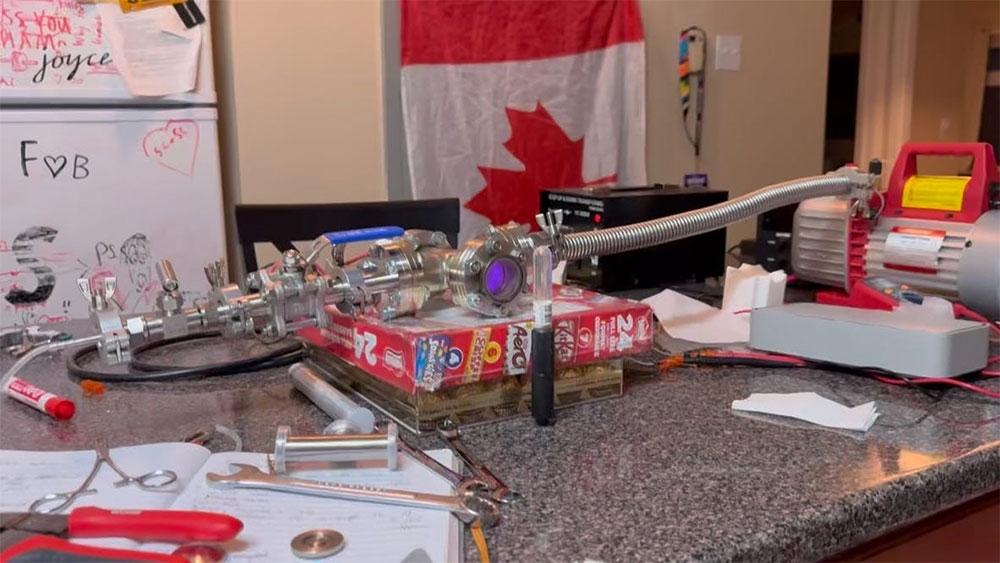
After securing all the components, Hudzah and a friend got to work. They spent the first 6 hours assembling the components and ensuring the vacuum chamber could reach 3 mTorr. Another friend joined them in the next 6 hours, and they spent the next 12 hours locating a step-up transformer, debugging it, dealing with a burned-out vacuum sensor, and a host of other odd jobs. Throughout the process, an AI chatbot helped them debug and process information.
Finally, over the next three hours, the team achieved nuclear fusion at home. Hudzah shared that since there was no lead shield to protect him, he 'turned on the system, opened the needle valve to let the deuterium flow in, and ran to another room to observe remotely.' In theory, neutrons and X-rays emitted from this device are carcinogenic and you must use lead shielding to protect yourself.
FAQ About Nuclear Fusion
What is Nuclear Fusion?
The ultimate goal of the project is to build a fusion reactor to detect neutrons
Why is Nuclear Fusion important?
Understanding Nuclear Fusion helps you evaluate its benefits, limitations, and potential risks before making a decision.
How can you use or manage Nuclear Fusion effectively?
Use the steps and recommendations in this guide, confirm important settings, and review the results before making further changes.
Related Articles
 12-year-old Boy Successfully Built a Nuclear Reactor at Home4 minutes read
 American Startup Reveals Modern 'Alchemy' Technology4 minutes read
 South Korea Achieved a New Breakthrough with Nuclear Fusion Experiments5 minutes read
 A Student Uses AI to Create a Nuclear Reactor at Home: What You Need to Know4 minutes read
 China's Artificial Sun Will Be Operational by 20203 minutes read
 Successfully Developed a New Type of Battery That Works on Nuclear Waste and Light4 minutes read
Reader Comments 0
Sign in with email or Google to join the discussion.