Table of Contents
New research by Professor Nicholaus Parziale has provided evidence in support of the Morkovin hypothesis, opening a major step forward in designing hypersonic aircraft that could shorten global flight times to just 1 hour.
A new experiment has provided strong support for the Morkovin hypothesis, a long-controversial idea in the field of aerodynamics. According to the results, turbulent air at Mach 6 (six times the speed of sound) behaves in a similar way to air at lower speeds. The finding could pave the way for hypersonic flight – and even cheaper space travel.
The dream of 'flying around the world in an hour'
Hypersonic flight, once the stuff of science fiction, is now creeping closer to reality. If successful, it could transform global aviation, reducing all-day flights to the length of a movie. For example, the Sydney-Los Angeles journey, which currently takes around 15 hours, could be reduced to just one hour if it reaches Mach 10 (10 times the speed of sound).
While this may seem impossible, progress is being made. Some military aircraft are already flying at speeds of Mach 2 to Mach 3, or two to three times the speed of sound. But flying at Mach 10 to complete a one-hour trip across the Pacific Ocean requires overcoming the enormous amounts of heat and turbulence created by cutting through the air at such high speeds.
At low speeds, air is considered an incompressible flow – the density of the air remains virtually unchanged, making calculations simple. But when it passes the sound barrier, the flow becomes a compressible flow – where density, pressure and temperature change continuously, making aerodynamic design very difficult.
Morkovin hypothesis – the key to hypersonic flight
Introduced by scientist Mark Morkovin in the mid-20th century, this hypothesis states that the turbulent properties of gas flows at Mach 5–6 remain similar to those at lower speeds, despite strong changes in density and temperature.
' Simply put, this hypothesis says that the 'vortex' motion of fast and slow air is not very different ,' – Professor Nicholaus Parziale explains. ' If that is true, you can apply the same aerodynamic simulation model to fast flows as well, without having to invent a completely new system .'
If proven, this would simplify hypersonic aircraft design, as it would not require a complete change to current aerodynamic computational models.
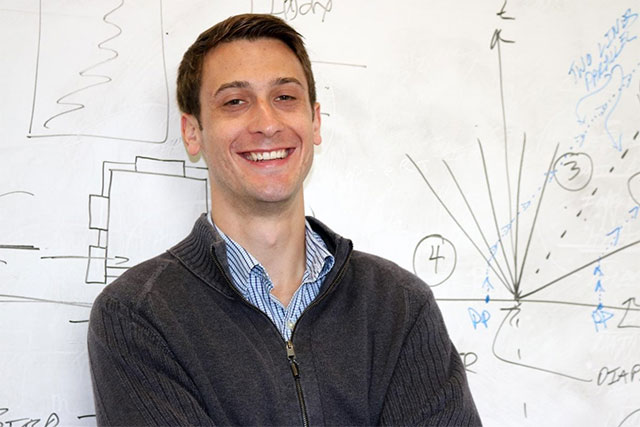
To verify this, Parziale's team conducted a study titled ' Hypersonic Turbulent Quantities in Support of Morkovin's Hypothesis', published on November 12 in the journal Nature Communications.
In the experiment, the team pumped krypton gas into the air in a wind tunnel and fired a laser to ionize it, creating a straight streak of light. They then used ultra-high-resolution cameras to record how the streak twisted, bent, and moved through the gas stream—much like a leaf swirling in a river.
' The wavy shape of the light trail gives us insight into the turbulent structure of the flow, ' says Parziale. ' The results show that at Mach 6, the turbulent flow is actually very similar to low-speed incompressible flow. '
The research team has been funded by the US Air Force (AFOSR) and the US Navy (ONR) over the years, starting with the Young Investigator Programs (YIPs) in 2016 and 2020.
Towards the era of hypersonic flight and space travel
While not yet fully confirmed, the research is a major step toward the realization of hypersonic flight. If Morkovin's hypothesis is correct, it would make simulations and designs of Mach 6 aircraft much more feasible, as it would not require massive supercomputers to calculate the billions of tiny fluctuations in the air.
Professor Parziale said this discovery also opens up opportunities for new types of space flight technology:
'If we could build aircraft that could fly at hypersonic speeds, we could also use them to get to low Earth orbit, instead of having to launch rockets. That would completely change the way humans travel — not just on Earth, but between Earth and near space.'
FAQ
What is new about hypersonic breakthrough opens era of flying around the earth in?
In practical terms, new research by Professor Nicholaus Parziale has provided evidence in support of the Morkovin hypothesis, opening a major step forward in designing hypersonic aircraft that could shorten global flight times to just 1 hour.
Why does this update matter?
The article highlights that morkovin hypothesis – the key to hypersonic flight Introduced by scientist Mark Morkovin in the mid-20th century, this hypothesis states that the turbulent properties of gas flows at Mach 5–6 remain similar to those at.
Is the change available to everyone?
Availability may depend on the product version, region, account, or rollout stage described in the article.
Related Articles
 Wingless Animals That Can Fly Like Birds6 minutes read
 How Much Money Do Fighter Planes Burn per Flight Hour?5 minutes read
 Marvel at the Cutting of the Twin Bullets Flying 200 Miles / H6 minutes read
 China Applies Military Hypersonic Technology to High-speed Trains Explained8 minutes read
 What Is G Hour?3 minutes read
 A Meteorite Is Rushing Towards Earth at Speeds up to over 33,0003 minutes read
Reader Comments 0
Sign in with email or Google to join the discussion.