Table of Contents
Our planet has gone through billions of years of catastrophic events that have shaped the world we live in. But one day, there will be an event so catastrophic that it will destroy this 'floating rock' and end the experiment called humanity. Here are the events that could end human life .
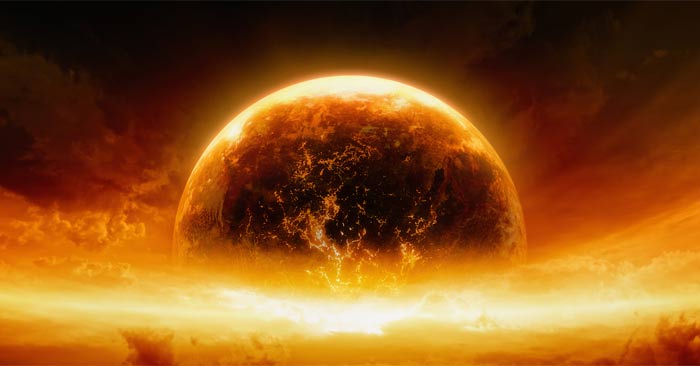
An asteroid causes a heat storm
Hurricanes remain some of the deadliest natural phenomena on our planet, and they leave a trail of destruction wherever they land. But if an asteroid hits the ocean with enough force and heat, hurricanes would be mere cotton balls compared to what happens next. A large enough asteroid could heat the ocean to over 110°F (49°C).
And this could cause a huge storm called a super typhoon. The winds would move as fast as the speed of sound. And the clouds would reach heights of up to 40 km (25 miles). The winds would spray water and aerosols into the stratosphere, destroying the ozone layer. So even if the winds don't take you into space, you could still be scorched by the radiation on the surface of the Earth.
Jupiter becomes a star
This gas giant has more than twice the mass of all the planets in our solar system combined. And the gases swirling in Jupiter's atmosphere are the same stuff that made up the Sun. But if Jupiter were to become 1,000 times more massive, that distant yellow dot would destroy our planet.
With such a large mass, Jupiter will turn into a star. Since this new star is located right in the middle of the Solar System, the orbits of celestial bodies will change. Earth may be pulled closer to Jupiter and burned by the heat emitted by the old planet.
Worse still, gravity could turn our world into a rogue planet. That would mean humans would be sent out into space, outside the Solar System, wandering endlessly in search of a new home. Without the heat of the Sun to keep us warm, the Earth's surface would freeze, wiping out all life on our planet.
The Sun "swallows" the Earth
Perhaps we should focus not on a star that has yet to form, but on the one we have. After all, it is this gas that makes life possible on Earth. But since it burns 600,000,000 tons of hydrogen every second, it is only a matter of time before this energy source runs out.
And when that happens, the Sun's core will become saturated with helium and begin to contract. The increased pressure and temperature will cause the Sun to spew out enormous amounts of energy. The Sun's outer layers will expand outward, creating a deadly heat wave on Earth. Our oceans will evaporate into thin air, and radiation will scorch the planet's surface. Eventually, the Sun, once the source of life, will engulf what's left of Earth. And if it continues to expand, the Solar System will face a new threat.
Earth sucked into black hole
If the Sun gains more mass before it collapses, you could witness the birth of one of the most mysterious forces in the universe, a black hole. The product of a dying star, the gravitational pull of this void can tear apart other stars and planets.
Right now, the Sun is too small to cause any of these disasters. But if a black hole appeared in front of Earth, the uneven gravitational pull would begin to deform the planet. Earthquakes and volcanic eruptions would erupt all over our world.
And as you approach the black hole's event horizon, the monster can stretch the Earth like a rubber band. A black hole sucks in matter by compressing it horizontally, making it look like a noodle. We call this spaghettification. Every bit of the Earth will be stretched out into a string of atoms and sucked into this hungry void.
All volcanoes explode
Think the future of Earth can't get any worse? Here's a FACT. And while the damage a black hole would do to our planet would be horrendous, Earth doesn't need the gravity of space to cause an apocalypse. The real threat is right under your feet.
There are currently 10 to 20 volcanoes erupting around our planet, spewing ash and gas into the atmosphere. But if all the volcanoes on Earth erupted, you would have no escape from the smoke and heat, no matter where you lived. Rocks reaching temperatures of 1,000 °C (1,830 °F) would travel at speeds of up to 700 km/h (450 mph).
With so much molten rock pouring onto the surface, the planet could be thrown off balance and the poles could shift. A thick layer of ash and gas would suffocate the Earth, eventually blocking out all sunlight. As the lava cooled, temperatures on Earth would plummet, plunging us into another Ice Age. While this wouldn't necessarily end all life on Earth, it would destroy any chance of sustaining it until the clouds cleared.
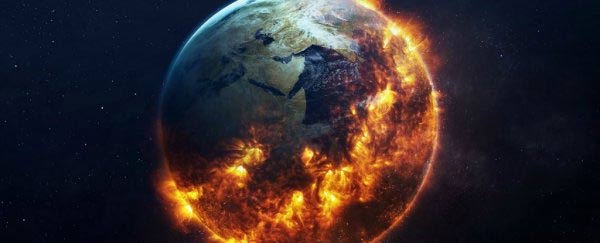
Life on Earth has ended many times before, and it's safe to say it could happen again. Do you think you're prepared for these eventualities?
Final Thoughts
The development covered in this article is worth following, but specifications, dates, and feature details may change until the relevant company or organization publishes an official confirmation.
FAQ
What is the main development covered in this article?
Our planet has gone through billions of years of catastrophic events that have shaped the world we live in. But one day, there will be an event so catastrophic that it will destroy this 'floating rock' and end the experiment called humanity.
What should you know about An asteroid causes a heat storm?
Hurricanes remain some of the deadliest natural phenomena on our planet, and they leave a trail of destruction wherever they land.
Is every reported detail officially confirmed?
Not necessarily. Product leaks, preview builds, research reports, and early announcements can change. Confirm important specifications, dates, and availability through an official source before making a decision.
Related Articles
 20 Outstanding Iot Events by 20203 minutes read
 The Most Prominent Technology Events in 20248 minutes read
 Events in C #: Event (Event) in C #6 minutes read
 Technologies That Can Save or Destroy Humanity: Complete Guide6 minutes read
 6 Famous Inventions but Made Scientists Regret for Life5 minutes read
 Guide to Creating Events, Activities on Facebook6 minutes read
Reader Comments 0
Sign in with email or Google to join the discussion.