Table of Contents
What the early Earth looked like serves as a mystery that almost everyone wants to know. And recently, the discovery of evidence of a lost world hidden deep inside the Earth has left everyone amazed.
What the early Earth looked like is a mystery that almost everyone wants to know. And recently, the discovery of evidence of a lost world hidden deep inside the Earth has left everyone amazed.
We all go through a rough patch in our youth, and most of us hope any evidence of it will disappear. Our planet is no exception – but as new research has found, Earth's dramatic changes aren't enough to completely obscure its past.
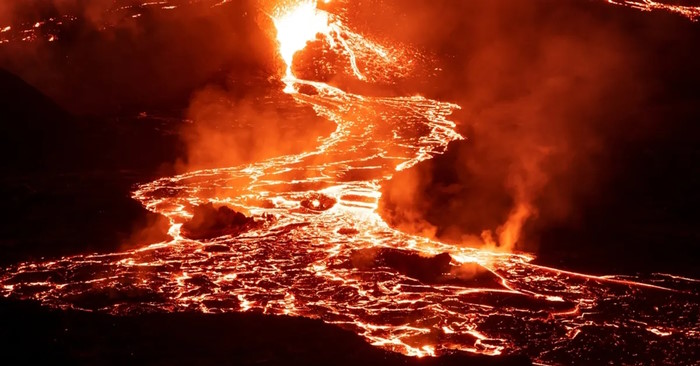
This may be the first direct evidence of materials Preserved from so-called 'pre-Earth,' says Nicole Nie, the Paul M. Cook Career Development Associate Professor of Earth and Planetary Sciences at MIT and lead author of the new study.
' We predict that this very early signal will gradually be erased over the course of Earth's evolution ,' she added.
Before the Earth was formed
Back in the early days, our planet was a very different place than it is now. We're not talking about different climates or different forms of life. Nor are we talking about the more dramatic differences like the barren land world of the Ordovician period, or the nearly oxygen-free Cambrian period.
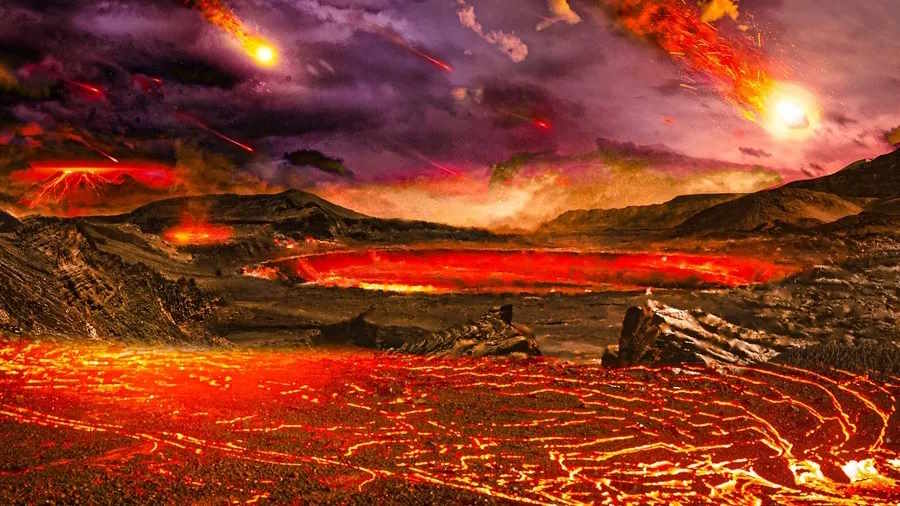
This was an Earth unrecognizable to modern eyes at a much more fundamental level: Molten, bubbling, and only two-thirds its current size – dancing in space with a twin planet called Theia.
Not only would that Earth be uninhabited – it would be hostile to life. The volatile elements that are essential for life, such as hydrogen, carbon, and sulfur, would be virtually absent; in fact, thanks to the heat of the sun and the rocky composition of Earth, they would be virtually impossible to exist in any usable state. To think that this planet would one day be home to all known life in the solar system would be not only optimistic, but also a little ridiculous.
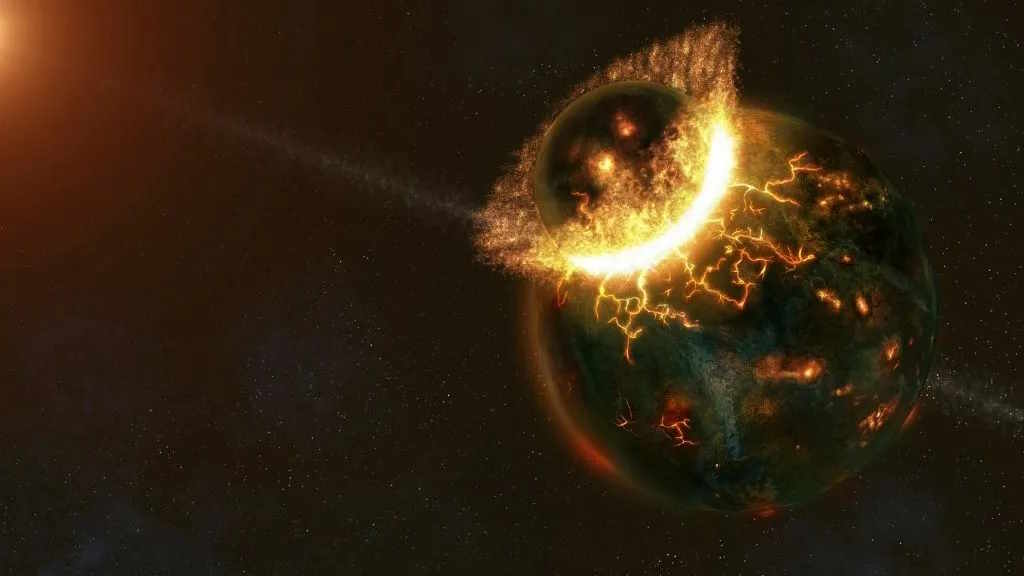
Then, for some reason, something catastrophic happened. Theia and Earth collided in an event sometimes called the 'Big Impact,' releasing enough energy to 'reset' Earth's internal chemistry. Our home planet was shattered, then melted, and grew much larger as it absorbed debris from its sister planet; meanwhile, what was left of Theia became humanity's moon.
For Earth, that was a stroke of luck. ' It was only the Theia collision that brought the volatile elements to Earth and ultimately made life possible there ,' explains Pascal Kruttasch, now an SNSF Postdoctoral Research Fellow at Imperial College London, who was not involved in the new research but is lead author of a recent paper examining the effects of the giant impact. Earth received water and carbon from the collision; we have a moon from it; even Earth's magnetic field and tectonic activity may be remnants of that earlier collision.
But is there any direct evidence of a world before that? Somehow, that evidence has been lost.
At least on Earth: much of what humanity knows about this story so far has been gleaned from comparing isotopes on the Moon and Earth, and by making inferences based on what substances are and are not present on the Moon compared to Earth.
But actually finding any remnants on Earth after the collision has been a pipe dream until now.
Message from the universe
Back in 2023, Nie and her colleagues are working on another project: analyzing and comparing meteorites from around the world. The goal is to compile a picture of how the solar system has evolved and changed over time—meteorites likely originate from different places and times, so they will provide a glimpse into how each of those points might have changed.
The team found something unexpected: an unusual " Potassium isotope " that is markedly different from the most common types of potassium found on Earth.
"We found that different meteorites have different potassium isotopic signatures ," Nie explains, " Which means potassium can be used as a tracer of the building blocks of Earth. "
And so, instead of analyzing meteorites, the team turned their attention to Earth itself—specifically, rocks from Greenland and Canada, where some of the oldest preserved rocks on the planet are found, and Hawaii, where ongoing volcanic activity regularly brings rocks up from deep within the Earth's mantle.
Amazingly, they found some samples that fit the hypothesis: materials that Were 'made differently ,' Nie says, than most materials on Earth. But was it really ancient Earth? Or was it just a coincidence? Well, this is where things get really interesting: like a primary school student dipping a treasure map in tea, the team simulated billions of years of aging and trauma on the samples – and what they found was as close to true as you can get.
The samples are no longer unusual – after simulated impacts of a giant impact, along with millions of years of simulated tectonic movements and geological changes, the team is finding something that actually looks a lot like modern materials. In other words: those early samples could be ' Part of a very ancient Earth, even before the giant impact ,' Nie says.
An unfinished story
It's a discovery that upends what we know about Earth and its history – but here's the thing: it's not done yet. The research began with meteorites, and the unusual potassium isotopes they carry – but those abnormalities don't quite match what the team found in samples deep underground.
That means the exact composition of the early planet Earth remains a mystery.
The study was published in the journal Nature Geoscience.
FAQ
What should you know about traces of a lost world discovered deep within the earth?
In practical terms, what the early Earth looked like is a mystery that almost everyone wants to know. And recently, the discovery of evidence of a lost world hidden deep inside the Earth has left everyone amazed.
Why does traces of a lost world discovered deep within the earth matter?
The article highlights that and recently, the discovery of evidence of a lost world hidden deep inside the Earth has left everyone amazed.
What is the main takeaway?
The main takeaway is that cook Career Development Associate Professor of Earth and Planetary Sciences at MIT and lead author of the new study .
Related Articles
 Scientists Discover Traces of Ancient Life in an Unexpected Place7 minutes read
 This Jewel Is Proof That There Is a Large Sea of Water Deep Beneath5 minutes read
 5 Outstanding Scientific Discoveries Discovered in 20173 minutes read
 What Is Deep Web? Where Is the Deep Web? Good or Bad?9 minutes read
 13 Spectacular Virtual Tours on Google Earth You Should Explore8 minutes read
 23 Billion Km Away from Earth, How the Spacecraft Communicates with Us5 minutes read
Reader Comments 0
Sign in with email or Google to join the discussion.