Table of Contents
This updated guide explores disintegrating planet creates a comet-like fire tail with practical details, clear explanations, and useful takeaways. Astronomers from the Massachusetts Institute of Technology (MIT) have discovered a planet called BD+05 4868 A that is in the process of disintegrating, leaving behind a long comet-like tail of material.
Located 140 light years from Earth, the planet has a mass similar to that of Mercury, but orbits its star in a super-tight orbit, making a year here last just over 30 hours. Such close proximity heats the planet's surface to 3,000°F (about 1,650°C), turning it into a seething mass of magma that steams away into space.
As it moves, material from the planet's surface is stripped away and evaporates, forming a giant debris tail behind it — a similar phenomenon that happens to comets as they approach the Sun.
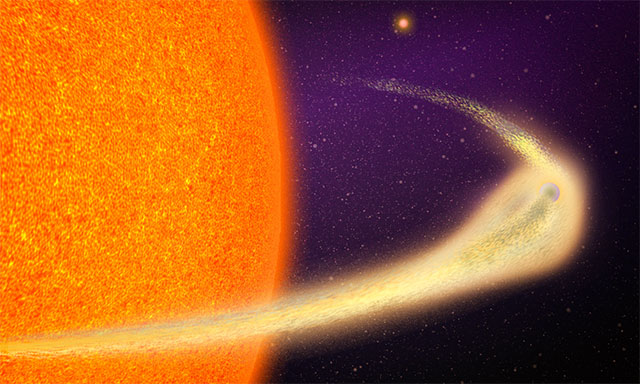
"This tail is so huge that it spans 9 million kilometers — half the orbit of the planet," said Dr. Marc Hon, lead researcher at MIT. " We weren't looking for this type of planet initially. When I checked the regular signals, I stumbled upon an anomalous signal ."
The long tail caught the team's attention when it produced a distinctive signal when the planet passed in front of its host star — a common method of detecting exoplanets based on dips in the star's brightness (called transits). In this case, the transits were unusually long and varied slightly with each cycle, suggesting that the planet's shape was constantly changing — a clue to the tail's existence.
"This transiting shape is typical of a comet with a long tail," Hon explains. " Still, the tail here is unlikely to contain volatile gas or ice like a real comet — they cannot survive long in the extreme temperatures close to their host star. Instead, mineral particles vaporized from the planet's surface may survive long enough to form this distinctive tail ."
The reason BD+05 4868 A is losing material is because of its low mass, which results in a weak gravitational pull that cannot hold the surface firmly. It is one of four decaying planets ever discovered and the closest to Earth, prompting scientists to want to study it further with the James Webb Space Telescope (JWST).
FAQ
What is the main takeaway about Disintegrating Planet Creates a Comet-Like Fire Tail?
The key is to understand the core idea, compare the available options, and apply the practical guidance that matches your situation.
What should beginners know about Disintegrating Planet Creates a Comet-Like Fire Tail?
Start with the essential steps and terminology. Avoid changing advanced settings until you understand how they affect performance, privacy, cost, or compatibility.
How can I use this information in practice?
Follow the relevant section in order, test one change at a time, and confirm the result before moving to the next step or recommendation.
Related Articles
 Picking Rats Back in the Wilderness, but After a Few Minutes3 minutes read
 Comet 26 Km Wide Can Collide with the Earth in 4479, Erase All Life2 minutes read
 Astronomers Discover Strange 'Comet' with Tail Up to 560,000km4 minutes read
 Giant Planet Discovered Orbiting a Tiny Star9 minutes read
 New Giant Exoplanet Discovered 400 Light Years from Earth, with Many5 minutes read
 Strange Black Planet Swallowed 94% of Light3 minutes read
Reader Comments 0
Sign in with email or Google to join the discussion.