Table of Contents
Explore your eyes reveal whether you're truly listening or not.
Blinking occurs automatically, like breathing, and most people rarely notice it. Previously, scientific studies on blinking focused primarily on vision. However, a new study from Concordia University approaches blinking from a completely different perspective: the connection between blinking and cognitive processes, particularly the ability to filter out distractions and focus on speech in noisy environments.
This study, published in the scientific journal Trends in Hearing, presents two experiments designed to track changes in blinking behavior under different listening conditions.
The more mentally intense the listening, the less you blink
The results showed that people blink less when they have to exert more effort to understand speech, especially in noisy environments. This reduced blinking frequency reflects the amount of 'mental capacity' the brain has to mobilize during daily listening.
Notably, the study also found that lighting conditions did not affect blinking frequency. Participants blinked at nearly the same frequency in brightly lit, moderately dark, and completely dark rooms.
' We wanted to know whether blinking is influenced by the environment, and how it relates to executive brain function ,' shared lead author Pénélope Coupal, honorary student at the Hearing and Cognition Lab. ' For example, do humans unconsciously 'time' blinking so as not to miss important information being said? '
The answer is: yes.
" We don't blink randomly, " Coupal said. " In fact, we blink less and more systematically when important information comes to mind. "
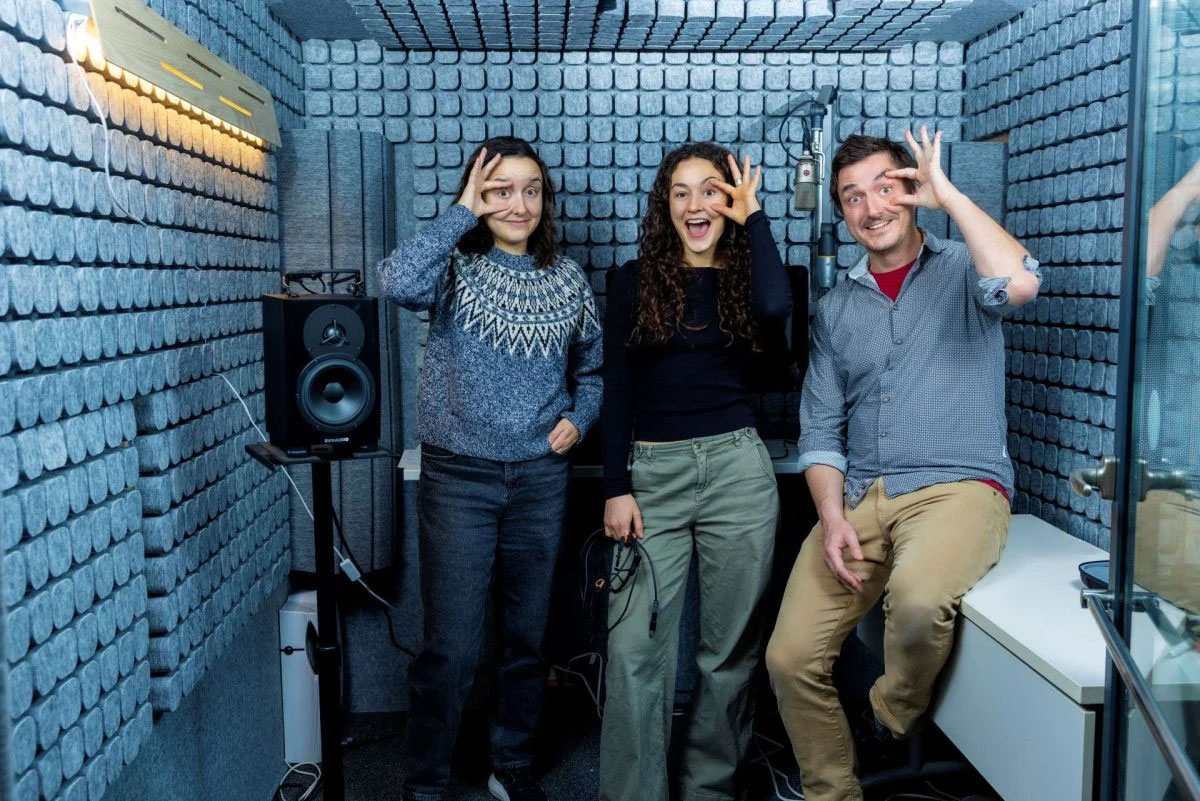
Monitor blinking while listening to speech in noisy environments
The first experiment involved nearly 50 adults. Each person sat in a soundproof room, looking at a crosshair on a screen and listening to short sentences through headphones, while the level of background noise constantly changed – from very quiet to extremely loud.
The signal-to-noise ratio (SNR) was adjusted to various levels. Participants wore eye-tracking glasses, recording every blink and the precise timing of each blink.
Each listening session was divided into three phases: before the statement begins, during the listening session, and after the statement ends. The results showed that blinking frequency decreased significantly while participants were listening, compared to before and after.
This effect is strongest when background noise is at its highest – that is, when understanding speech becomes most difficult and requires the most effort from the brain.
Light is not the deciding factor
In the second experiment, the researchers continued to examine blinking behavior but changed the lighting conditions in the room. Participants performed the same listening exercise at different SNR levels, in dark, medium-light, and bright environments.
The results showed that the blinking pattern remained the same under all lighting conditions. This demonstrates that the variation in blinking frequency stems from cognitive needs, rather than the amount of light entering the eye.
Although blinking frequency varies greatly among individuals – some blink only about 10 times per minute, while others may blink up to 70 times per minute – the overall trend remains clear and statistically significant.
Reconsidering blinking as an indicator of brain activity
Previously, studies linking eye activity to mental effort focused primarily on pupillary dilation (pupilometry). In many cases, blinking was considered 'noise' and excluded from the data analysis.
Conversely, this study utilized older data to directly analyze the timing and frequency of blinking. Scientists suggest that blinking could become a simple, low-effort indicator for assessing cognitive function, both in the laboratory and in real life.
"Our research shows that blinking is associated with missing information, both visual and auditory," said co-author Mickael Deroche, Associate Professor in the Department of Psychology.
Perhaps that's why we unconsciously suppress blinking when important information is being conveyed. However, to draw more convincing conclusions, we need to pinpoint exactly when and how visual-auditory information is interrupted during blinking. This will be the next research step.
Final Thoughts
Understanding your eyes reveal whether you're truly listening or not makes it easier to evaluate the information and apply the most relevant recommendations. Focus on the key points above and verify details that may change over time.
FAQ
What is your eyes reveal whether you're truly listening or not?
Explore your eyes reveal whether you're truly listening or not.
What key points does this article cover?
The article focuses on The more mentally intense the listening, the less you blink, Monitor blinking while listening to speech in noisy environments, Light is not the deciding factor, with practical explanations and examples.
How can you use this information in practice?
Use the explanations to compare options, verify important details, and make a more informed decision. Apply the recommendations that best match your goals and situation.
Related Articles
 15 Great Benefits of Listening to Music You May Not Know15 minutes read
 Unintentional Habits Make Your Eyes Grow More and More4 minutes read
 6 Golden Habits Keep Eyes from Increasing: Good Food for the Eyes7 minutes read
 Moon FM, the New Radio Listening Application for Android and iOS8 minutes read
 The Reason Why the Eyes Wake up Every Morning and Full of Rust Will4 minutes read
 20 Interesting Facts About EYES May Be Unknown5 minutes read
Reader Comments 0
Sign in with email or Google to join the discussion.