Table of Contents
Explore chimpanzees can think rationally like humans, including the key concepts, practical examples, important considerations, and useful guidance.
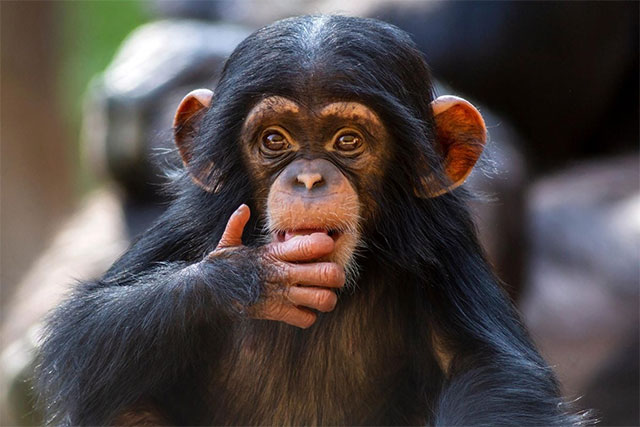
The study was conducted by a team of experts including Emily Sanford, a postdoctoral researcher in psychology at the University of California, Berkeley; Professor Jan Engelmann (UC Berkeley) and Professor Hanna Schleihauf (Utrecht University, Netherlands). The results show that, similar to humans, chimpanzees know how to adjust their decisions based on the reliability of available information – a key feature of rational thinking.
Experiments in the 'kingdom of chimpanzees'
At the Ngamba Island Chimpanzee Conservation Center (Uganda), the research team tested this ability by placing two boxes in front of chimpanzees, only one of which contained food.
Initially, they were given a cue for the 'correct' box. Then the team presented a clearer clue, but one that favored the other box. As a result, many chimps switched their choice, suggesting they found the new cue more reliable. This is the kind of flexible reasoning we see in four-year-olds.
To ensure that the results reflected true reason and not instinct, the team conducted carefully controlled experiments that incorporated computational modeling. This allowed them to rule out simpler hypotheses—such as chimps being influenced only by the most recent cue (recency bias) or responding to the most obvious cue. The simulations confirmed that the way chimps changed their choices matched a rational reasoning strategy.
'We recorded the first choice, then the second choice, and compared whether they changed their beliefs ,' said Ms Sanford. ' Computational models also allowed us to test whether the way they thought was consistent with different reasoning strategies. '
This research challenges the traditional view that rational thinking – the ability to form and adjust beliefs based on evidence – is a human prerogative. The difference between humans and chimpanzees is not an absolute gap, but a continuum.
Wider applications in science and artificial intelligence
Sanford says the findings have far-reaching implications beyond psychology. Understanding how primates regulate beliefs could change the way scientists approach learning, child development, and even artificial intelligence (AI) models. The research could help us think differently about early childhood education or how to build inference models in AI. Young children are not a blank slate when they enter the classroom.
The next step for the research is to conduct a similar test on children, aged 2 to 4, to compare how young children and chimpanzees regulate their beliefs. In the future, the team hopes to extend the study to other primates, to build a 'comparative map' of rational thinking abilities across evolutionary branches.
Animals are much smarter and more adaptable than we think. They may not understand the concept of 'science', but they are still surviving in a complex world using rational thinking and strategies – something we should respect.'
Final Thoughts
Understanding chimpanzees can think rationally like humans makes it easier to evaluate the information and apply the most relevant recommendations. Focus on the key points above and verify details that may change over time.
FAQ
What is chimpanzees can think rationally like humans?
Explore chimpanzees can think rationally like humans, including the key concepts, practical examples, important considerations, and useful guidance.
What key points does this article cover?
The article focuses on Experiments in the 'kingdom of chimpanzees', Wider applications in science and artificial intelligence, with practical explanations and examples.
How can you use this information in practice?
Use the explanations to compare options, verify important details, and make a more informed decision. Apply the recommendations that best match your goals and situation.
Related Articles
 This Chimpanzee Population Has a Hobby of Throwing Rocks at Trees and the4 minutes read
 Falling from the Tree, the Chimp Was Beaten to Death2 minutes read
 What Is the Most Intelligent Animal on the Planet Besides Humans?4 minutes read
 The Chimpanzee Speaks Surprisingly Human Language: What You Need to Know4 minutes read
 AI Platforms Can Learn from Experience Just Like Humans11 minutes read
 Dogs Have the Ability to Think Like Humans, Even Smarter Than Children5 minutes read
Reader Comments 0
Sign in with email or Google to join the discussion.