Table of Contents
Why can't we fly planes into space? What stops them from flying higher and higher?
Why can't we fly planes into space? What stops them from flying higher and higher?
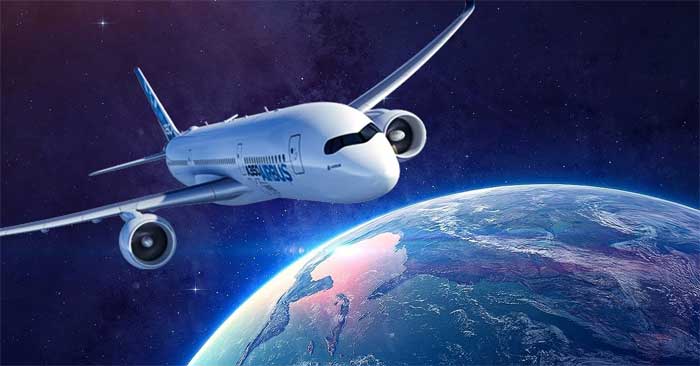
Assuming we are in a conventional jet, one of the main problems is air or lack of air as we get closer to space.
The plane flies because when it is pushed forward, the wings, which are designed to make the air flow faster above than below, create lift. As the vehicle flies faster, the wings create more lift, and when the lift is greater than the weight of the plane, it rises into the air.
To keep the plane climbing, it needs more speed to increase its lift. If you slow down a little, the plane will stabilize in level flight, and if you slow down, the plane will start to fall because the lift from the wings is not enough to overcome the weight of the plane.
As the plane flies higher in the atmosphere, the air becomes thinner and thinner, so the plane must fly faster to create more lift until it reaches an altitude where the engines fail due to lack of oxygen or the air is too thin to create enough lift.
This is a much simpler way of looking at it because when you get to the speed of sound or Mach 1, the speed also changes with altitude and if the aircraft has fairly straight wings, the airflow over the wing can become unstable and lose lift. This unstable airflow can also shake the control surfaces, the flaps on the wing, up and down, so hard that they can break off and then you lose control of the aircraft. That's why supersonic aircraft have very swept back wings and are often triangular in shape like Concorde and the space shuttle.
Hypoxia
Just as we need air to breathe, the engine also needs oxygen to burn fuel to create the force to push the plane forward.
Jet engines, however, can operate at higher altitudes than humans. We humans have a limit of about 8,000 meters, or about 26,000 feet. Above this altitude, what mountaineers call the 'death zone,' there is no oxygen for humans to survive for long periods of time.
Mount Everest is 29,000 feet high (about 8,800 meters) and the air density there is only about 33% of what it is at sea level. In practice, with each breath you take, you only get 33% of the oxygen you get. If you stay at this altitude without supplemental oxygen, you will experience a condition called 'Hypoxia'. The lack of oxygen causes the body to gradually shut down and die, and this has been the cause of more than 200 deaths on Mount Everest.
At 40,000 feet, or about 12,000 meters, the upper limit of most modern airliners, the air density there is only about 18% of what it is at sea level. If you were on a plane with rapid decompression at 40,000 feet, you would have about 5-10 seconds to put on your emergency oxygen mask before you lost consciousness.
Concorde flew at 60,000 feet (about 18,300 meters), where air density was only 7% of what it was at sea level. To reach that altitude, it had to fly at Mach 2, twice the speed of sound, or 1,350 miles per hour (about 2,190 km/h).
The highest-flying jetliner in level flight is the Lockheed SR-71 Blackbird, which flies at 85,069 meters (25,929 feet), where the air density is only 2% of what it is at sea level. At that altitude, it flies at about Mach 3.2, or 2,190 miles per hour (3,400 km/h).
SR-71 pilots had to wear full-pressure suits with their own oxygen supply in case of cabin depressurization or emergency ejection. This was proven when, in 1966, an SR-71 piloted by Bill Weaver exploded at Mach 3.1 at 78,000 feet (about 23,000 meters) while on a performance-optimization test flight.
At that altitude, your blood would boil, similar to opening a bottle of soda, as the nitrogen in your blood turns to gas in the low-pressure atmosphere. The pressure suit worked, and Weaver survived the fall from 78,000 feet, but unfortunately, navigator Jim Zwayer died from a broken neck, which caused the plane to break apart.
While you might think the SR-71 is fast, to get into space You should reach what's called 'escape velocity.' This is where you're traveling faster than the force of gravity pulling you back to the ground, and that speed is 25,020 mph or 40,270 km/h. If that doesn't matter, there's also the accepted altitude where space begins: 328,000 feet or 100,000 meters, which is more than three times higher than the SR-71's highest flight.
Conventional jet engines like the one on the SR-71 have a maximum airspeed limit of about Mach 3.5, or 2,685 mph. Beyond that limit, the air pressure and temperature become too high for the compressor in the engine to operate efficiently.
To achieve hypersonic speeds, experimental drones like the NASA X-43 use SCRAMJET engines. The X-43 is currently the world's fastest free-flying aircraft, reaching Mach 9.6 or 7,310 mph in November 2004.
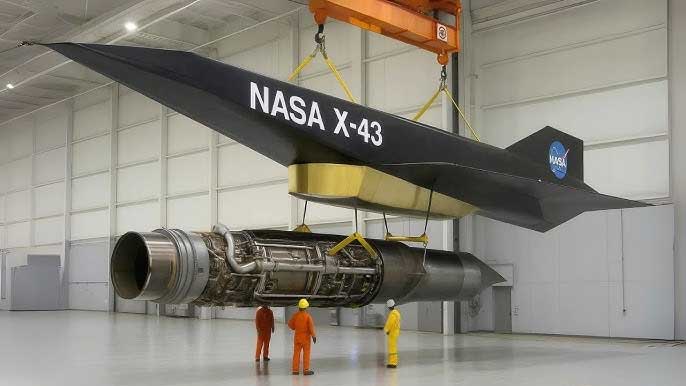
SCRAMJET engines eliminate the turbofan compressor of a jet engine so they have no moving parts, instead they use shock waves within the engine to compress and increase the temperature of the air within the engine to burn fuel and create thrust, and in theory they can fly at speeds up to Mach 20.
The problem is that they don't operate at speeds below Mach 5, so they have to be boosted by rocket boosters before they can operate, much like the NASA X-43 does. They also don't work in space because there's no oxygen-rich air to burn the fuel.
This is why space vehicles are launched using rockets. Rockets can have much more power and can operate from 0 speed on the launch pad to Mach 33 and beyond, which is Earth's escape velocity.
One of the first experimental spaceplanes was the North American X-15, which reached an altitude of 353,000 feet (about 107,000 meters) in 1963 and was powered by a liquid-fueled rocket engine… but had to be carried to an altitude of 45,000 feet (about 13,600 meters) attached to the undercarriage of a B52 bomber before being launched.
Then of course we had the Space Shuttle, the Soviet version of the "Buran", SpaceShipOne and the Boeing X-37, all examples of spaceplanes that are actually just rocket-powered gliders.
Rockets differ from jet engines in that they carry their own oxygen to burn their fuel and do not rely on atmospheric oxygen. In practice, they work just as well in space as they do in the atmosphere. The problem with rockets is that they are very heavy because they need to carry an oxidizer.
Look at the shuttle, its external fuel and fuel tanks, and the two solid rocket boosters, which weigh 1,940 tons at launch, and that's not counting the shuttle itself, all of which had to be carried with it to the edge of space, where it was jettisoned. The maximum payload the shuttle could carry into low Earth orbit was 27.5 tons, which, in terms of payload ratio, was only 1.3% of its total takeoff weight.
Rockets, however, can generate enormous amounts of energy, allowing them to reach the speed needed to escape Earth's gravity and fly into orbit or beyond.
But what about the future, will we ever have planes that can take off from a runway, fly into space, and then return to the runway? There are still significant technical problems to overcome, but one design that looks promising is the Skylon.
It is a SSTO (Single Stage To Orbit) design, meaning that unlike a rocket, it remains a single unit, rather than having a separate main stage that detaches and returns to Earth, along with a smaller second stage that is sent into orbit. Key to Skylon's operation is the Synchronized Air-Breathing Rocket Engine (SABRE).
It is a hybrid rocket engine that can take off like a conventional jet engine and inhale air up to 93,000 feet at speeds up to Mach 5.4, then transition into rocket mode to fly into space at altitudes of up to 800km or 500 miles.
It will then re-enter Earth's atmosphere and return, landing like an airplane taking in air to be inspected, refueled and ready for the next launch.
Because of its more efficient engines and better wing lift, it will use only 20% of the fuel of a conventional rocket.
It still needs to carry oxidizer for the rocket portion of the journey, but much less than a conventional rocket would require. This allows for a larger payload when compared to the shuttle's total weight of about 5.5% compared to 1.3%.
Skylon's unmanned test flights could take place as early as 2025 if all goes well…. but a potential major hurdle is recent advances in reusable rockets like the SpaceX Falcon f9r and Blue Origin's new Shepard, which could make Skylon development too expensive for satellite deployment and resupply to the International Space Station.
One possibility, however, is a rocket-less version of the SABRE engine, which could make supersonic air travel a more viable option than the SCRAMJET engine.
Only time can change that, but this is an exciting time for both the future of air and space travel, as we may well see a future where you can fly aircraft into space.
FAQ
Why Can't Planes Fly into Space: Explained?
In practical terms, why can't we fly planes into space? What stops them from flying higher and higher.
What factors are most important?
The article highlights that it is a hybrid rocket engine that can take off like a conventional jet engine and inhale air up to 93,000 feet at speeds up to Mach 5.4, then transition into rocket mode to fly into space at altitudes of up to 800km or.
What is the main takeaway?
The main takeaway is that only time can change that, but this is an exciting time for both the future of air and space travel, as we may well see a future where we can fly aircraft into space.
Related Articles
 10 Aircraft with the Most ''craziest'' Design in History5 minutes read
 Fire Needs Air to Burn, so How Does the Rocket Work in Space7 minutes read
 After Nearly 60 Years, the Cause of the 747 Plane Has a Big Bump3 minutes read
 Tips for Fighting in the 1945 Air Force4 minutes read
 The Reason the Plane Cannot Fly into Space2 minutes read
 Why Is It Rare for Any Plane to Fly Over Tibet?4 minutes read
Reader Comments 0
Sign in with email or Google to join the discussion.