Table of Contents
Explore when semiconductors become superconductors, including the key concepts, practical examples, important considerations, and useful guidance.
For years, researchers have been trying to create semiconductor materials that can be superconducting, which can improve the efficiency and save energy for technologies such as computer chips, solar cells, and quantum sensors. If these two properties can be combined in the same material, humans will be one step closer to a generation of faster, more efficient, and more energy-efficient devices.
However, making this idea a reality is not simple. The materials that underpin today's electronics, such as silicon and germanium, are stubborn in becoming superconductors, because to achieve this, the atomic structure must be maintained at a perfect level, allowing electrons to move smoothly without resistance — a requirement that is extremely difficult in terms of physics and technology.
Revolutionary potential for quantum technology and consumer devices
In a study recently published in the journal Nature Nanotechnology , an international team of scientists has created a superconducting version of germanium. This new material can conduct electricity without any resistance, allowing an endless flow of current without losing energy.
This is an important step forward, opening up the possibility of creating electronic circuits that are faster, consume less power and are more environmentally friendly in the future.
' Establishing superconductivity in germanium – which is already widely used in computer chips and fiber optic cables – could revolutionize a wide range of technological products and industrial devices ,' said Professor Javad Shabani, a physicist at New York University (NYU) and director of the Center for Quantum Information Physics.
University of Queensland physicist Peter Jacobson – co-author of the study – added:
These materials could become the basis for quantum circuits, sensors, and ultra-energy-efficient electronics that operate at cryogenic (ultra-low temperature) environments. Germanium has long been the workhorse of advanced semiconductors, and now demonstrating that it can become superconducting under well-controlled conditions opens the door to large-scale manufacturing of next-generation quantum devices.
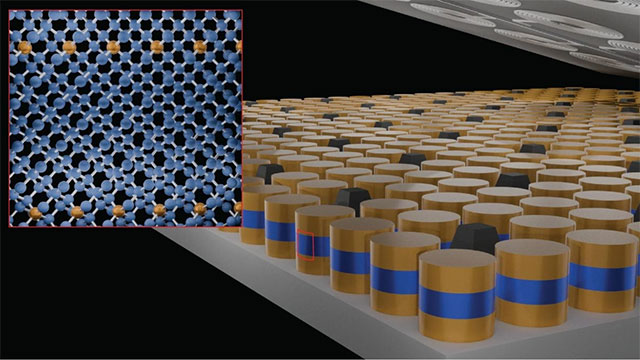
Why are germanium and silicon so important?
Germanium and silicon, both members of group IV of the periodic table, possess a diamond-like crystal structure, which creates electrical properties that are somewhere between a metal and an insulator. This makes them ideal materials for durable, stable, and easy-to-manufacture devices.
To turn these materials into superconductors, scientists must adjust the atomic structure to increase the number of conducting electrons. When the necessary threshold is reached, the electrons pair up and move freely through the crystal without resistance – the fundamental phenomenon of superconductivity. However, maintaining this state at the atomic level is extremely difficult.
In the new study, the team created a film of germanium doped with gallium – a soft element common in the electronics industry. This process, called 'doping', has long been used to change the electrical properties of semiconductors. But adding too much gallium can destabilize the material, causing the crystal to break down and it can no longer superconduct.
However, the research team overcame that limitation using advanced X-ray techniques, which forced gallium atoms to replace germanium atoms in the crystal at high concentrations while maintaining a stable structure.
As a result, the new material can conduct electricity completely without resistance at a temperature of 3.5 Kelvin (equivalent to –453°F), officially becoming a superconductor.
Physicist Julian Steele (University of Queensland), co-author, said:
Instead of conventional ion implantation, the team used molecular beam epitaxy to precisely implant gallium atoms into the germanium crystal lattice. This allowed us to achieve the atomic-scale structural precision needed to observe and control the formation of superconductivity in this material.
Group IV elements like silicon and germanium are not naturally superconducting. But when their crystals are properly tuned, pairs of electrons can form and move freely, creating a superconducting state – something that was once considered impossible with traditional semiconductors.
Final Thoughts
Understanding when semiconductors become superconductors makes it easier to evaluate the information and apply the most relevant recommendations. Focus on the key points above and verify details that may change over time.
FAQ
What is when semiconductors become superconductors?
Explore when semiconductors become superconductors, including the key concepts, practical examples, important considerations, and useful guidance.
What key points does this article cover?
The article focuses on Revolutionary potential for quantum technology and consumer devices, Why are germanium and silicon so important?, with practical explanations and examples.
How can you use this information in practice?
Use the explanations to compare options, verify important details, and make a more informed decision. Apply the recommendations that best match your goals and situation.
Related Articles
 New Combinations of Oxides and Semiconductors Can Create New Electronic Devices4 minutes read
 What Is CES? Why Is the Tech World Boiling for CES?12 minutes read
 The World's First 2D Computer Was Born: A Turning Point That Ended The5 minutes read
 LG Electronics Introduced the First 3D Laptop3 minutes read
 Launch of the World's First Hybrid Chip That Combines Electronics4 minutes read
 The Computer Keeps Turning on and Off Without the Screen on, What Should I Do8 minutes read
Reader Comments 0
Sign in with email or Google to join the discussion.