Table of Contents
This guide provides a clear, practical overview of "The Strangest Maritime Mysteries, Still Unsolved". It organizes the most useful details, explains important considerations, and highlights the steps or choices that matter most.
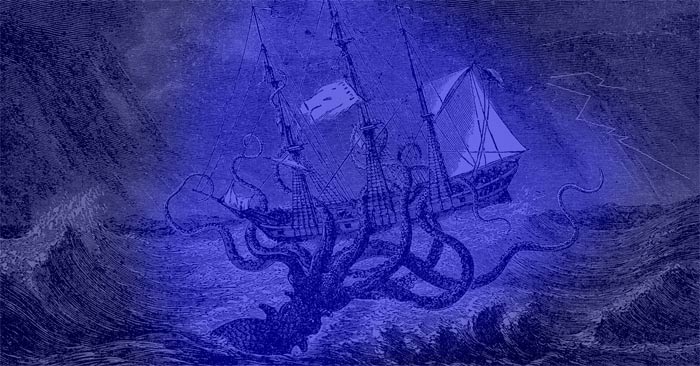
The oceans cover more than 70% of our planet, so it's no surprise that their seemingly impenetrable depths hold a host of fascinating mysteries, from lost ships to strange monsters. Here are some of the mysteries of the ocean - some that scientists think they've at least partially explained, while others remain truly puzzling.
Mary Celeste
On December 5, 1872, the crew of the British ship Dei Gratia spotted a ship rocking some 400 miles off the coast of the Azores. They approached the Mary Celeste to offer assistance, but upon boarding, they were shocked to find it completely deserted. The crew had disappeared without a trace, their belongings still in the hold; six months' worth of food and drink were still intact, and their precious cargo of industrial alcohol was still largely intact. The only clues were five and a half feet of water in the hold, a missing lifeboat, and a dismantled pump. It was the beginning of an enduring mystery as to what happened to the crew, and why they abandoned an apparently sound ship at sea.
Many theories have been put forward, including one by mystery writer Arthur Conan Doyle, who wrote a short story in 1884 suggesting that the crew had fallen victim to a former slave who was out for revenge. A more recent theory suggests that rough seas and a broken pump forced the captain to abandon ship. Since the missing crew have never been found, it seems unlikely that there will ever be a satisfactory answer to this mystery.
Yonaguni Monument
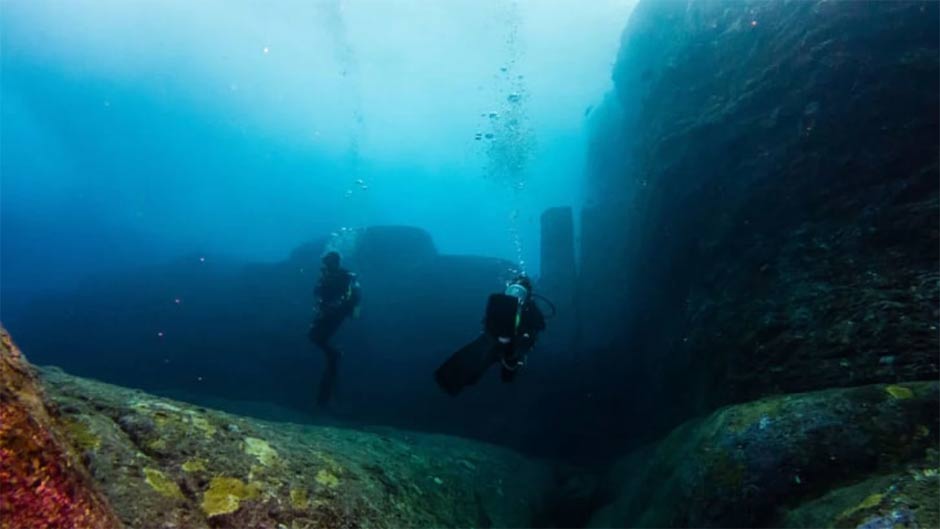
In 1986, a diver looking for a good spot to see hammerhead sharks off the coast of Japan's Ryukyu Islands stumbled upon a fascinating underwater landscape. The site was said to resemble an ancient submerged village, with steps, holes, and triangles seemingly carved into the rock. Since its discovery, the site, known as the Yonaguni Monument, has been controversial. Some researchers, such as marine geologist Masaaki Kimura, have argued that it is clearly a man-made environment, perhaps a city thousands of years old that sank due to earthquakes that ravaged the area. Others believe it is a natural geological phenomenon reflecting layers of sandstone in a tectonically active area. The site is open to divers, so those who are truly curious can strap on a scuba tank and explore for themselves.
Bermuda Triangle
The Bermuda Triangle has probably generated more wild theories, articles, and online discussions than any other ocean mystery—more than 50 ships and 20 planes are said to have disappeared there. Although the triangle has never been officially defined, according to some sources, it covers at least 500,000 square miles and is located between Bermuda, Florida, and Puerto Rico.
The mystery first came to public attention in December 1945 when Flight 19, consisting of five US Navy TBM Avenger torpedo bombers and 14 crew members, disappeared without a trace during a routine training mission in the area. Interest was further piqued when it was later revealed that one of the search and rescue aircraft sent to search for the missing crew had also disappeared. Articles and books such as Charles Berlitz's The Bermuda Triangle, first published in 1974 and since then selling over 20 million copies in 30 languages, have helped perpetuate the mystery, offering potential theories both natural and supernatural. Scientists and the world-renowned insurance company Lloyd's of London—have attempted to debunk the myth of the Bermuda Triangle, presenting evidence that the disappearance rate in this vast and busy triangle is no higher than in other comparable shipping routes. But that's the power of a good story.
Kraken
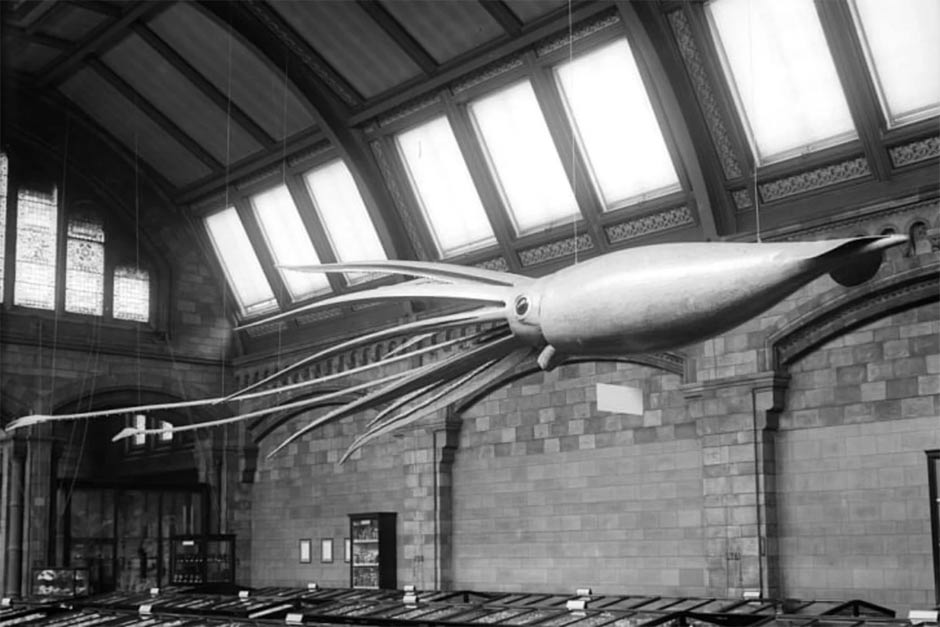
For hundreds of years, sailors have told tales of a giant sea creature with fearsome tentacles called the kraken. Tales of the legendary kraken first appeared in Scandinavia in the 12th century, and in 1555, Swedish cartographer Olaus Magnus provided a description of a sea creature with "long, sharp horns all round, like a root growing from the base of a tree: They were ten or twelve cubits long, very black, and had very large eyes." These tales persisted, often referring to a creature so large that it looked like an island. In his 1755 book Natural History of Norway, Danish historian Erik Ludvigsen Pontoppidan described the kraken as " the world's largest sea monster ."
Scientists have suggested that these tales may have originated from sightings of the giant squid (Architeuthis dux), although evidence of an even larger but extremely elusive giant squid (Mesonychoteuthis hamiltoni) has also been discovered. The giant squid is found in the deepest reaches of the Southern Ocean, surrounding Antarctica, and is thought to grow to 14 metres long and weigh 540 kg. The problem is that the animal is so rare, with very few intact specimens found, and no living specimens ever observed, meaning that estimating its size is difficult.
Researchers also found large scars on the sperm whales, which they believe could be the result of violent encounters with giant squid, which are known for their sharp rotating hooks at the tips of their tentacles.
Treasure of the Royal Merchant
The wreckage of the Merchant Royal is known as one of the richest shipwrecks ever. The ship set sail from the New World in 1641, carrying 46kg of gold, 400 Mexican silver bars, and thousands of precious stones — a total haul that is believed to be worth $1.3 billion today. The ship was caught in a storm and is believed to have sunk somewhere off the coast of Cornwall, England. The lost shipwreck has been dubbed the ' el Dorado of the seas ' due to the immense value of its cargo, and over the years, countless treasure hunters have searched in vain for its final resting place, which remains undiscovered. In 2019, fishermen recovered what is believed to be the Merchant Royal's anchor, but the treacherous conditions and the extreme depth at which the wreck is believed to lie have so far left the treasure unclaimed.
FAQ
What should you know about mary Celeste?
On December 5, 1872, the crew of the British ship Dei Gratia spotted a ship rocking some 400 miles off the coast of the Azores. They approached the Mary Celeste to offer assistance, but upon boarding, they were shocked to find it completely deserted. The crew had disappeared without a trace, their belongings still in the hold.
What should you know about yonaguni Monument?
In 1986, a diver looking for a good spot to see hammerhead sharks off the coast of Japan's Ryukyu Islands stumbled upon a fascinating underwater landscape. The site was said to resemble an ancient submerged village, with steps, holes, and triangles seemingly carved into the rock. Since its discovery, the site, known as the.
What should you know about bermuda Triangle?
The Bermuda Triangle has probably generated more wild theories, articles, and online discussions than any other ocean mystery—more than 50 ships and 20 planes are said to have disappeared there. Although the triangle has never been officially defined, according to some sources, it covers at least 500,000 square miles and is.
What should you know about kraken?
For hundreds of years, sailors have told tales of a giant sea creature with fearsome tentacles called the kraken. Tales of the legendary kraken first appeared in Scandinavia in the 12th century, and in 1555, Swedish cartographer Olaus Magnus provided a description of a sea creature with "long, sharp horns all round, like a root.
Related Articles
 Unsolved Medical Mysteries: Complete Guide6 minutes read
 Strange Unsolved Mysteries in 2025: Explained7 minutes read
 Mysterious Unsolved Murders and Disappearances: Key Cases4 minutes read
 How to Check the Balance of Maritime Bank Account7 minutes read
 Satellite Creates a Detailed Picture of Maritime Operations3 minutes read
 Unsolved Mysteries in World War 2: Subhas Chandra Bose4 minutes read
Reader Comments 0
Sign in with email or Google to join the discussion.