Table of Contents
Overview
This guide covers interesting facts about the pacific ocean in clear, practical terms. It covers the key concepts, recommended steps, common limitations, and useful checks so you can make a better-informed decision.
The Pacific Ocean is one of the largest oceans on Earth. So who named the Pacific Ocean and what secrets does it hold? Here are some interesting facts about the Pacific Ocean that you should know.
The Pacific Ocean is the world's largest ocean, stretching from the Arctic to the Southern Ocean, from the Bering Sea to Antarctica's Ross Sea. It is connected to the Atlantic Ocean via the Bering Strait to the north, while the Drake Passage and the Strait of Magellan connect it to the south.
To the east of the Pacific Ocean are the Americas, while to the west are the Asian and Australian land masses. It is also divided into the North Pacific and the South Pacific by the Equator.
The Pacific Ocean covers more than 30% of the Earth's surface. It is twice the size of the Atlantic Ocean and contains twice as much water. Second, it is larger than the combined surface area of all the continents.
The Pacific Ocean covers approximately 63.8 million square miles and contains 714 million cubic kilometers of water. It also contains many marginal seas and water masses, such as the Bering Sea, Coral Sea, Sea of Okhotsk, Sea of Japan, South and East China Seas, and Tasman Sea. Notable gulfs include the Gulf of Alaska and the Gulf of Tonkin.
Not only does the Pacific Ocean have the highest mountain on Earth and the deepest trench in the world, it also has interesting things that not everyone knows.
1. One of the five recognized oceans on Earth

Geographers and scientists divide the huge, interconnected mass of water that covers 71% of the Earth's surface into five oceans. The largest ocean is the Pacific Ocean, followed by the Atlantic, Indian, Southern, and Arctic Oceans.
2. Contains many water
Not all oceans contain the same amount of water. According to the National Oceanic and Atmospheric Administration (NOAA), the Pacific Ocean holds 49.4% of the Earth's total water, twice as much as the Atlantic Ocean.
In addition, the Pacific Ocean is the deepest ocean by far, with an average depth of 4,000m.
3. Origin of the name Pacific Ocean

On September 20, 1519, Ferdinand Magellan, a Portuguese explorer and navigator, led an expedition of 270 sailors from Spain across the Atlantic Ocean. They successfully navigated through the point between the southern tip of mainland South America and the Tierra Del Fuego archipelago, now known as the "Strait of Magellan". This is the connecting point between the Atlantic and Pacific Oceans.
In late 1520, when arriving at the Philippine archipelago, Magellan and his crew found the sea here quite calm and windless, so they named this sea area "Pacific Ocean" - a peaceful sea.
4. Contains the highest mountain on Earth
Mount Everest is the world's tallest mountain above sea level, at 8,848m. But it is still shorter than Mauna Kea, a now-dormant volcano below sea level in Hawaii, which rises to 10,210m.
5. There are two major ocean gyres
The Earth's rotation and the arrangement of the continents create a vast system of circular ocean currents (gyres) that redistribute heat from the Sun and nutrients to the many forms of life in the oceans.
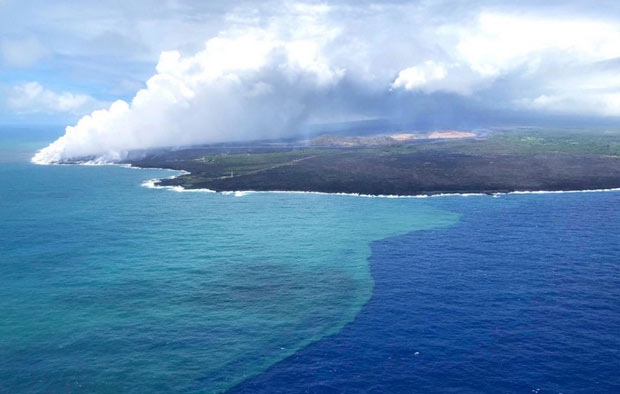
There are 5 major ocean gyres in the world. 2 of them appear in the Pacific Ocean:
- North Pacific Gyre: Above the equator running clockwise from California, USA to Japan.
- South Pacific Gyre: Below moving in the opposite direction.
The garbage that humans throw into the ocean is transported around the oceans by these ocean currents.
6. Contains Nemo Point
In the South Pacific Ocean and below the equator, there is a place called Point Nemo - Point Nemo or "The Ocean's Pole of Inaccessibility". For details, please see the article 'Point Nemo, the most isolated place on the planet, the burial ground of the International Space Station at the end of its mission'.
7. Contains the deepest point on Earth
The Challenger Deep, at 10,944 metres (35,000 feet) below the Pacific Ocean, is the deepest known point on Earth. It is located at the southern end of the Mariana Trench.
Key Takeaways
Use the guidance above as a practical reference for interesting facts about the pacific ocean. Check compatibility, follow the steps carefully, and verify important details with official documentation when software, security, accounts, health, or purchases are involved.
FAQ
What is the main point of this article?
This article explains interesting facts about the pacific ocean that not everyone knows, including the central facts, context, practical implications, and details needed to understand the topic.
Why does this topic matter?
It may affect performance, cost, safety, convenience, purchasing decisions, or how people understand a broader development.
Could the information change over time?
Yes. Product details, software features, prices, policies, codes, and news developments can change, so verify time-sensitive information with official sources.
Related Articles
 Interesting Facts About the Sun That You May Not Know15 minutes read
 40 Interesting Facts You Didn't Know About the Sun13 minutes read
 The Pacific and 5 Unexplained Mysteries Challenge Scientists4 minutes read
 Surprise with the Facts About the Ocean5 minutes read
 12 Interesting Facts About Red Planet - Mars May Not Be Known6 minutes read
 Explore the Mysterious 8th Continent Submerged Under the Pacific3 minutes read
Reader Comments 0
Sign in with email or Google to join the discussion.