Table of Contents
Discover Siemens Xelibri – the 'different' fashion phone line of the early 2000s. Unique design, quirky advertising but a miserable failure, leaving a special mark in mobile history.
The early 2000s were perhaps the most exciting period for those who loved mobile phones. Instead of being just a rough 'brick' for making calls, phones gradually became compact, multi-functional devices and quickly evolved into a fashion icon with a strong 'personality'.
Nokia was the one who started this trend with the 'legendary' 8110, the phone that appeared in the movie The Matrix . Since then, phones have become more than just a means of communication, they have become a style statement. Thanks to impressive models like the 8810 or 3310, Nokia held a huge market share in 2001, larger than the next three competitors combined.
Coming in third was Siemens – the German giant with ambitions beyond Europe. Siemens didn't just want to compete with Nokia, but did it in a truly remarkable way: by creating a line of stylish phones. And so Xelibri was born.
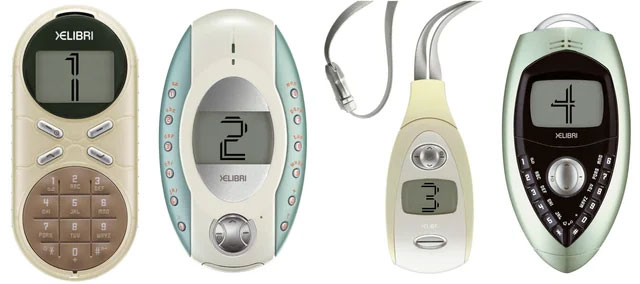
Xelibri – an effort to surpass Nokia
The Xelibri concept was conceived by Siemens board member Rudi Lamprecht, who wanted to make a global splash with an unprecedented product that would attract enthusiasts and open the door for Siemens to enter new markets.
The project was led by George Appling, head of the newly formed Xelibri division. The first collection, called ' Space on Earth', was launched in early 2003 with four models, focusing on unique design rather than functionality.
- Xelibri 1 : looks like something out of a sci-fi movie.
- Xelibri 2 and 4 : reminiscent of the communication equipment in Star Trek .
- Xelibri 3 : innovative but still a bit 'easier to use'.
Despite the unusual design, Siemens launched a strange advertising campaign, trying to be more 'weird' than the PlayStation ads in the early 2000s, leaving many people confused instead of convinced.
Half a year later, Siemens launched the 'Fashion Extravaganza – Beauty for Sale' Collection, collaborating with design studio IDEO and even inviting director David Fincher to make the commercial.
- Xelibri 5 & 7 : familiar-looking phones with a 'refined' look.
- Xelibri 6 : combines a phone with a makeup box, with a round mirror inside.
- Xelibri 8 : designed to be worn around the neck as jewelry.
That said, this was also the last collection. By the first half of 2004, the Xelibri line was discontinued. Just one year later, Siemens' phone division was sold to BenQ.
A 'glamorous' failure
Despite its popularity, after only two collections of eight models, Xelibri officially disappeared. Extremely low sales were the main reason: a total of only 780,000 units were sold worldwide, and less than 100,000 units of each model.
The reasons for the failure of this product line are not too difficult to point out. First, Siemens priced the product too high, the cheapest model sold for 199 euros (~380 USD today), while the most expensive was up to 399 euros (~700 USD today). Next, these were phones with strange designs but lacked features. The first models only had monochrome screens, later models had color screens but did not have a camera - a 'hot' feature at the time.
Also, poor materials and finishing quality also make the product look cheap, like a toy. This is accompanied by a bad user experience. The interface is slow, making it difficult to dial numbers or text, especially on models without a traditional keyboard.
On the other side, Nokia and Motorola still maintain the balance: eye-catching design without sacrificing features. For example, Nokia N-Gage or Motorola Razr V3 – both beautiful and useful, becoming legendary.
The remaining legacy
The Xelibri is a case of putting all your eggs in the design basket and forgetting the basics. Despite its failure, the phone still stands out – unique, quirky, and still remembered by vintage phone collectors more than 20 years later.
Not the legacy Siemens wanted, but the Xelibri is still one of the Most distinctive Phone lines ever.
FAQ
What should you know about siemens xelibri?
In practical terms, discover Siemens Xelibri – the 'different' fashion phone line of the early 2000s. Unique design, quirky advertising but a miserable failure, leaving a special mark in mobile history.
Why does siemens xelibri matter?
The article highlights that despite its failure, the phone still stands out – unique, quirky, and still remembered by vintage phone collectors more than 20 years later.
What is the main takeaway?
The main takeaway is that not the legacy Siemens wanted, but the Xelibri is still one of the Most distinctive phone lines ever.
Related Articles
 Top 10 Ugliest Phones of All Time5 minutes read
 7 Most Unique Phone Panels You've Ever Seen3 minutes read
 Click: How to Create an Archimedes Screw Using Siemens Nx 124 minutes read
 12 Scary Fashion Trends Ever Popular in History11 minutes read
 Sony TX1 'Beautiful, Beautiful and Beautiful'10 minutes read
 How to Dress in a Unique Way This Year5 minutes read
Reader Comments 0
Sign in with email or Google to join the discussion.