Table of Contents
Explore scientists have discovered a way to convert co₂ into a valuable fuel source.
The study, published in the journal Chem , was led by postdoctoral researcher Justin Wedal (Yale) and graduate student Kyler Virtue (University of Missouri), with expert contributions from Professor Nilay Hazari (Yale) and Professor Wesley Bernskoetter (Missouri).
Hydrogen fuel cells generate electricity by converting chemical energy stored in hydrogen – in principle quite similar to conventional batteries. However, despite its high potential, this technology still faces a major obstacle: how to produce and store hydrogen cheaply, efficiently, and on a large scale.
"Harnessing carbon dioxide is becoming a top priority as we seek renewable chemical sources to replace those derived from fossil fuels," said Professor Nilay Hazari, Chair of the Chemistry Department at Yale University.
Formic acid – the protonated form of formate – is now produced in large quantities for a variety of industrial purposes such as food preservation, antimicrobial treatment, and leather tanning. In addition, scientists are also investigating formic acid as a potential hydrogen source for fuel cells, provided it can be produced in a sustainable and feasible way.
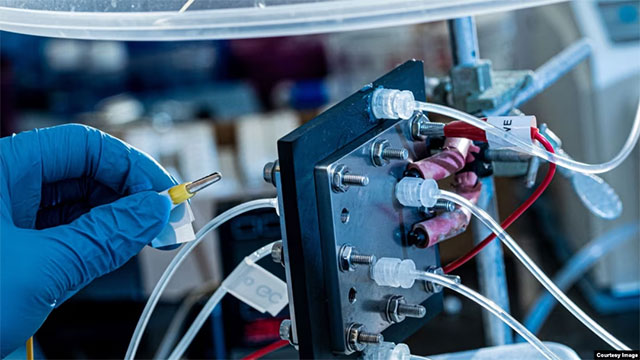
The catalyst problem: expensive, unstable, and toxic
Currently, industrial-scale formate production still relies primarily on fossil fuels, and is therefore not considered a sustainable long-term solution. According to researchers, a more environmentally friendly approach is to produce formate directly from atmospheric CO₂, which both reduces greenhouse gas emissions and creates a valuable product.
However, this process requires the right catalyst, and this is the major challenge.
Many effective catalysts currently available utilize precious metals, which are expensive, rare, and highly toxic. Conversely, more common, stable, and cheaper metals are often less effective because they decompose easily, reducing their ability to convert CO₂ into formate.
Professor Hazari's research team has proposed a new approach to solving this problem.
By improving the ligand design (ligands are atoms or molecules that bond to a metal and influence its reactivity), scientists added an extra atom to the ligand, stabilizing the manganese catalyst. As a result, the catalyst's lifespan was significantly extended, even surpassing the performance of many precious metal catalysts.
" I'm really excited to see how effective ligand design is ," Wedal shared.
The research team also suggests that this method is not limited to converting CO₂ into formate, but can be applied to many other catalytic reactions, opening new avenues for sustainable chemistry and clean energy technology.
Final Thoughts
Understanding scientists have discovered a way to convert co₂ into a valuable fuel source makes it easier to evaluate the information and apply the most relevant recommendations. Focus on the key points above and verify details that may change over time.
FAQ
What is scientists have discovered a way to convert co₂ into a valuable fuel source?
Explore scientists have discovered a way to convert co₂ into a valuable fuel source.
What key points does this article cover?
The article focuses on The catalyst problem: expensive, unstable, and toxic, with practical explanations and examples.
How can you use this information in practice?
Use the explanations to compare options, verify important details, and make a more informed decision. Apply the recommendations that best match your goals and situation.
Related Articles
 How to Adjust an Igniter on an Oil Furnace7 minutes read
 CO2 Emissions Will Be Used as Fuel for Cars in the Future3 minutes read
 How to Clean a Fuel Pump: Step-by-Step Guide14 minutes read
 How to Blow Fire: Step-by-Step Guide14 minutes read
 The Source of Biofuels from Coffee Can Be Used to Operate Buses4 minutes read
 How to Fuel a Race Car: Step-by-Step Guide5 minutes read
Reader Comments 0
Sign in with email or Google to join the discussion.