Table of Contents
New research unravels the mysterious differences between two gas giant planets
Explore polar cyclones reveal the hidden inner structures of jupiter and saturn.
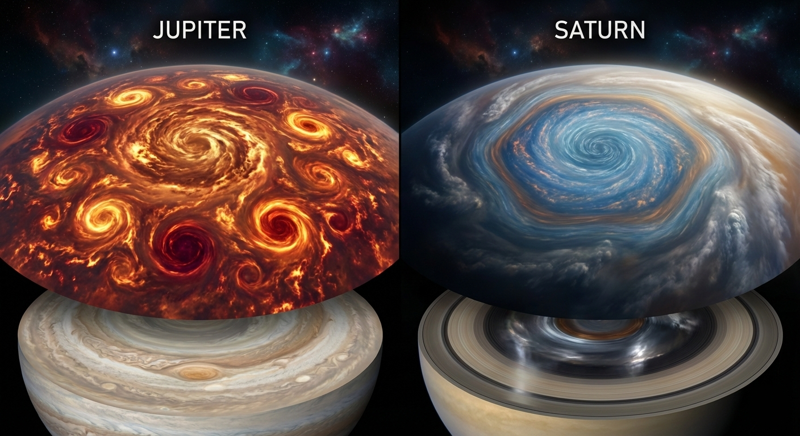
This composite image, constructed from data collected by NASA's Juno probe JIRAM , shows a central vortex at Jupiter's North Pole , surrounded by eight smaller vortices . JIRAM operates in the infrared range, and the colors in the image represent radiant heat :
-
Yellow clouds (thinner) have a light temperature of approximately -13°C .
-
While the deep red area (the densest cloud cover) can reach temperatures as low as -83°C . Image source: NASA / JPL-Caltech / SwRI / ASI / INAF / JIRAM.
" Our research shows that the planet's internal properties and the 'softness' of the cyclone base directly influence the observed fluid flow patterns on the surface ," said Dr. Wanying Kang (MIT).
The research was inspired by detailed images of Jupiter and Saturn provided by NASA's Juno and Cassini missions.
Juno and Cassini: Two missions unlock the North Poles of gas planets
The Juno spacecraft has been orbiting Jupiter since 2016 and has captured spectacular images of the North Pole with its many intensely swirling cyclones . From this data, scientists estimate that each of Jupiter's cyclones has a diameter of up to 5,000 km .
Meanwhile, the Cassini spacecraft – before self-destructing in Saturn's atmosphere in 2017 – orbited the planet for 13 years . Cassini discovered that at Saturn's North Pole there was only a single hexagonal cyclone , measuring up to 29,000 km in diameter.
" Jupiter and Saturn are almost identical in size and both are primarily composed of hydrogen and helium, but their polar cyclones are completely different , and that has puzzled scientists for years," shared graduate student Jiaru Shi (MIT).
2D models help explain the phenomenon of polar vortices
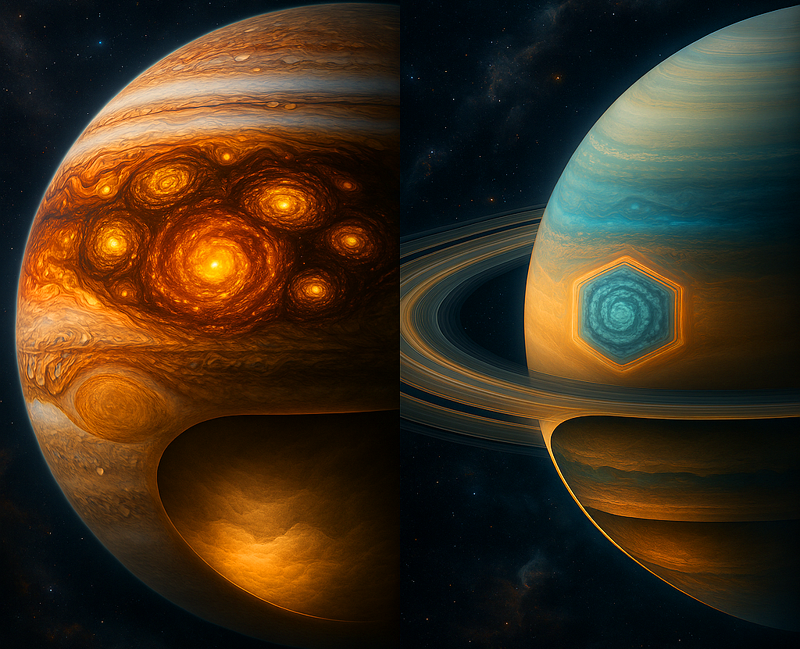
The research team aims to find the physical mechanism that explains why one planet forms a single polar vortex , while the other appears to have many smaller vortices .
They used a two-dimensional (2D) fluid dynamics model to simulate the evolution of cyclones on the planet's surface. Although cyclones are essentially three-dimensional phenomena, due to Jupiter and Saturn's extremely high rotation speeds , fluid motion tends to be uniform along the axis of rotation , allowing the 3D problem to be reduced to 2D while maintaining accuracy.
" In fast-rotating systems, fluid flow remains almost constant along the axis of rotation , so a 2D model is perfectly reasonable," Dr. Kang explained. "This makes simulations hundreds of times faster and significantly reduces computational costs."
The model is built upon an equation describing the evolution of vortex flow , which has been widely used to simulate vortex storms at mid-latitudes on Earth , and has been adapted to fit the polar regions of gas planets .
The 'softness' of the bottom of the whirlpool: the key to making the difference
In the simulation scenarios, the research team varied several parameters, such as:
- Planet size
- Rotation speed
- Internal heat source
- And the softness or stiffness of the air layer at the bottom of the vortex .
Initially, the fluid is placed in a state of random turbulence , then allowed to evolve over time.
The results show that:
- Some scenarios form a giant vortex , similar to Saturn.
- While other scenarios create multiple small vortices coexisting , similar to Jupiter.
Further analysis reveals that the determining factor lies in the softness of the material layer beneath the cyclone :
- If the gas layer at the bottom of the vortex is light and soft , the vortex cannot grow too large, allowing many small vortices to coexist at the planetary pole—as on Jupiter.
- Conversely, if the bottom layer is denser and more rigid , the vortex can expand to planetary scale, forming a single polar vortex —as on Saturn.
If this mechanism is correct, it implies that Jupiter has a lighter and softer internal structure , while Saturn may contain heavier, metal-rich, and condensed matter , resulting in a more pronounced stratification.
" What we observe on the surface can directly reflect the deep internal structure of the planet ," Shi emphasized. "This helps us better understand the true nature of these gas giant planets."
This research will be published in the prestigious scientific journal Proceedings of the National Academy of Sciences (PNAS) .
Final Thoughts
Understanding polar cyclones reveal the hidden inner structures of jupiter and saturn makes it easier to evaluate the information and apply the most relevant recommendations. Focus on the key points above and verify details that may change over time.
FAQ
What is polar cyclones reveal the hidden inner structures of jupiter and saturn?
Explore polar cyclones reveal the hidden inner structures of jupiter and saturn.
What key points does this article cover?
The article focuses on New research unravels the mysterious differences between two gas giant planets, Juno and Cassini: Two missions unlock the North Poles of gas planets, 2D models help explain the phenomenon of polar vortices, with practical explanations and examples.
How can you use this information in practice?
Use the explanations to compare options, verify important details, and make a more informed decision. Apply the recommendations that best match your goals and situation.
Related Articles
 Interesting Truth About Saturn5 minutes read
 Listen to the Strange Sound Obtained from Planets in the Solar3 minutes read
 Video: Cassini Spacecraft Successfully Performs the Journey Around4 minutes read
 Enceladus: Saturn's 'Tiny' Moon Hides Essentials for Life4 minutes read
 White Polar Bears Die Because of Love Loss That Many People Suffer4 minutes read
 2 More Moons Found Around Jupiter3 minutes read
Reader Comments 0
Sign in with email or Google to join the discussion.