Table of Contents
First-person perspective in PUBG Mobile removes the third-person camera's ability to look around cover. To play FPP well, you must gather information with sound, controlled peeks, crosshair placement, and team communication. The narrower view feels less forgiving at first, but it also means opponents cannot safely inspect a corner without exposing themselves.
Adjust controls before entering a ranked match
- Choose a field of view and camera sensitivity that let you turn comfortably without making small adjustments unstable.
- Place lean, crouch, jump, scope, and fire buttons where they can be used together.
- Set separate sensitivity values for the optics you use most.
- Test gyroscope aiming in Training Mode before enabling it for every scope.
- Use headphones at a safe volume and confirm left-right audio channels.
Change one setting at a time and practice the same movement in Training Mode. A dramatic sensitivity change immediately before a match usually causes more problems than it solves.
Defend without giving away every position
In FPP, seeing through a doorway or window requires the character's viewpoint to approach it. Do not pace continuously around a room; footsteps reveal the floor and direction to an enemy outside.
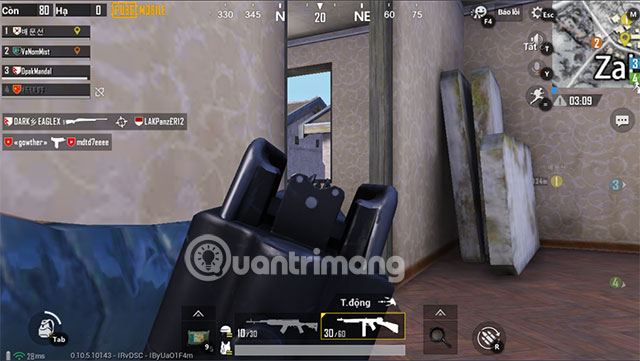
Hold an off-angle with the crosshair at likely head or upper-body height, then make short information peeks. Change position after firing. If a grenade lands nearby, move immediately—do not assume a wall or doorframe will block the blast.
Strong defense still needs an escape route. The positioning principles in the PUBG Mobile ambush guide apply to FPP, but every sightline must be checked from the character's actual viewpoint.
Use sound as directional information
Footsteps, doors, vaults, reloads, healing, vehicles, and gunfire provide information that the camera cannot. Stop your own movement briefly, rotate toward the sound, and use the minimap indicator with stereo position rather than relying on either one alone.
Remember that stairs and multi-story buildings can make vertical location difficult to judge. Use changes in material—wood, concrete, grass—and volume to narrow the position, then communicate uncertainty to the squad instead of calling an exact floor without evidence.
Scan with deliberate movements
FPP makes the center of the screen important. Keep the crosshair at the height where an opponent is likely to appear and pre-aim doorways, ridges, and the edges of cover as you move.

- Clear one angle at a time rather than swinging into several sightlines.
- Use a quick lean peek to gather information, then return to cover.
- Expose from an unexpected side or height after the first exchange.
- Scan terrain before using a scope; magnification narrows awareness.
- Recheck previously cleared areas when the safe zone or gunfire changes movement.
The distant-enemy spotting guide covers parachutes, sound cues, terrain prediction, and high-ground safety.
Drive with limited peripheral vision
Vehicles are more difficult to manage in FPP because the camera cannot see as far around the body of the car. Look through the route before accelerating and use free look only when it does not prevent steering.
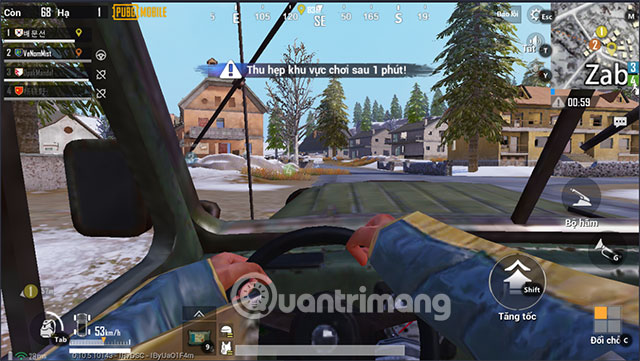
In a squad, passengers should watch the sides and rear, call obstacles, and mark pursuing vehicles. The driver should prioritize the route rather than turning constantly to search for enemies.

If a vehicle follows, do not stop in open ground merely to fight it. Reach hard cover, park with the vehicle's stronger side protected, and exit away from the threat. More route and vehicle guidance is available in the PUBG Mobile vehicle guide.
Clear buildings methodically
- Listen outside and identify doors, windows, and possible exits.
- Choose an entry that does not expose the entire squad to one angle.
- Pre-aim the first likely corner before stepping through.
- Clear near corners before looking at the far side of the room.
- Keep enough spacing for teammates to move and trade shots.
- After clearing, watch the route the squad used; another team may follow.
Coordinate information, not just movement
FPP squads depend on concise calls. State direction, distance, landmark, number of players, and movement when known: “two players, northwest ridge, moving right” is more useful than “enemy there.” Mark the position and update it when the opponent relocates.
Do not stack the whole squad behind the same tree or doorway. Create different but mutually supporting angles so one player can return fire when another is pressured.
Practice the transition from TPP
Start with Training Mode, then play unranked or lower-pressure FPP matches. Focus on one skill per session: crosshair height, sound, building clears, or driving. Avoid switching between FPP and TPP every few minutes while building muscle memory.
FPP rewards information gathered through legitimate exposure and teamwork. Once you stop depending on the third-person camera, fights become easier to read and your movement becomes more deliberate in both perspectives.
Related Articles
 How to Enter the Practice Mode PUBG Mobile5 minutes read
 How to Monitor Remote Enemies on PUBG Mobile5 minutes read
 Comparison Between PUBG Mobile VNG and PUBG Mobile International6 minutes read
 PUBG Mobile: the Most Popular Locations Vikendi8 minutes read
 Pubg Mobile Payload: How to Payload Pubg Mobile Mode6 minutes read
 Standard Tips in PUBG Mobile8 minutes read
Reader Comments 0
Sign in with email or Google to join the discussion.