Table of Contents
Researchers at Worcester Polytechnic Institute have developed an enzymatic structural material (ESM) that incorporates carbon dioxide into solid minerals. It is a promising approach to lower-carbon construction, but the reported results should not be read as proof that it can already replace concrete in every building.
How the material is made
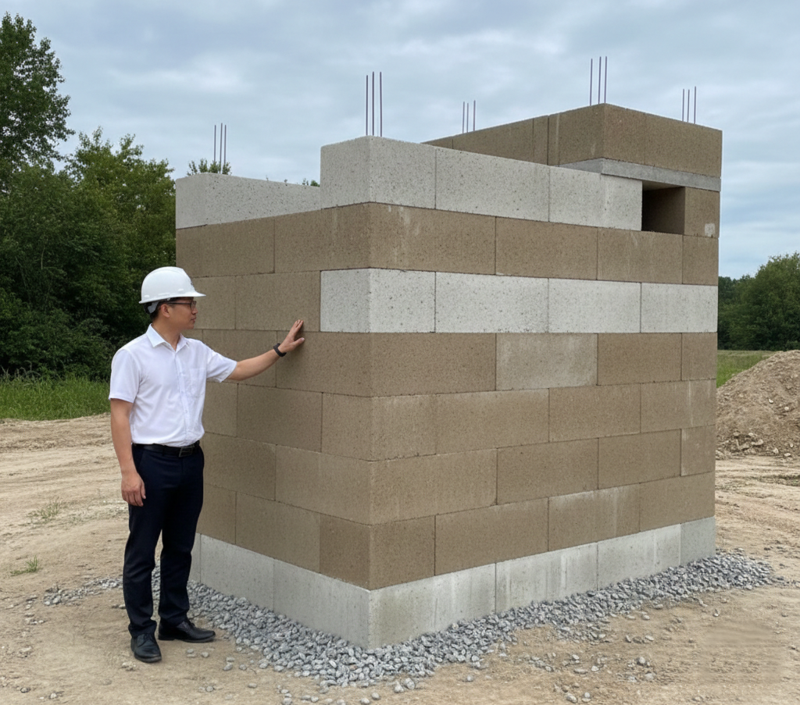
The study, Durable, high-strength carbon-negative enzymatic structural materials via a capillary suspension technique, describes combining enzyme-driven mineral formation with a capillary suspension process. Precipitated calcium minerals are incorporated into a sand-and-carbon matrix, then thermal curing forms the bulk material.
The researchers report water stability and compressive strength approaching that of structural concrete. Those are useful material properties, but compressive strength alone does not establish suitability for an entire structural system. Reinforcement, connections, loads and durability also matter.
What WPI reports about carbon capture
In its December 5, 2025 announcement, WPI reports that producing one cubic meter of ESM sequesters more than 6 kilograms of CO₂. The unit is cubic meters of material, not square meters of surface area.
WPI describes the material as carbon-negative and compares it with a conventional-concrete emissions figure. Such comparisons depend on the mix, production process and assessment boundary; they should not be treated as a universal value for all concrete.
Storing carbon in minerals is different from continuously cleaning the surrounding air after installation. A carbon-negative assessment also needs to account for emissions from inputs, production and other included stages, rather than counting stored CO₂ alone.
Potential applications and advantages
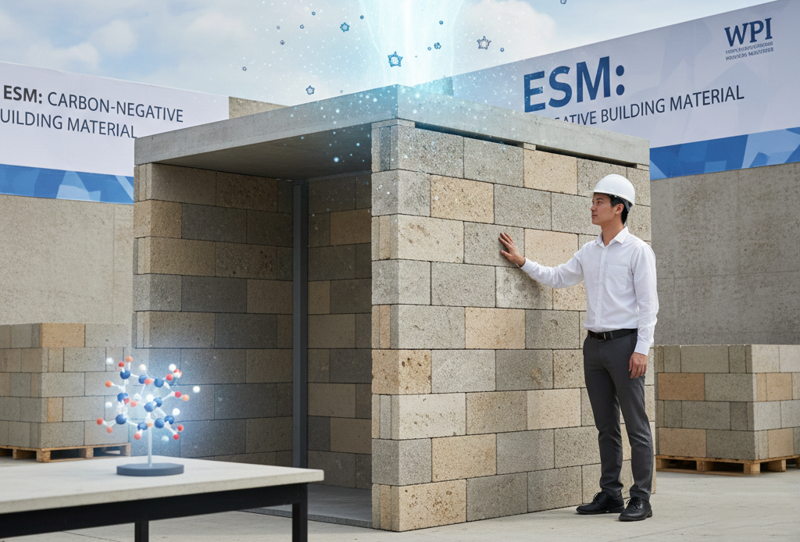
WPI identifies roof decks, wall panels and modular components as possible applications. It also reports rapid shaping and curing under mild conditions, tunable strength, repairability and recyclability. These properties could reduce production energy or waste if they translate successfully into practical manufacturing.
Recyclability is a material capability, not a guarantee that every discarded component will be recovered. Likewise, potential repairability does not establish a particular maintenance saving or service life.
What still needs to be established
Before a proposed use can be treated as a routine construction option, it needs evidence appropriate to that use: manufacturing consistency, performance under expected loads and exposure, applicable approvals, cost and a workable supply chain. The research announcement does not by itself establish those outcomes.
The useful finding is an enzyme-assisted route to a strong, water-stable material with reported carbon storage. Claims that it is the first carbon-absorbing building material, solves construction's climate impact, or is already a low-cost replacement for all concrete go beyond that evidence.
Related Articles
 The Journey to Net-zero Emissions in the Global Automotive Industry Explained10 minutes read
 Detection of 'Super Dark' Material, Capable of Absorbing 99.3% of Light: Explained4 minutes read
 Microsoft Has Committed to a Roadmap of 'Recovering' Co24 minutes read
 Apple Produces New Ultra-light Carbon Fiber Products3 minutes read
 In the Future, Wood Is the Only Material to Build Skyscrapers, Not4 minutes read
 How to Use Concrete Drilling Machine Correctly, for Nice Borehole5 minutes read
Reader Comments 0
Sign in with email or Google to join the discussion.