Table of Contents
The Multiscale Aperture Synthesis Imager (MASI) combines measurements from several sensors to reconstruct finer detail than an individual sensor can provide. Developed by researchers led by Guoan Zheng at the University of Connecticut, it uses software to align the measurements instead of relying on extremely precise physical synchronization.
The important advance is a different way to collect and combine optical information. It is not ordinary photo enlargement, and it does not mean that software can recover arbitrary detail from any camera image.
What a synthetic aperture does
An aperture describes the opening or effective collection area of an imaging system. A synthetic aperture combines measurements taken at different positions to behave like a larger collection area. For an introduction to conventional cameras, see our photography basics guide.
Combining light waves coherently requires accounting for their phase: where each wave is in its cycle. Visible wavelengths are very short, making this alignment demanding. MASI shifts part of that challenge from physical alignment to computation.
How MASI reconstructs an image
- Record diffraction patterns. Coded sensors at different positions collect patterns produced as light spreads after interacting with the object. The system does not use a conventional lens to focus a finished image onto each sensor.
- Recover the wavefields. Algorithms reconstruct information about amplitude and phase from the measurements.
- Align the measurements computationally. The software adjusts relative phase offsets and propagates the recovered fields back toward the object plane.
- Combine the information. The resulting synthetic aperture covers more than one sensor’s collection area, supporting a more detailed reconstruction.
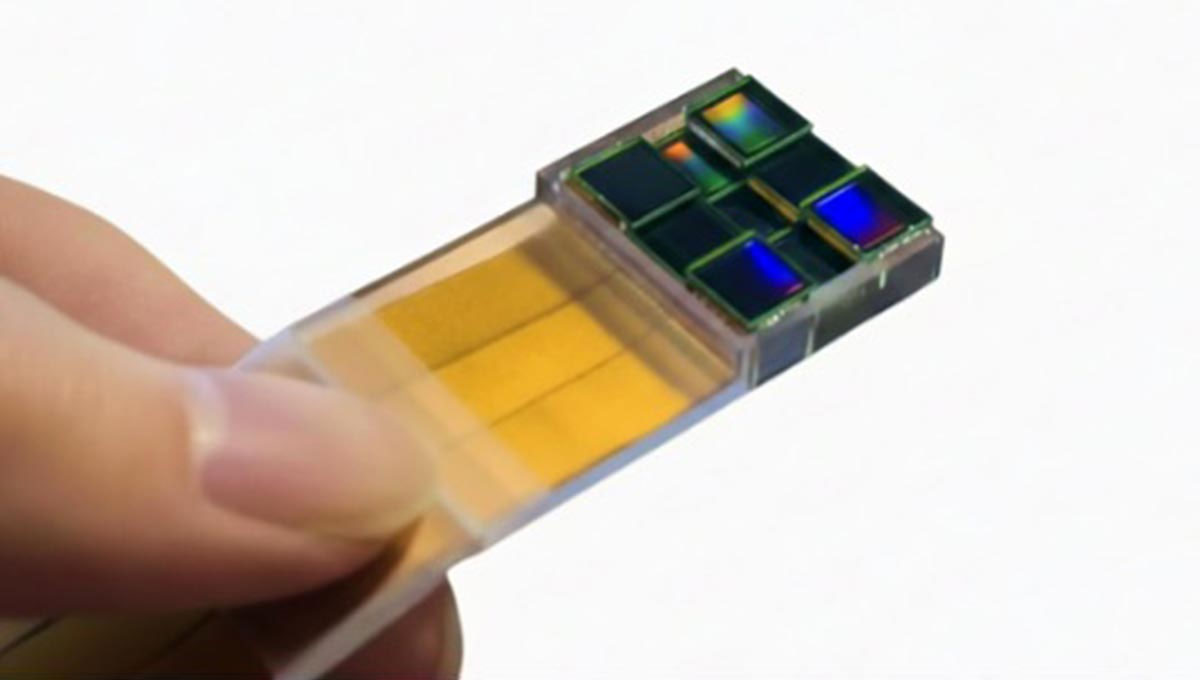
What the demonstration shows
The UConn research report describes sub-micrometer detail at working distances measured in centimeters, along with wide-field coverage. These are results from the research setup, not a universal resolution specification for distant subjects.
Resolution depends on the information collected and the imaging geometry. Increasing the effective aperture can improve the limit associated with a single sensor; describing this as overcoming every diffraction or physical limit would be misleading.
The distinction also helps explain why camera quality involves more than megapixel count. Sampling, optics, illumination, and reconstruction all affect the detail a system can actually resolve.
Potential uses and remaining questions
The researchers identify possibilities in surface inspection, forensics, biomedical imaging, and remote sensing. These are application directions rather than proof of a clinically validated diagnostic device or a ready replacement for ordinary cameras.
To assess a practical implementation, look for its tested working distance, field of view, resolution, acquisition conditions, and reconstruction time. Those details determine whether the method fits a particular inspection or imaging task.
Related Articles
 2025 science highlights: optical computing, malaria antibodies, and AI
 7 Great Distance Measuring Apps for Mobile Devices
 Summary of the best photo viewing software on PC
 How to calculate the distance to view TV reasonably and safely for health
 Good tips make it easy to remove unwanted details from your photos
 Top running applications, measuring running distance
Reader Comments 0
Sign in with email or Google to join the discussion.