Table of Contents
Explore 8 ChatGPT prompts to make brainstorming more effective.
There are countless examples, especially on Reddit. Experimenting with this collection on personal projects is up to each individual. The goal is to transform vague thoughts into verifiable ideas before embarking on actual work. In this article, let's explore 8 ChatGPT prompts that can make brainstorming more effective.
1. Help ChatGPT understand your context
Set expectations early to avoid vague ideas
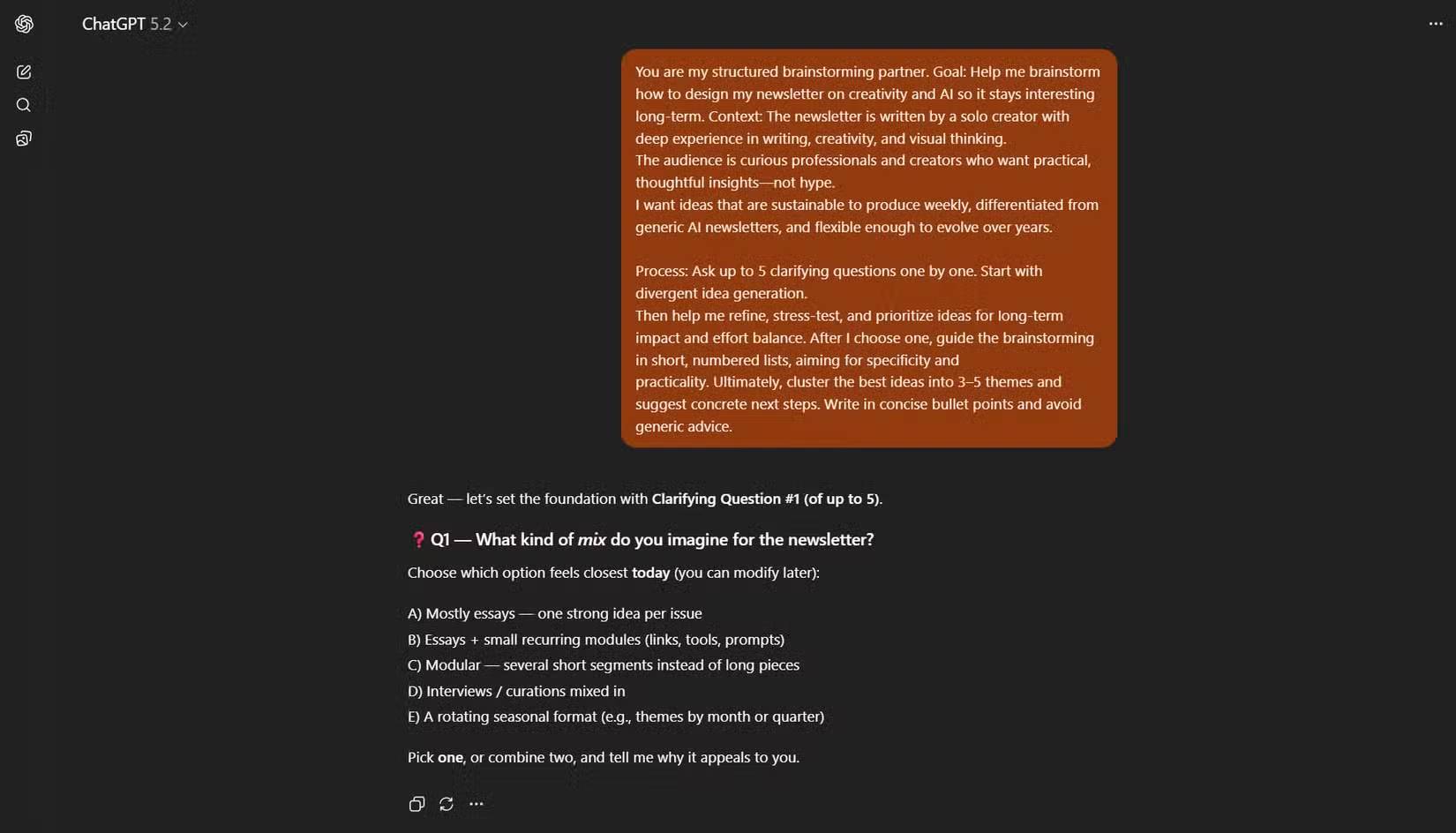
Before generating ideas, always start by letting ChatGPT know how to respond. This 'core' prompt question shapes the entire session and guides the model to avoid superficial suggestions.
You are my structured brainstorming partner. Goal: Help me brainstorm on [description of topic/problem/outcome]. Context: [object, constraints, time, resources]. Process: Ask up to 5 clarifying questions. Suggest 3-5 different brainstorming frameworks we can use (e.g., SCAMPER, mind mapping, assumptions, constraints, fundamental principles). After I choose a framework, guide the brainstorming process with concise, numbered lists focused on specificity and practicality. Finally, group the best ideas into 3-5 themes and suggest specific next steps. Write in concise bullet points and avoid general advice.
The objective and context need to be clearly stated from the outset so the model understands your situation. This prompt is especially useful for complex tasks such as content planning or life goal strategy. Starting with this detailed communication will save a lot of effort later. Remember, context, clarity, and purpose are crucial in all prompts.
2. Generate the quantity beforehand with classic divergence ideas
Speed and range are more important than quality in the early stages
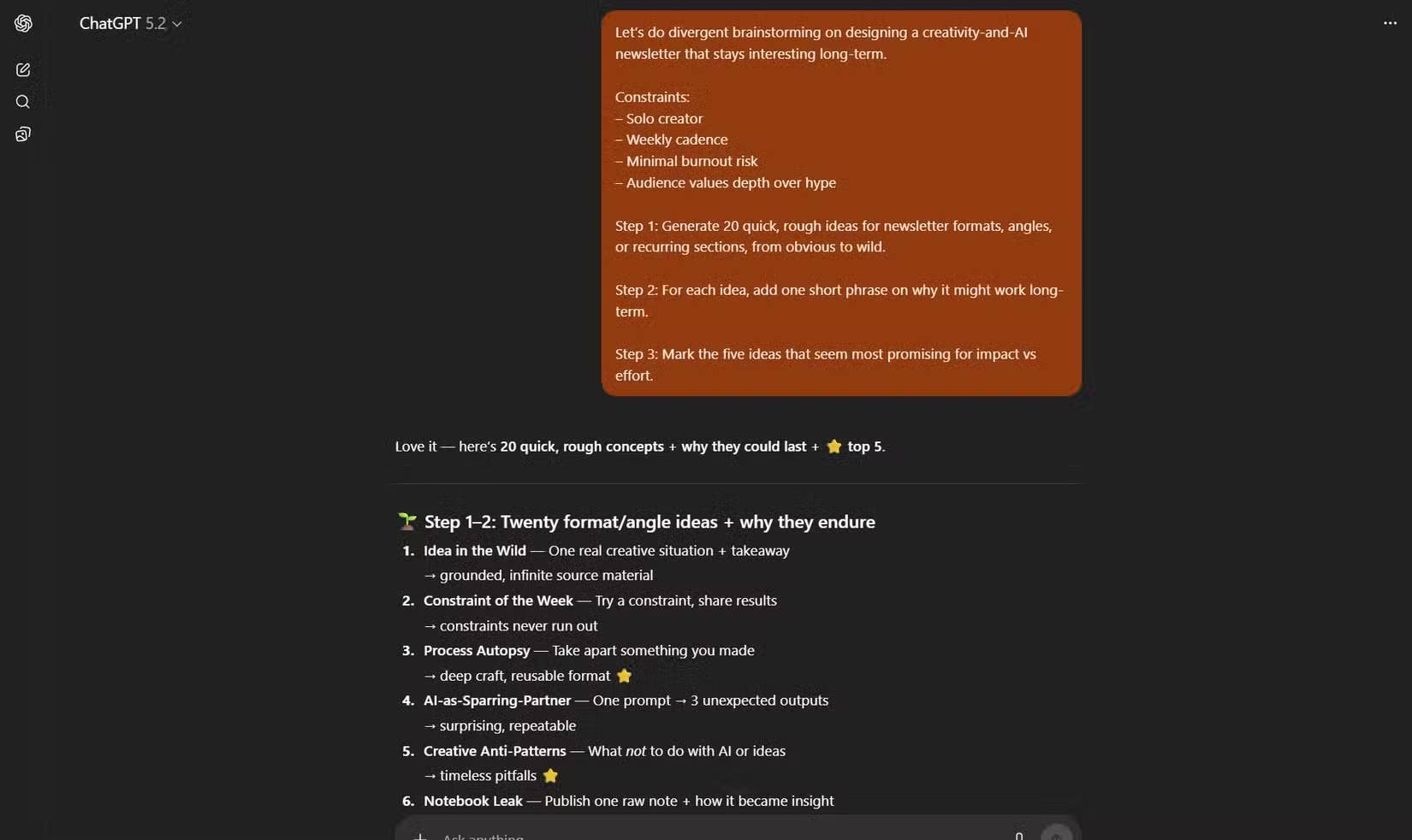
This is a classic lesson from the Brainstorming 101 course. When you're stuck, the quickest way is often to generate as many ideas as possible. Even silly ones. This exercise forces ChatGPT and your brain to work at full capacity by requiring a large number of ideas first. Selection and prioritization can be done later.
Let's do a divergent brainstorming session on [topic]. Constraints: [budget/time/industry/target audience/etc.]. Step 1: Generate 20 quick, rough ideas in a numbered list, from obvious to bold. Step 2: For each idea, add a short phrase explaining why it might work. Step 3: Mark the 5 ideas that seem most promising in terms of impact versus effort.
The final step is crucial. Without it, you'll have a list you'll never revisit. A numbered list also makes it easier to refer to specific ideas in subsequent exercises. The best ideas are often at the end of the list. Try combining ChatGPT with mind mapping to find connections between ideas.
3. Use reverse brainstorming to identify potential risks
Analyze the ideas to see what really matters
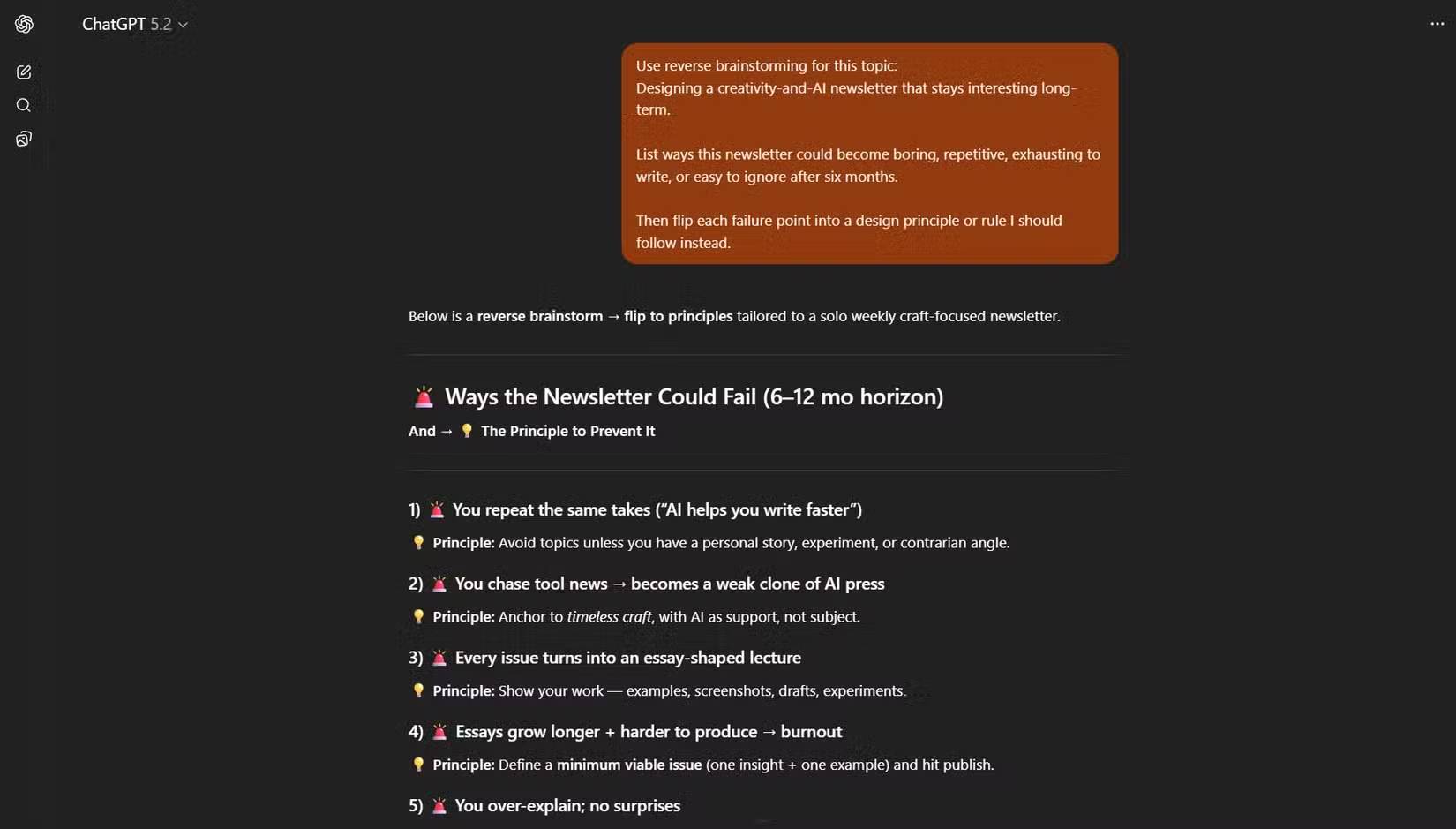
Reverse brainstorming reverses the question: Instead of asking how to succeed, you ask how to fail. It's like conducting a risk analysis before an event occurs.
Use reverse brainstorming for [topic]. List 15 ways to make this problem worse. For each 'worse' idea, flip it into a constructive idea or defense. Present the flipped list as specific, verifiable actions or concepts.
This prompt quickly highlights weak ideas and common mistakes. If an idea fails because it's too general, focusing on the specific area will be your leverage. If it fails because it's too complex, simplicity is the answer. Use this method when an idea feels 'good' but isn't convincing, and it often explains why.
4. Use your imagination with random keywords!
Unrelated ideas often open up many unexpected paths
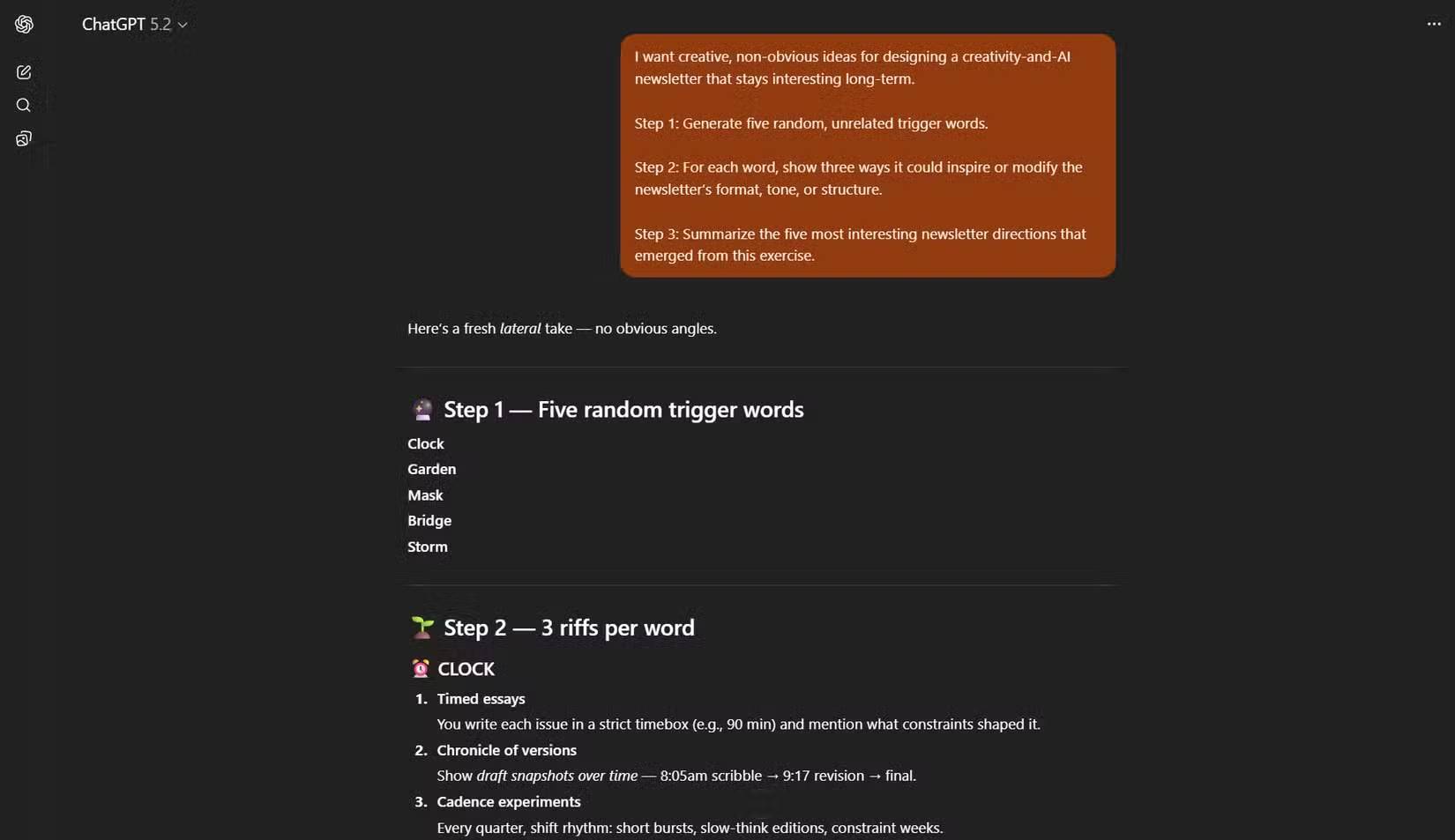
When things start to sound similar, randomness helps. This exercise forces unrelated ideas to combine, creating new connections. But be careful, this is actually very difficult for brain cells. perhaps that's why ChatGPT is so useful.
I want to generate creative, unexpected ideas for [topic]. Step 1: Create 5 random, unrelated keywords. Step 2: For each keyword, identify 3 ways it could inspire or change my ideas. Step 3: Summarize the 5 most interesting directions that have emerged.
The keywords themselves aren't important. The value comes from translating them into metaphors, implications, or perspectives that you wouldn't normally consider.
5. Think outside the box with the SCAMPER framework
A framework helps you follow a thought process
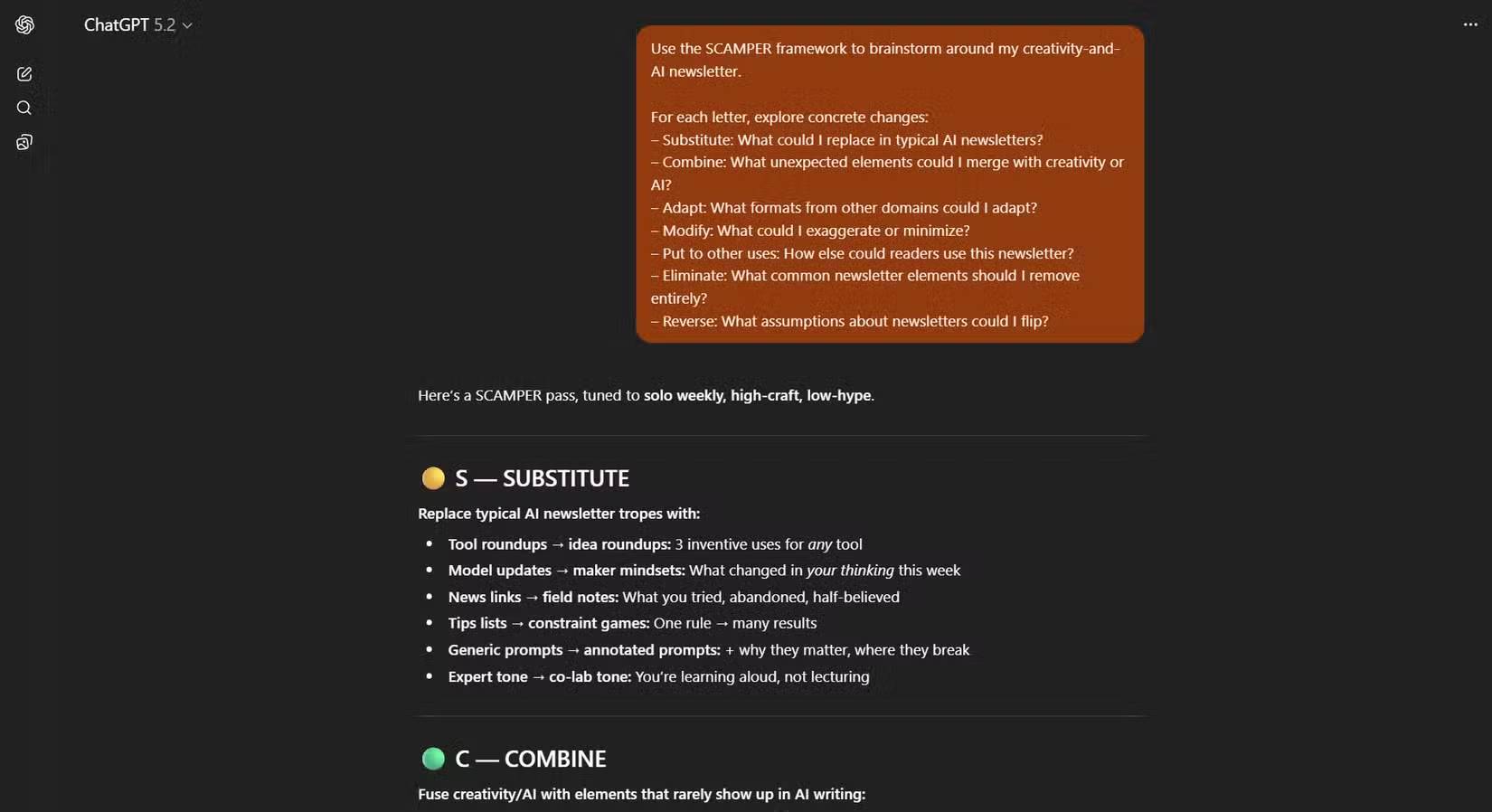
Edward de Bono popularized lateral thinking. SCAMPER is a classic innovation framework for implementing this, and it's incredibly fast with AI.
Use the SCAMPER framework to brainstorm around [product/project/topic], with each idea: Replace, Combine, Adapt, Modify, Repurpose, Eliminate, Reverse. Generate 3-5 specific ideas, not general advice. Keep each idea in a sentence. Finish with a concise list of the top 5 ideas across all the SCAMPER steps.
This suggestion works very well with a good basic idea. So, use it later in the brainstorming process. It helps you see how small changes, like removing a feature or combining two elements, can significantly improve clarity or usefulness.
6. Assess the pressure of the idea using a SWOT analysis
Strategic thinking improves the quality and feasibility of ideas
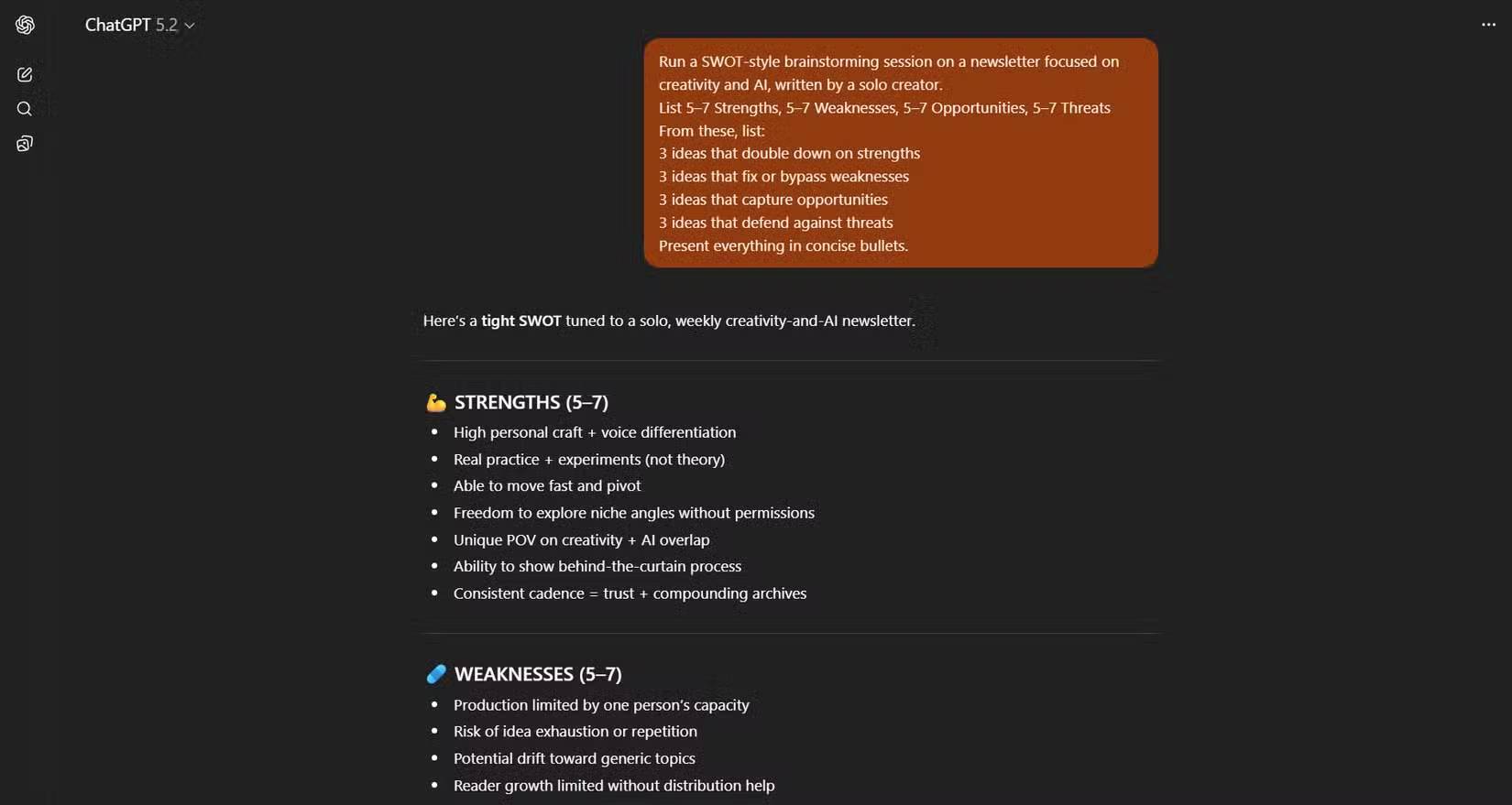
A SWOT analysis brings the brainstorming process into the real world and highlights the trade-offs you may have to make in the future.
Conduct a SWOT brainstorming session on [idea or project]. List 5-7 strengths, 5-7 weaknesses, 5-7 opportunities, and 5-7 threats.
From there, list them:
- 3 ideas focusing on strengths
- 3 ideas to overcome or ignore weaknesses
- 3 ideas for seizing opportunities
- 3 ideas for preventing threats
Present everything in concise bullet points.
Use this method when you don't want to dismiss an idea that sounds great on paper (or screen). Using visual diagramming tools can help you brainstorm and get a general overview.
7. Change your perspective using role-playing brainstorming
Different perspectives reveal needs you've never considered
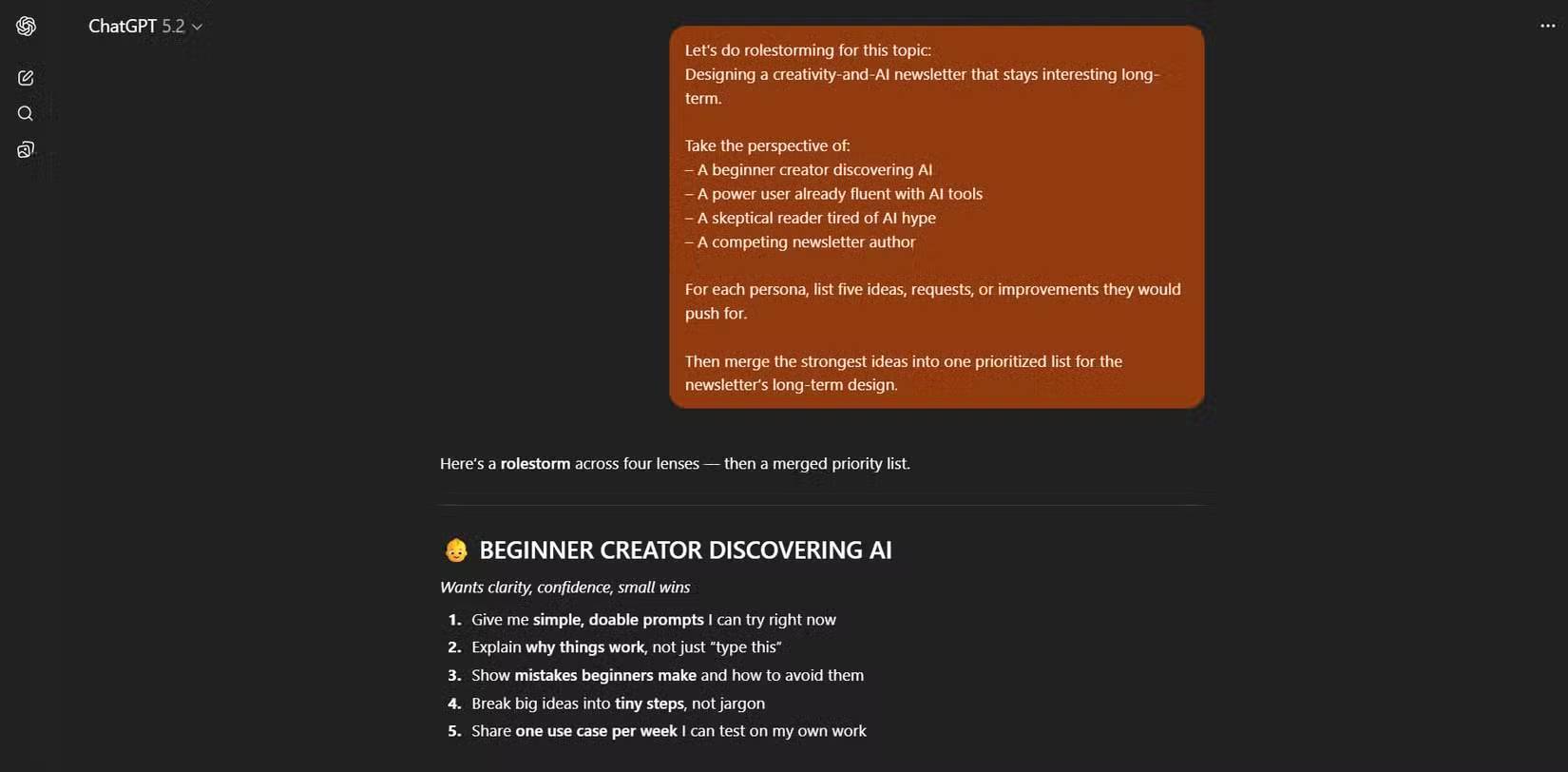
Role-playing brainstorming forces you to put yourself in someone else's shoes. This method is incredibly useful for identifying weaknesses in a product or process.
We will conduct a 'role-playing brainstorming' for [topic]. Put yourself in the shoes of: – A beginner – An advanced user – A key stakeholder – A competitor
For each user profile, list five ideas, requests, or improvements they would like to see improved. Then, combine the best ideas into a prioritized list.
As a writer, the overlapping insights between user profiles help you refine your content for a wider audience.
8. Transform ideas into action plans
Turn brainstorming sessions into practical plans
End your brainstorming session with this question:
Take the list of ideas I've provided and turn them into a practical action plan.
Score each idea based on impact (1-5) and effort (1-5) with a brief explanation.
Categorize ideas into: Quick Success, Long-Term Project, Experimental, and Cancelled.
Propose a two-week action plan with specific tasks to test the three best ideas.
You don't want your ideas to just sit in a document without leading anywhere. The best ideas shouldn't be based solely on intuition. The best ideas are a balance between intuition and concrete evidence.
Final Thoughts
Understanding 8 chatgpt prompts to make brainstorming more effective makes it easier to evaluate the information and apply the most relevant recommendations. Focus on the key points above and verify details that may change over time.
FAQ
What is 8 chatgpt prompts to make brainstorming more effective?
Explore 8 ChatGPT prompts to make brainstorming more effective.
What key points does this article cover?
The article focuses on 1. Help ChatGPT understand your context, Set expectations early to avoid vague ideas, 2. Generate the quantity beforehand with classic divergence ideas, with practical explanations and examples.
How can you use this information in practice?
Use the explanations to compare options, verify important details, and make a more informed decision. Apply the recommendations that best match your goals and situation.
Related Articles
 minutes read
 Top ChatGPT Prompts for Finance: Practical Guide9 minutes read
 How to Come up with the Best Prompts to Learn with ChatGPT9 minutes read
 9 Great ChatGPT Prompts for a Productive Workday: Explained7 minutes read
 Top ChatGPT Prompts for Executives: Practical Guide9 minutes read
 How to Always Get Perfect Replies from ChatGPT with These 7 Prompts10 minutes read
Reader Comments 0
Sign in with email or Google to join the discussion.