Table of Contents
SHiELD stands for Self-Protect High Energy Laser Demonstrator. The US Air Force Research Laboratory (AFRL) developed the program to investigate whether a laser system carried in an aircraft pod could defend against incoming missiles. It was a technology demonstration program, not a proven “death shield” protecting a fleet of fighter jets.
The distinction matters because successful testing of one part of a system does not establish that the complete system has been integrated, flight-tested, and deployed for operational use.
What SHiELD was designed to demonstrate
AFRL described an aircraft-mounted directed-energy system intended to demonstrate defense against surface-to-air and air-to-air missiles. Unlike a flare or chaff decoy, a defensive laser concept aims to affect the incoming threat directly.
That goal does not imply an impenetrable shield. A demonstrated capability against particular test targets must be evaluated within the conditions of that test. Aircraft protection involves multiple systems and cannot be reduced to one technology.
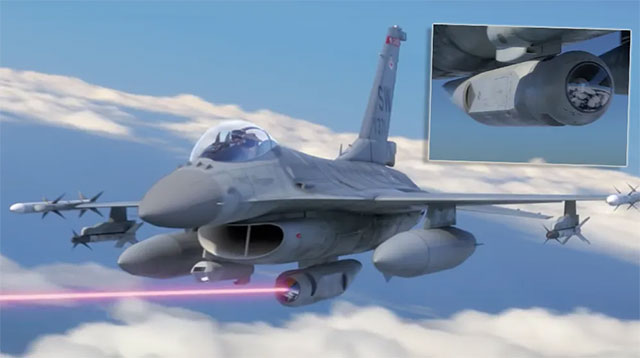
The 2019 test used a ground-based surrogate
In its 2019 test report, the Air Force said a Demonstrator Laser Weapon System shot down several air-launched missiles in flight at White Sands Missile Range. The laser system was a ground-based test surrogate for the planned SHiELD airborne system.
“Air-launched missiles” describes the targets. It does not mean that the defensive laser was fired from a fighter aircraft. The report presented the result as a development milestone, so it should not be described as proof of an operational airborne capability.
The program involved several subsystems and partners
A February 2021 AFRL announcement described the main assemblies as the pod, laser, and beam-control system. It discussed receiving and integrating those assemblies and named Lockheed Martin, Boeing, and Northrop Grumman as partners.
Calling SHiELD an exclusively Lockheed Martin-developed system therefore leaves out the wider AFRL program and its other contributors. Likewise, an announcement about assembly delivery is different from a report of successful operational deployment.
Why an external pod involves tradeoffs
An aircraft-mounted system has to fit the aircraft and its mission. An external pod can raise questions about weight, drag, power requirements, and use of attachment points otherwise available for equipment or weapons. Flight conditions also differ from a ground test.
These tradeoffs do not establish that the system is automatically unsuitable for every stealth aircraft, or suitable for every older aircraft. A list of possible host aircraft is not a confirmed procurement or installation plan.
How to interpret claims about deployment
The historical announcements cited here establish a research objective, a surrogate ground test, and subsystem-development work. They do not establish that SHiELD provides comprehensive missile protection on F-15s, F-16s, A-10s, or any other named fleet today.
To assess a deployment claim, look for a dated official announcement identifying the actual platform and distinguishing a prototype, a flight demonstration, and operational service. Avoid treating earlier projected schedules as completed milestones.
Related Articles
 Biting criticism of billionaires, now it is the US Air Force's turn to be told by Elon Musk: 'The era of jet fighters is over'
 The first battle between AI and pilot
 Review IObit Malware Fighter 7 and give you the 100 key Pro version
 Close up of gunfire, bombs of fighters from the cockpit
 Hotspot Shield - Free VPN Software
 How much money do fighter planes burn per flight hour?
Reader Comments 0
Sign in with email or Google to join the discussion.