Table of Contents
Tangram serves as a game that combines entertainment and education. From seven simple pieces, the game opens up a world of unlimited creativity.
Tangram is a dissection puzzle that originated in China. The game consists of seven flat geometric pieces (called tans) that can be combined to create a variety of shapes. Players can arrange them into the shapes of people, animals, objects, or abstract geometric patterns. The prerequisites are that all seven pieces must be used, not overlapped, and laid flat on a flat surface.
1. Origin & development history
Tangrams originated in China around the late 18th century, although there are many legends about their origins. Some stories say that tangrams originated from the idea of 'a square mirror breaking into seven pieces', and then people discovered the endless possibilities of creating shapes from these fragments.
By the early 19th century, tangrams had spread to Europe and America, where they quickly became a fad. Tangram instruction books and sets were mass-produced, making them a popular pastime. During the World Wars, tangrams exploded in popularity again, thanks to their simplicity, ease of play, and ability to stimulate the mind without the need for elaborate equipment.
2. Structure and rules of play

2.1 Structure of the pieces (Tans)
The standard tangram set has 7 pieces, including:
| Piece | Shape | Quantity |
| Big triangle | Large right isosceles triangle | 2 |
| Medium triangle | Right isosceles triangle | 1 |
| Small triangle | Small right isosceles triangle | 2 |
| Square | Small square | 1 |
| Parallelogram | Parallelogram symmetry | 1 |
When put together in the correct position, all seven pieces will form a complete square.
2.2 How to play
Players must adhere to some basic rules including:
- Use all 7 pieces - Don't leave any out.
- No overlapping - pieces should be placed next to each other, not stacked.
- Rotate and flip pieces - players can rotate or flip parallelogram and triangle pieces to fit.
- Complete the pattern - arrange all the pieces to fit the given silhouette. Or create your own patterns.
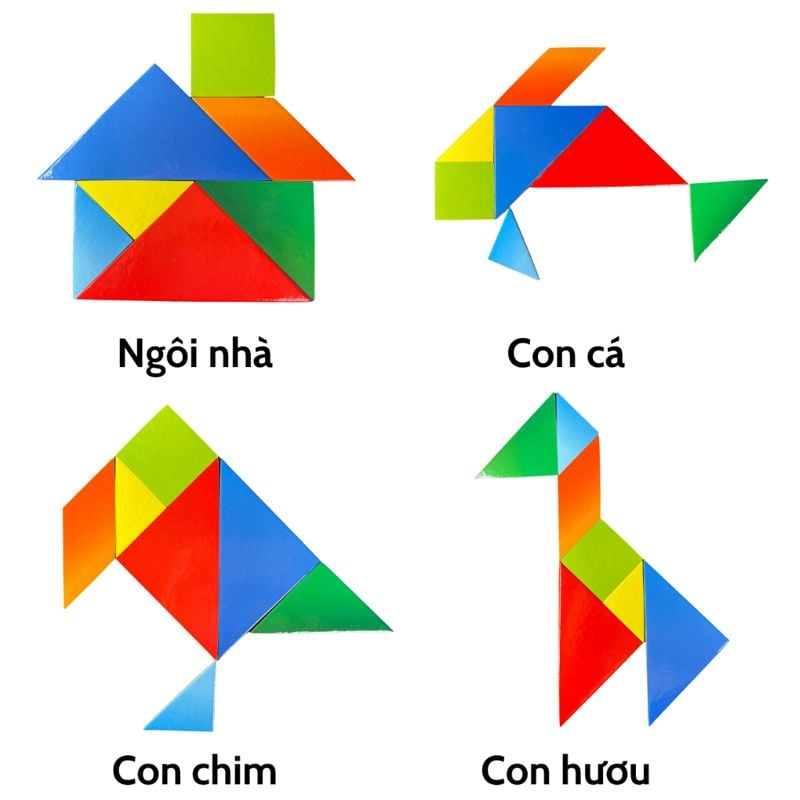
2.3 Steps to play with the model
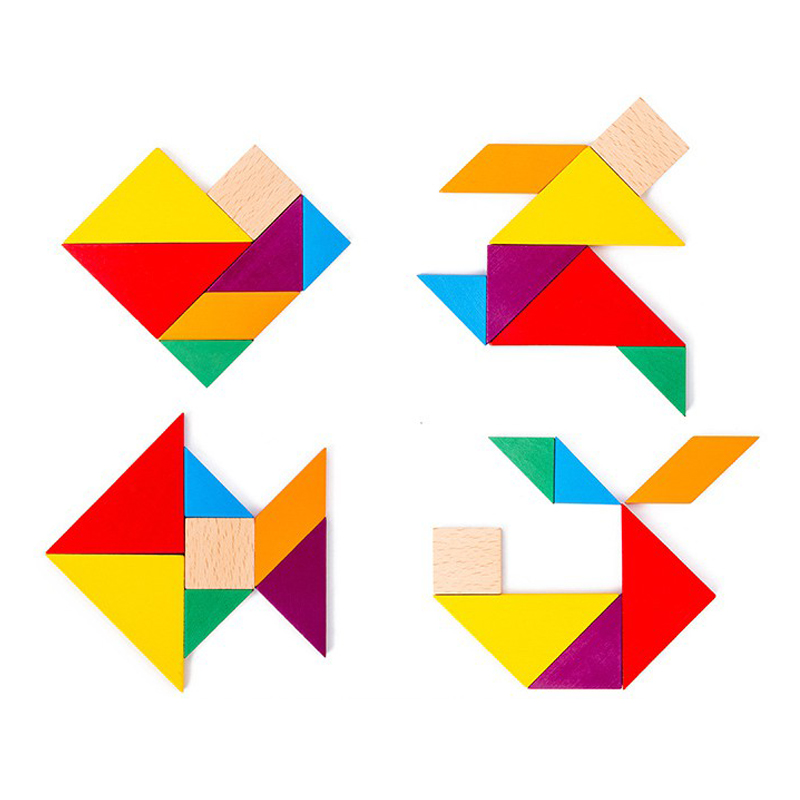
- Choose a pattern : For example a cat, a boat, a house or an abstract geometric pattern.
- Shadow frame observation : Look at the overall shadow shape, estimate the size of each part.
- Start with the big pieces : Usually players should place 2 big triangles first to create the basic frame.
- Continue to assemble the medium and small pieces : Gradually assemble to match the silhouette.
- Adjusting the rotation/flip of the pieces : If they don't fit, try rotating or flipping the parallelogram and small triangle pieces.
- Completion : When all 7 pieces completely cover the silhouette, the player is successful.
3. Versions & Variants
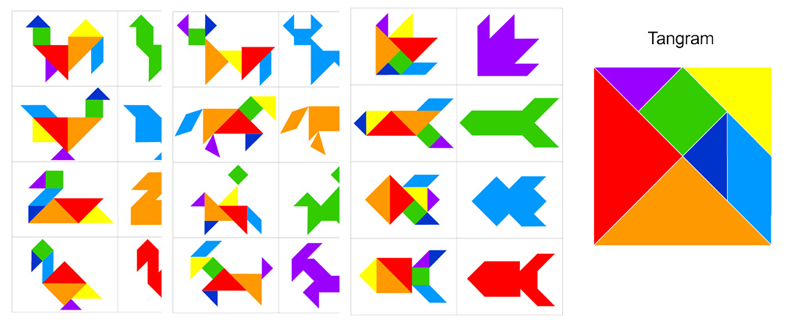
Over time, the tangram developed into several different versions:
- Traditional tangram set: Made of wood, plastic or paper, often used in homes or schools.
- Tangram for kids: Simple patterns like houses, cats, boats, help children easily access and practice their imagination.
- Advanced Tangrams: More complex patterns, often just silhouettes, make players think longer.
- Tangram online and mobile app: Allows players to experience on phones, computers, with thousands of different challenges.
- Educational variant: Used in teaching mathematics, practicing geometry skills and spatial thinking abilities.
4. Benefits & Applications
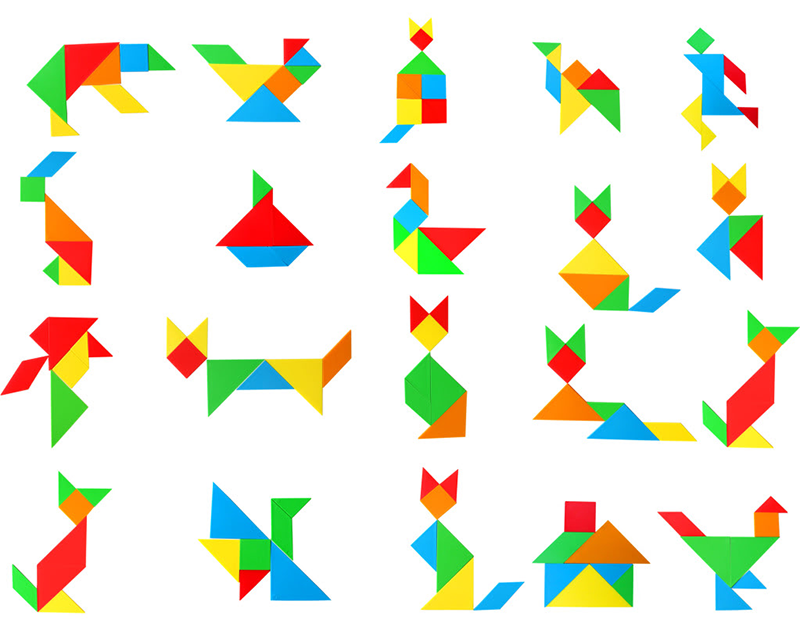
Tangram is not only an entertaining game but also brings many benefits, including:
- Geometric thinking training: Helps players understand area, perimeter, symmetry and geometric transformation.
- Develop imagination and creative thinking: Players can create countless different shapes.
- Improves problem solving skills: Tangram requires patience, experimentation and repeated tweaking to achieve results.
- Educational applications: Many teachers use tangrams to teach math, spatial thinking skills, and dexterity.
- Applications in psychology: Tangrams are sometimes used as a tool to test cognitive abilities, concentration levels, and visual memory.
Nowadays, tangrams are no longer limited to traditional wooden or paper puzzles. With the development of technology, a series of online tangram applications have been born, helping players to try their hand at anytime, anywhere. These applications also have rankings, hint features or competition modes, making tangrams more modern and attractive.
Tangram is a game that combines entertainment and education. From seven simple pieces, the game opens up a world of unlimited creativity, where everyone can explore their thinking and imagination. Whether for children or adults, tangram brings joy and practical benefits in both learning and life.
FAQ
How do you play, explanation, variations, origin: step-by-step guide?
In practical terms, tangram is a game that combines entertainment and education. From seven simple pieces, the game opens up a world of unlimited creativity.
What should you check before getting started?
Review the requirements, compatible device or software version, and any warnings described in the guide before making changes.
What should you do if the steps do not work?
Repeat the steps in order, confirm that your app or system is up to date, and review the troubleshooting details provided above.
Related Articles
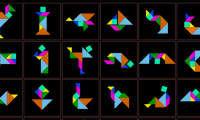 Tips for Playing Tangram Game: Practical Guide6 minutes read
 Easy Sudoku Solver Tips4 minutes read
 Decipher the Mystery of the Origin of Billions of Tons of2 minutes read
 Instructions for Creating Origin Account4 minutes read
 How to Get Gift Code Poke Origin3 minutes read
 Latest Danh Tuong Origin Code and How to Redeem Code5 minutes read
Reader Comments 0
Sign in with email or Google to join the discussion.