Table of Contents
The water released when chopping onions – propanethial S-oxide – often causes choppers' eyes to water. Now, scientists have found a simple way to reduce the problem.
Onion Overview
The water released when chopping onions – propanethial S-oxide – often causes choppers' eyes to water. Now, Scientists have found a simple way to reduce the problem.
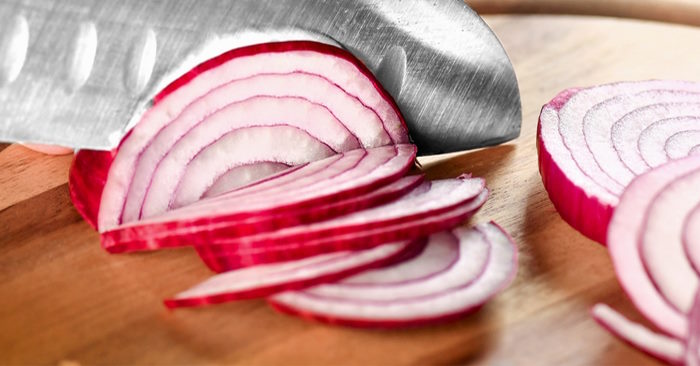
In experiments by researchers from Cornell University in the US , sharper blades and slower cutting speeds significantly reduced the amount of gas released from onions during cooking, keeping eyes drier and kitchen surfaces safer.
Biomechanist Zixuan Wu and his team used a mini-cutter, a high-resolution camera, and sensors to carefully monitor the water droplets released when slicing onions, comparing their characteristics to knife sharpness, slicing speed, and cutting force.
" We found that the speed at which the water-containing gas escapes is much higher than the speed at which the blade cuts through ," said physicist Sunghwan Jung.
Each layer in an onion has an upper and lower skin, and when these layers are punctured, analysis shows that two effects occur: an instantaneous spray of mist, and then a slower permeation of liquid through the layers.
The researchers found that dull knives produced significantly more droplets and sprayed them more quickly. Because it took more force to cut through the skin, pressure built up in the onion juice. Faster, more forceful cuts with a dull blade pushed the droplets farther.
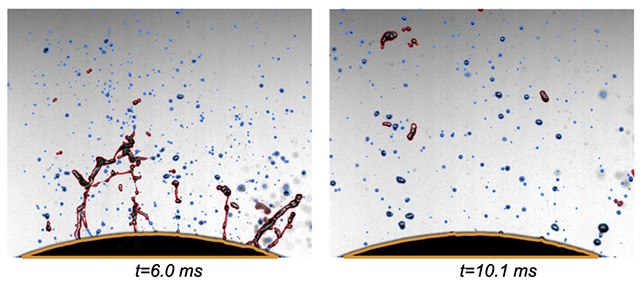
Observations show that the initial velocity of the droplets can be very high, up to 40 meters per second - that is, 144 kilometers per hour. It is these droplets that pose the greatest threat to the eyes.
Researchers were also able to disprove the popular theory that chilled onions produce less fog and reduce tearing due to better chopping. The initial temperature of the onions didn't seem to make any real difference; if anything, chilling them actually made the condition worse.
' These observations are supported by theoretical models that are able to accurately capture independently measured fracture forces, ' the researchers write in their published paper.
The history of onions in the kitchen dates back some 5,000 years, with even mention of hidden 'tears' Inside onions in Shakespeare's play Antony and Cleopatra.
Now we have a better understanding of how the aerosols that cause those tears are created and released, and what can be done about them. The team found that using a sharp blade and gentle cuts helps keep the mist of droplets below eye level.
This discovery also has implications for food safety. If bacteria are present, the type of cutting will affect how they spread. As we saw with the E. coli outbreak at McDonald's in the US last year, many You can get sick very quickly from pathogens spread by onions.
' Let's say you have pathogens in the top layer of an onion ,' says Jung. ' By cutting the onion, those pathogens can be encapsulated in droplets and then they can spread. '
This study was published in PNAS.
FAQ
What should you know about surprised with an extremely simple way to help you cut onions without tearing?
In practical terms, the water released when chopping onions – propanethial S-oxide – often causes choppers' eyes to water. Now, scientists have found a simple way to reduce the problem.
Why does surprised with an extremely simple way to help you cut onions without tearing matter?
The article highlights that now, Scientists have found a simple way to reduce the problem.
What is the main takeaway?
The main takeaway is that researchers were also able to disprove the popular theory that chilled onions produce less fog and reduce tearing due to better chopping.
Related Articles
 It Turns Out That This Is the Reason Why We Shed Tears4 minutes read
 Interesting Facts About Onions You May Not Know4 minutes read
 What Does It Mean to Eat Onions? What Does It Mean?3 minutes read
 What Do Doctors Say About the Rumor of Using Onions to Suck Out Flu5 minutes read
 Growing Onions in a Glass of Water Can Both Decorate and Help3 minutes read
 20 Interesting Facts About EYES May Be Unknown5 minutes read
Reader Comments 0
Sign in with email or Google to join the discussion.