Table of Contents
Explore scientists discover traces of ancient life in an unexpected place.
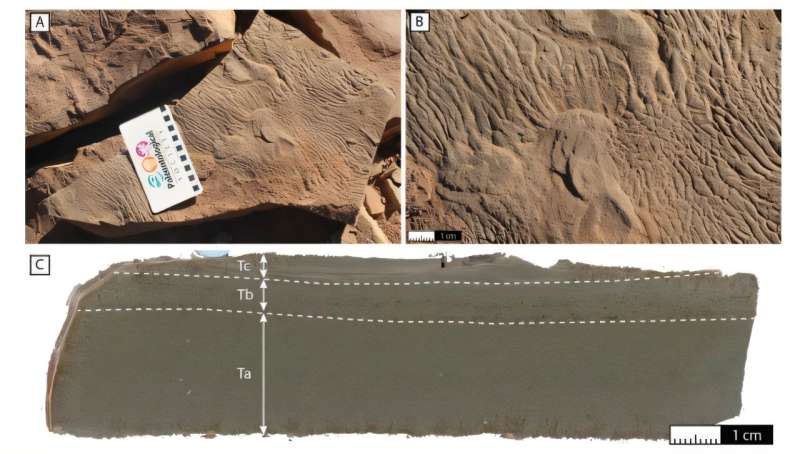
To reach the area that was once a coral reef, they had to traverse layers of turbidite – sediments formed from powerful currents of mud and debris at the bottom of the ocean. Turbidite typically retains familiar ripples, but Martindale noticed something unusual superimposed on these ripples. The rock's surface had small, uneven wrinkles and bumps, completely unlike what she had expected.
Unexpected patterns in the stone
" As we walked along the layers of turbidite, I noticed one side of the layer had some very beautiful ripples ," Martindale recounted. "I called Stéphane over right away and said, ' Look, these are wrinkle structures! '"
Wrinkle structures are small ridges and shallow pits, ranging in size from a few millimeters to a few centimeters, that form on sandy seabeds when algae or microorganisms develop into biomats or clumps. These fragile structures are often swept away when animals stir up the sediment.
Therefore, they are rarely found in rocks younger than about 540 million years old – the time when animal life exploded and began to violently disturb the seabed surface. In modern environments, wrinkled structures are usually associated with shallow tidal zones, where sunlight is sufficient for photosynthetic algae to thrive.
The problem is that the turbidites Martindale is studying formed at a depth of at least 180 meters, where sunlight cannot penetrate. This almost rules out the possibility of photosynthetic algae – the familiar 'culprit' behind today's wrinkles. Previous reports of wrinkles in ancient turbidite sediments have also been questioned, further fueling the controversy surrounding this discovery.
Furthermore, these rock formations are only about 180 million years old, a time when the seabed habitats have been heavily disturbed by animals, making the preservation of such delicate structures highly unlikely. Every element of the geological context suggests these patterns 'shouldn't exist,' and Martindale understood that he had to verify all the evidence with extreme caution.
'We had to examine each piece of evidence one by one to be sure this really was a wrinkled structure within turbidite,' Martindale said, because structures of photosynthetic origin like this 'shouldn't be present in such a deep water environment.''
Hypothesis testing
Once the research team confirmed the sedimentary layers were indeed turbidite, the next step was to prove that the observed patterns were actually of biological origin. Analysis revealed that the rock layers directly beneath the folds had unusually high carbon content – a typical sign of biological activity.
Additionally, videos recorded by remotely operated submersibles at the seabed, below the illuminated areas, show that microbial mats can still form thanks to chemosynthetic bacteria. These are bacteria that obtain energy from chemical reactions, rather than sunlight.
By combining geological, chemical, and similar examples from modern environments, the research team concluded that they had observed crease structures created by chemosynthetic organisms within the rock profile. Turbidite flows carry nutrients and organic matter, reducing oxygen concentrations and creating conditions favorable for chemosynthetic life.
During the quiet periods between turbidite depositions, bacteria grow into mats on the sediment surface, subsequently forming the characteristic creases observed by Martindale in Morocco. Usually, the next turbidite layer washes these mats away, but sometimes, they are rarely preserved within the rock.
The significance for the search for ancient life.
In the future, Martindale hopes to conduct lab experiments to understand in more detail how these structures form in the turbidite environment. She also hopes that this discovery will encourage other researchers to broaden their perspective, incorporating chemosynthetic microbial mats into a model that previously only acknowledged a photosynthetic origin for the wrinkled structures.
At that point, geologists could begin searching for traces of life in environments previously considered 'hopeless' in the quest for the earliest signs of life on Earth.
" The wrinkled structures are incredibly important evidence in the early evolution of life ," Martindale emphasized. If we ignore the possibility of their existence in turbidites, " we may be missing a crucial piece of the history of the microbial world ."
Final Thoughts
Understanding scientists discover traces of ancient life in an unexpected place makes it easier to evaluate the information and apply the most relevant recommendations. Focus on the key points above and verify details that may change over time.
FAQ
What is scientists discover traces of ancient life in an unexpected place?
Explore scientists discover traces of ancient life in an unexpected place.
What key points does this article cover?
The article explains the core concept, important considerations, and practical details readers should understand.
How can you use this information in practice?
Use the explanations to compare options, verify important details, and make a more informed decision. Apply the recommendations that best match your goals and situation.
Related Articles
 Traces of Life in an Unexpected Place in the Middle of the Solar System5 minutes read
 Archaeologists Found Traces of Ancient Villages in 5,500 BC in Switzerland3 minutes read
 Discover the Mysterious Mummification Process of the Ancient6 minutes read
 Ancient Embankment Found in Aswan, Egypt4 minutes read
 Back in the Past to Find Out How the Ancient Romans Went3 minutes read
 400 Mysterious Ancient Footprints Near Volcanic Regions in Africa3 minutes read
Reader Comments 0
Sign in with email or Google to join the discussion.