Table of Contents
New research suggests that ancient volcanoes on Mars may have emitted greenhouse gases that warmed the planet and created conditions for microbial life.
Volcanoes on early Mars may have emitted 'active' sulfur gases, helping to warm the planet and create conditions for microorganisms to survive, a new study suggests.
While scientists are still trying to piece together the 'picture' of early Mars, this research opens up the possibility that the red planet's atmosphere was once warm and stable enough to support life. According to the team, ancient volcanic eruptions released large amounts of sulfur gas, creating a greenhouse effect and trapping heat on the planet.
The work, published in Science Advances , was carried out by a team at the University of Texas at Austin.
Potential environment for life
To learn more about the early chemistry of Mars, the team analyzed the composition of meteorite samples from the planet. That data was used to run more than 40 different simulations, examining temperatures, chemical conditions, and gas concentrations to estimate the carbon, nitrogen, and sulfur-containing gases emitted by Mars' volcanoes.
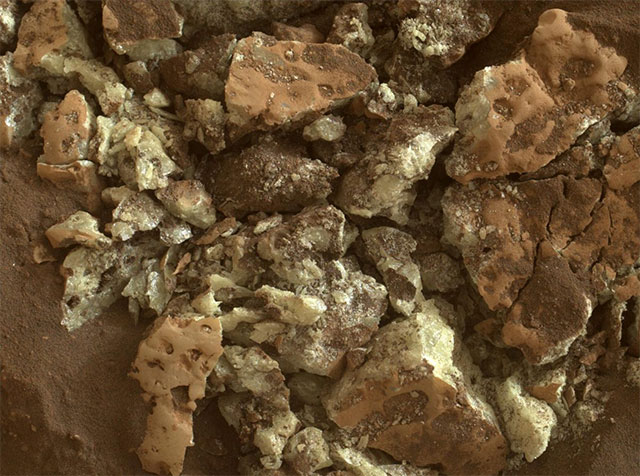
The results contradict many older models—which suggested that the time was awash with sulfur dioxide (SO₂). Instead, the simulations suggest that 3–4 billion years ago, Mars may have emitted various forms of 'reduced' sulfur, including hydrogen sulfide (H₂S), disulfur (S₂), and even sulfur hexafluoride (SF₆)—a powerful heat-trapping greenhouse gas.
According to lead author Lucia Bellino , a graduate student at the Jackson School of Geosciences (UT Austin), these reduced sulfur gases may have created a unique environment:
The presence of reduced sulfur dioxide can create smog and contribute to the formation of greenhouse gases such as SF₆, which help trap heat and maintain liquid water. The redox conditions and gas formations are also very similar to hot spring environments on Earth, where microorganisms thrive.
Unlike previous studies that only looked at surface emissions, this work simulates the entire geological cycle: how sulfur changes inside the planet, separates from minerals, and is released to the surface as a gas. This helps to reconstruct a more realistic picture of the ancient atmosphere of Mars.
Additionally, the study found that sulfur was constantly changing states. Although Martian meteorites contain many reduced sulfur, the planet's surface contains sulfur bound to oxygen.
' This suggests that the sulfur cycle – the conversion between different forms – may have been the dominant process on early Mars ,' said Mr Bellino.
NASA discovery
While the research was underway, NASA made a surprise announcement: the Curiosity rover ran over and cracked a rock, revealing Pure elemental sulfur . This was the first time sulfur unbound from oxygen had been detected.
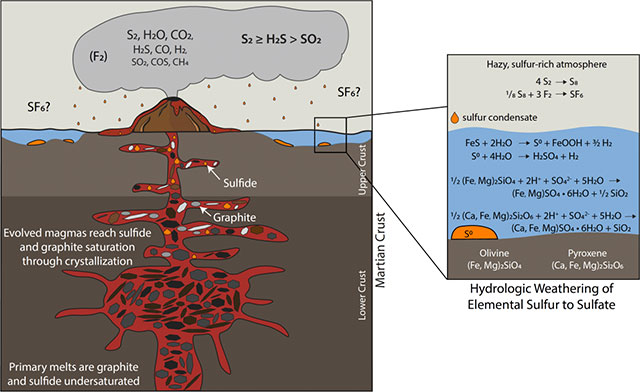
This is exactly in line with the model proposed by the research team. Professor Chenguang Sun, Bellino's advisor, shared:
When S₂ is released, it tends to precipitate out as elemental sulfur. We initially had no evidence from the field, but NASA's findings confirm it.
The team will expand the simulations to see where the water supply on early Mars came from, whether volcanic activity could have provided large amounts of water, and whether reduced sulfur forms could have served as 'food' for microorganisms, much like they do in hot springs on Earth.
Today, Mars is far from the Sun and very cold, with an average temperature of about -80°F (-62°C). Bellino hopes that climate modelers can use the results of this study to estimate the real climate of ancient Mars—and if life arose, how long it survived in that warm environment.
FAQ
What should you know about early mars had an environment suitable for life?
In practical terms, new research suggests that ancient volcanoes on Mars may have emitted greenhouse gases that warmed the planet and created conditions for microbial life.
Why does early mars had an environment suitable for life matter?
The article highlights that while scientists are still trying to piece together the 'picture' of early Mars, this research opens up the possibility that the red planet's atmosphere was once warm and stable enough to support life.
What is the main takeaway?
The main takeaway is that potential environment for life To learn more about the early chemistry of Mars, the team analyzed the composition of meteorite samples from the planet.
Related Articles
 The Microbiome in Desert Lagoons May Reflect Early Life on Mars Explained5 minutes read
 How Does Human Body Change in Mars4 minutes read
 Chinese Companies Simulate the Exact Martian Environment Right in the Gobi Desert4 minutes read
 Find Strong Evidence of Life on Mars3 minutes read
 There Are Major Changes in the Atmosphere of Mars3 minutes read
 Could Life Exist on Mars? Yeast Offers a Surprising Answer: Explained5 minutes read
Reader Comments 0
Sign in with email or Google to join the discussion.