Table of Contents
What serves as a scaly snail? What does a scaly snail look like?
What is a scaly snail? What does a scaly snail look like? Let's find out together!
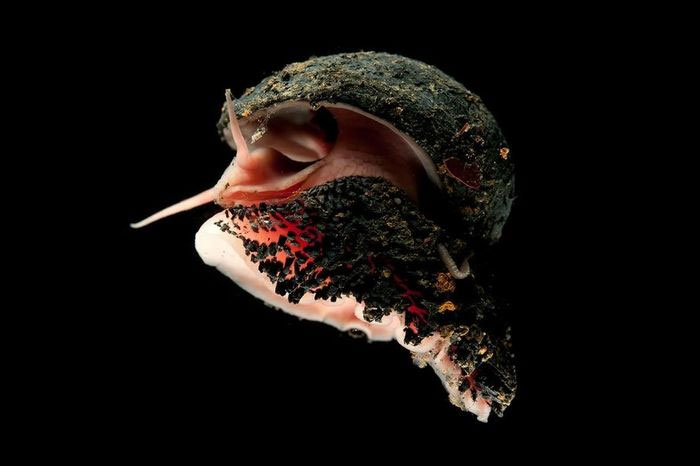
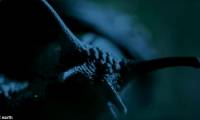
Scaly-footed snails are about the size of a garden snail, about 2cm long. They live in hydrothermal vents at depths of over 2000m, where the water pressure, temperature and acidity are high, while the oxygen content is very low.
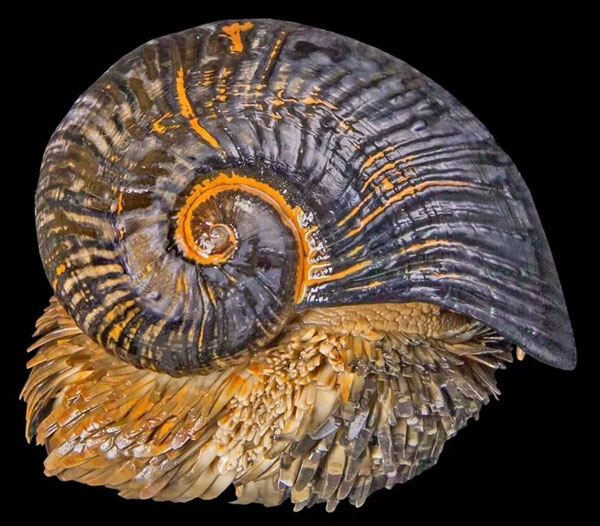
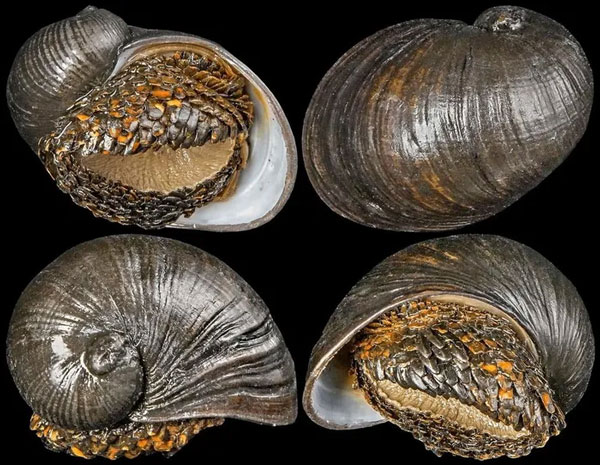
The harsh environment has led the scaly-footed snail to evolve a unique suit of armor. Its shell consists of three layers, each of which is thought to have a different protective function.
- Outer layer: Made of iron sulfide (Fe3S4) about 30 micrometers thick. This is the only animal on Earth that uses iron compounds as a protective layer.
- Middle layer: Organic horn, is the thickest and hardest layer of the three shell layers.
- Innermost layer: Aragonite - a form of calcium carbonate commonly found in the shells of many different mollusks and corals.

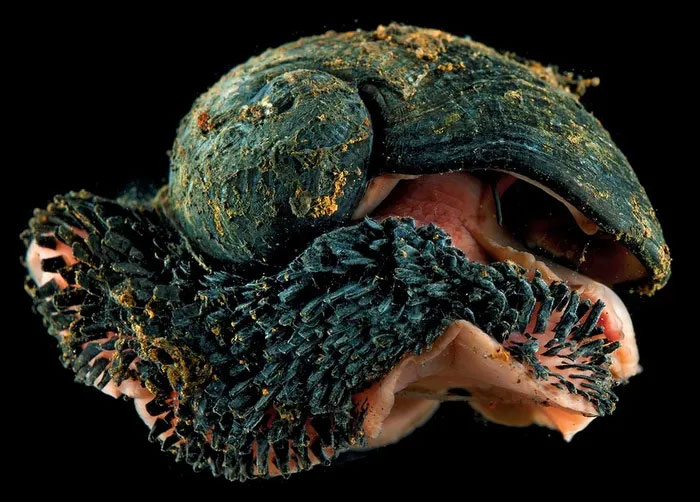
The scaly foot's sides are covered with hundreds of iron mineralized debris, including iron sulfides greigite and pyrite, which may be protective or simply toxic sulfide waste deposited by the endosymbionts.
Scaly-footed snails obtain all their nutrients from chemoautotrophs of endosymbiotic bacteria, so they are required to live in symbiosis with bacteria throughout their lives.
This strange snail species has both male and female reproductive organs, which mature at the same time.
The scaly foot snail is listed as Endangered due to habitat loss from the impacts of deep-sea mining.
Why is this scaly snail special?
Like many other species in nature, this snail's appearance, with its large, dark shell and armored feet, is a product of its environment. The hydrothermal vents are located about 2.4 km (1.5 miles) deep, and the water that pours out from them can reach temperatures of over 371°C (700°F). So the creature needed a way to survive in the harsh waters. It all came down to its armored shell.
Snails' scales are also part of their defense system, but not in the way you might think. They're not there to protect the mollusk's soft flesh from predators, but rather to protect it from itself.
Lepidoptera snails do not hunt; they make their own food from bacteria that grow inside a special pouch in their throats. These bacteria convert chemicals from hydrothermal vents into energy and provide the snail with everything it needs through a process called chemosynthesis.
That said, the bacteria produce large amounts of sulfur as a byproduct of their symbiotic relationship, which is toxic to the snails. As a result, the snails developed scales, structures that suck the sulfur out of their bodies and leave it as iron compounds on the outside.
FAQ
What should you know about scaly-footed snail?
In practical terms, what is a scaly snail? What does a scaly snail look like.
Why does scaly-footed snail matter?
The article highlights that the harsh environment has led the scaly-footed snail to evolve a unique suit of armor.
What is the main takeaway?
The main takeaway is that this is the only animal on Earth that uses iron compounds as a protective layer.
Related Articles
 Scalloped Snails: Complete Guide3 minutes read
 African Black-footed Cat: Looks Innocent but Is the 'World's Most Dangerous' Cat5 minutes read
 Doctors Discovered a Sea Snail Living in the Skin of an 11-year-old Boy5 minutes read
 The Most Exotic Snail in the World Makes the US Military Study3 minutes read
 Sea Snails 'Disguise' the Crust into an Image Like the Milky Way4 minutes read
 Shivered by the Snail 6,000 Teeth That Eat Deep in the Earth Like Monsters in the Movie3 minutes read
Reader Comments 0
Sign in with email or Google to join the discussion.