Table of Contents
Living in Africa for over a million and a half years, Paranthropus shared its habitat with Homo and may have created tools even before humans appeared.
Living in Africa for more than one and a half million years, Paranthropus shared its habitat with Homo and may have created tools even before the appearance of the hominid genus.
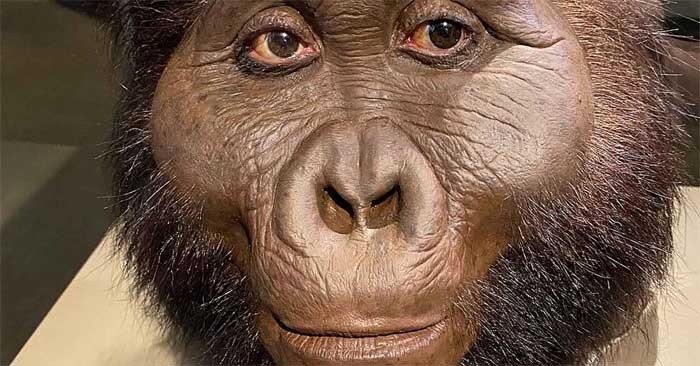


In the 1970s, archaeologists found stone tools (Oldowan technology) alongside Paranthropus fossils, both in Tanzania and South Africa. At first, this seemed like a simple coincidence. Then other discoveries began to show a direct stratigraphic link between these tools and Paranthropus. In fact: they lived in the same place at the same time, and it is uncertain whether they were the people who used (and perhaps made) the objects.
We now know that Oldowan technology predates the emergence of the genus Homo, which means that the clear distinction between 'who is creative' and 'who is not' may be just our own prejudice, not supported by data.
They lived together with other human species: a long and crowded coexistence.
Throughout its history, Paranthropus was far from alone. It shared Africa with several Australopithecus species and with early Homo: habilis, rudolfensis, ergaster, erectus. And not only that: it even lived at the same time as the first hominins to leave Africa, such as Homo georgicus.
A true 'evolutionary jungle' is made up of coexistence, competition, and perhaps even cultural mixing. There is nothing like the idea of linear evolution, from ape to man. In reality, evolution is a series of intertwining branches, some of which have become extinct, leaving only us as the last remaining representatives.
Why is the rediscovery of Paranthropus important today?
Most of us assume that intelligence is what makes humans unique. However, the story of Paranthropus forces us to reconsider that adaptability, survival, and even technological innovation are not exclusively human prerogatives.
These hominins have been around for a long time, with small brains but probably underestimated capabilities. And that says a lot about how evolution really works.
Talking about them today is not just an exercise in curiosity, but also a way to understand how complex and communal our history on this planet is. And there is still so much more to discover.
FAQ
What should you know about paranthropus?
In practical terms, living in Africa for over a million and a half years, Paranthropus shared its habitat with Homo and may have created tools even before humans appeared.
Why does paranthropus matter?
The article highlights that in the 1970s, archaeologists found stone tools (Oldowan technology) alongside Paranthropus fossils, both in Tanzania and South Africa.
What is the main takeaway?
The main takeaway is that however, the story of Paranthropus forces us to reconsider that adaptability, survival, and even technological innovation are not exclusively human prerogatives.
Related Articles
 Artificial Intelligence Discovers the Unprecedented Human Ancestors3 minutes read
 Underground Water Dominates the Migration of Human Ancestors3 minutes read
 Ni No Kuni: Cross Worlds - How to Turn Off Auto-Battle and Auto-Play4 minutes read
 Human Ancestors Caused the Extinction of Animals 4 Million Years6 minutes read
 Listed 12 Most Monstrous Practices That Our Ancestors Had Done11 minutes read
 Anime World Simulator: Full Latest Giftcode and How to Redeem Code11 minutes read
Reader Comments 0
Sign in with email or Google to join the discussion.