Table of Contents
This guide explains how to delete Objects and Objects in Photoshop, with clear steps, practical tips, and important checks before you begin.
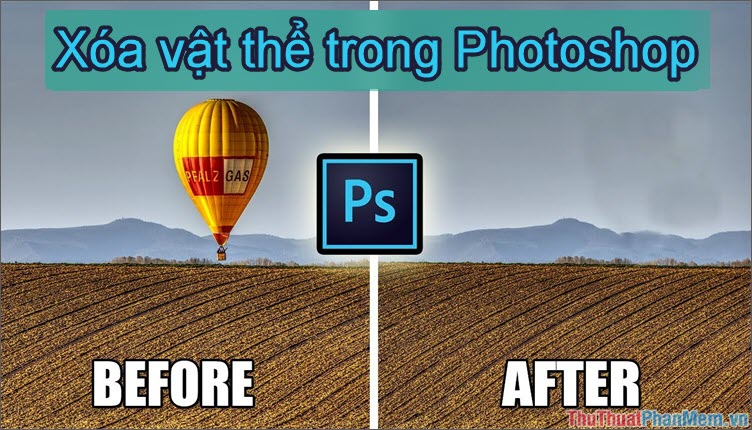
Today's article, Thuthuatphanmem. vn will guide you how to delete objects and objects in Photoshop software in the simplest way.
1. Delete objects and objects with Content - Aware Fill tool
This is a quick and effective tool to remove simple and less detailed objects from a photo. The downside of this tool is that it may not be really optimal and may create blur after deletion.
Step 1: You open the image to delete objects in Photoshop. Use the Rectangular Marquee Tool to localize the object to be deleted.
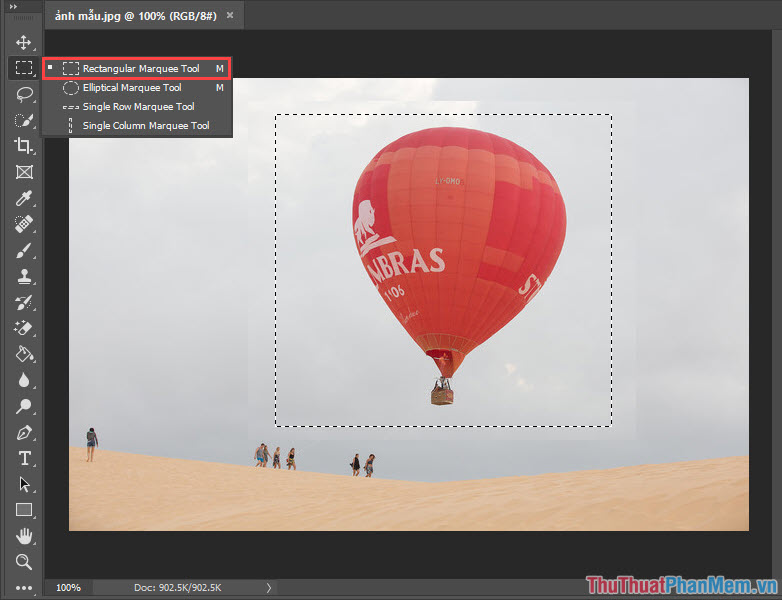
Step 2: Go to Edit, select Fill or press Shift + F5 to open Content-Aware Fill tool .

Step 3: You set the Content-Aware parameter as shown below and then click OK.

The image below is a picture after successfully erasing objects with Content-Aware Fill . If you see the image when you delete the traces still not satisfied, then you localize the error image and then use Content-Aware to correct it so that the image looks the best.

2. Use the Clone Stamp Tool
This tool is less used by difficult implementation and takes more time than Content-Aware Fill tool . However, if you combine the Content-Aware Fill with the Clone Stamp Tool , it is much better to remove the object of the image and produce the complete image with much better quality and realism.
Step 1: Open the image you need to delete the object and open the Clone Stamp Tool as shown below.

Step 2: Right-click on the screen, the Clone Stamp Tool Property window will appear. Here, we resize the selection by sliding the Size scroll bar . With the Hardness part, we will adjust the opacity of the border. The smaller the hardness is, the more blurred the edges are, suitable for editing more detailed photos.

Step 4: Hold the Alt key and right-click the original image area to select the image area to copy.

Step 5: You proceed to delete the object by holding the left mouse button and moving the area to be copied. When moving the copy area, notice that the circle (1) is the area we are copying and the plus sign (2) is the original area.
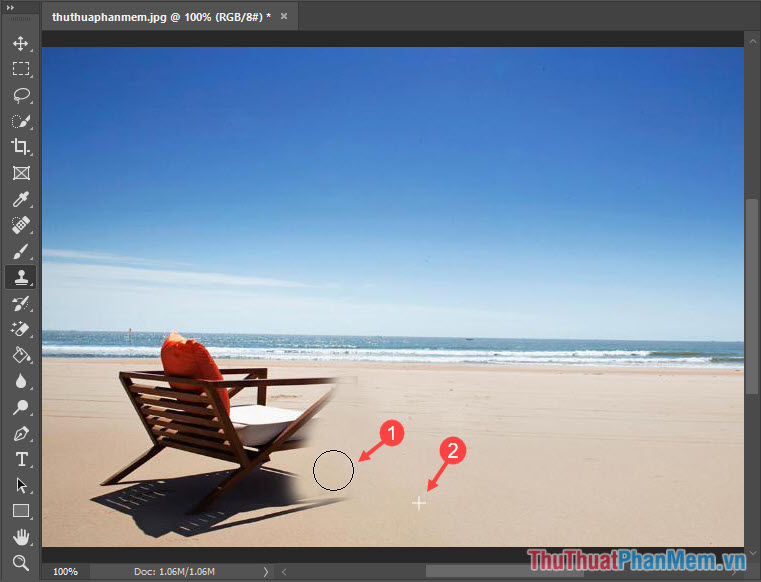
Once completed we will have the photo deleted the chair as shown below.

With two ways to delete objects and objects with Content-Aware Fill and Clone Stamp Tool . Hope readers understand how to delete objects in Photoshop. However, to remove objects effectively, you need to combine both ways, you can delete with Content-Aware Fill and use the Clone Stamp Tool to compensate for the defective images. Thank you for following this article, if the article has some unknown parts, please comment in the comment section below!
FAQ
What should I know about Delete Objects and Objects in Photoshop?
Focus on the key features, requirements, limitations, and practical use cases explained in this guide.
How do I get the best results with Delete Objects and Objects in Photoshop?
Follow the recommended steps, use current software or information, confirm compatibility, and review settings before major changes.
Are there any risks or limitations?
Potential limitations depend on compatibility, data quality, cost, privacy, support, and how the product or method is used.
Related Articles
 How to Use Photoshop CS5 - Part 16: Delete Any Object from the Image6 minutes read
 Steps to Delete Selections in Photoshop Are Very Easy and6 minutes read
 How to Deleting Multiple Objects Using the Image Overlay Method2 minutes read
 Remove Objects in Photos with Photoshop's New AI-Powered Remove Tool5 minutes read
 How to Use Photoshop CS5 - Part 9: Delete Complex Backgrounds in6 minutes read
 How to Delete Any Details in the Image with GIMP7 minutes read
Reader Comments 0
Sign in with email or Google to join the discussion.