Table of Contents
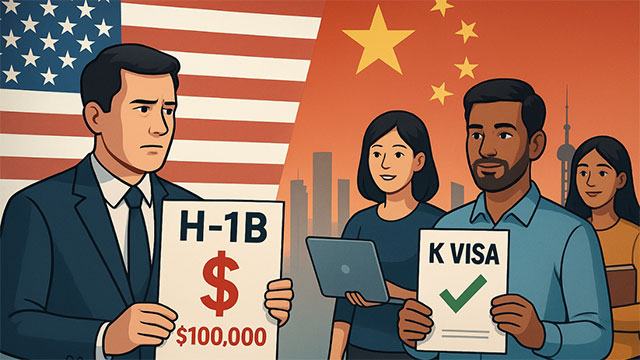
China launches K visa, competing with US H-1B, to attract young global tech talent amid economic and political tensions.
For years, US technology companies have relied on the H-1B visa Program to attract top young talent from around the world. This is considered one of the relatively accessible paths for international engineers and technology experts to work in the US.
That said, applying for an H-1B has become increasingly difficult and expensive, especially after former President Donald Trump signed an executive order raising the application fee to $100,000. This move has caused many young talents to consider seeking opportunities in other countries.
According to Reuters, China recently introduced a new program called The K visa , aimed at attracting international technology workers in the context of escalating economic and political tensions with the US.
What is different about the K Visa?
Unlike the US H-1B, the K visa does not require a sponsor or a job offer. Instead, applicants – especially young graduates in STEM (science, technology, engineering and mathematics) fields – can directly enter, live and start working for technology companies in China.
This move shows that Beijing not only wants to maintain its role as a 'factory' for US technology corporations, but is also determined to improve its position by directly competing in recruiting global brainpower.
Despite its openness, China's K visa program still faces many barriers:
- Language and cultural barriers : Chinese remains a major challenge for international workers.
- Unclear review criteria : the specific conditions for being granted a K visa have not yet been announced in detail.
- Restrictions on permanent residence : the path to citizenship or permanent residence in China remains very limited.
- Incentives are not transparent : policies for financial support, accommodation, or employment services are not clearly defined.
Not only China, many countries such as Germany, New Zealand and South Korea are also loosening visa requirements to 'open the door' to international talent, especially in the high-tech field. This is considered a global competition to attract young and creative minds.
The big question is whether the US government will consider adjusting the huge H-1B fee or not. Because if not, Washington may face the risk of losing a part of the young talent - the force that is considered the 'fuel' for the development of Silicon Valley.
FAQ
What is new about china launches K visa to attract young global tech talent?
In practical terms, china launches K visa, competing with US H-1B, to attract young global tech talent amid economic and political tensions.
Why does this update matter?
The article highlights that not only China, many countries such as Germany, New Zealand and South Korea are also loosening visa requirements to 'open the door' to international talent, especially in the high-tech field.
Is the change available to everyone?
Availability may depend on the product version, region, account, or rollout stage described in the article.
Related Articles
 China Launches First 6nm GPU for Gaming & AI: Performance Surpasses4 minutes read
 Visa Launches Cryptocurrency Advisory Service3 minutes read
 What Is Visa Exemption: What Is Visa-free?6 minutes read
 Driver Talent - Free Driver Updater: Driver Talent Pro6 minutes read
 New Trend of Global Technology Supply Chain: 'Not Made in5 minutes read
 How to Use Driver Talent for Free Driver Updates7 minutes read
Reader Comments 0
Sign in with email or Google to join the discussion.