Table of Contents
Explore car lidar systems can permanently damage smartphone cameras.
Smartphone CMOS sensors are particularly sensitive to high-intensity infrared radiation
A short video posted by @Rainmaker1973 on social media shows a Volvo EX90 with a LiDAR array mounted on its roof. With this setup, the car almost has a complete ADAS (Advanced Driver-Assistance System) system, supporting features such as automatic emergency braking, collision avoidance, adaptive cruise control, and accurately identifying pedestrians, cyclists, road obstacles, and other hazards.
But as the video illustrates, this system is also powerful enough to "burn" the phone's camera. The preview screen of the recording device begins to show pinkish-purple specks of noise, resembling stars, accompanied by streaks extending towards the LiDAR cluster. LiDAR systems in vehicles typically use 1,550nm infrared lasers, and if the smartphone camera is exposed long enough, this can lead to permanent dead pixels on the sensor.
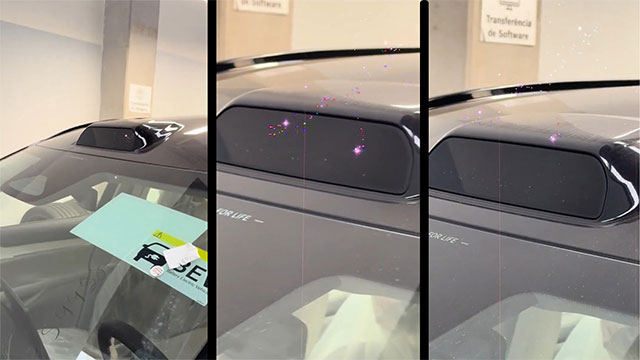
Besides generating heat, CMOS sensors in phones are also extremely sensitive to high-powered IR radiation. This hardware is not designed to absorb a focused beam, which is created to reflect from objects at distances of up to hundreds of meters. Therefore, when exposed directly to this light, the sensor is highly susceptible to irreparable damage.
If you're worried about whether the LiDAR on the Volvo EX90 could harm your eyes, the good news is there's no need to be overly concerned. These systems are certified as Class 1 lasers, meaning they are safe under normal usage conditions. The 1,550nm wavelength is blocked before it can affect the human retina.
However, as mentioned above, cameras aren't so 'lucky'. Therefore, unless you have a 'backup' phone that isn't crucial for testing, it's best never to point your smartphone camera directly at your car's LiDAR system, to avoid the risk of unnecessarily losing the camera.
Final Thoughts
Understanding car lidar systems can permanently damage smartphone cameras makes it easier to evaluate the information and apply the most relevant recommendations. Focus on the key points above and verify details that may change over time.
FAQ
What is car lidar systems can permanently damage smartphone cameras?
Explore car lidar systems can permanently damage smartphone cameras.
What key points does this article cover?
The article focuses on Smartphone CMOS sensors are particularly sensitive to high-intensity infrared radiation, with practical explanations and examples.
How can you use this information in practice?
Use the explanations to compare options, verify important details, and make a more informed decision. Apply the recommendations that best match your goals and situation.
Related Articles
 What Is LiDAR Sensor? What Effect Is LiDAR on iPhone 12 Pro, iPhone 12 Pro4 minutes read
 Lidar and Tof Sensors: What's the Difference?6 minutes read
 Smartphone with 9 Cameras Coming Soon3 minutes read
 Why When the Whole Smartphone Village Is Racing Zooming7 minutes read
 Smartphone Cameras Will Gradually Replace DSLR Cameras Completely9 minutes read
 iPad Pro 2020 Has a Second 'Abdominal' Operation, Revealing4 minutes read
Reader Comments 0
Sign in with email or Google to join the discussion.