Table of Contents
This guide provides a clear, practical overview of "Oxford Scientists Create Light from 'darkness'". It organizes the most useful details, explains important considerations, and highlights the steps or choices that matter most.
Using a highly advanced version of the OSIRIS (Outdoor Scene and InfraRed Image Simulation) simulation software, the team recreated a phenomenon called vacuum four-wave mixing. In this process, electromagnetic fields from three powerful laser pulses polarize virtual particles in the vacuum, causing photons to bounce off each other—resulting in a fourth laser beam.
Professor Peter Norreys from Oxford's Department of Physics said: ' This is not just an academic curiosity – but a major step towards experimental confirmation of quantum effects that have until now remained largely theoretical '.
The research comes amid a growing trend toward global deployment of multi-Petawatt laser systems that can generate extremely strong electromagnetic fields. Facilities such as Vulcan 20-20 in the UK, ELI in Europe, SHINE and SEL in China, along with the OPAL (optical parametric amplifier line) dual-beam laser in the US, are expected to reach the power levels needed to observe these rare quantum effects in practical experiments.
To make the simulations more accurate, the team used a semi-classical numerical solver based on the Heisenberg-Euler Lagrangian. This approach allowed them to model the two main quantum vacuum effects and check their results against known predictions of vacuum birefringence — a phenomenon in which light splits or shifts when passing through a strong electromagnetic field.
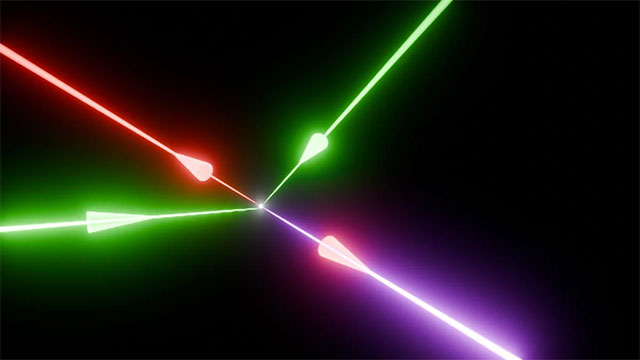
They tested both plane-wave and Gaussian laser pulses, and found that their outputs agreed well with existing theories. For the four-wave mixing case, they used three Gaussian beams and were able to track the formation of the fourth beam over time. The simulations also showed some astigmatism—where the output beams weren't perfectly shaped—and gave clear measurements of how long the interaction lasted and the size of the affected area.
'Our computer program provides a time-resolved 3D window into quantum vacuum interactions that were previously out of reach,' said team member Dr Zixin Zhang. ' By applying the model to a triple-beam scattering experiment, we were able to capture the entire range of quantum signatures, along with detailed insights into the interaction region and key time scales .'
The team compared their results with simpler models and past data to make sure everything checked out. These tools are expected to help scientists design real-world experiments, with greater control over the timing, shape, and direction of the lasers.
Professor Luis Silva, co-author from the Instituto Superior Técnico and a Visiting Professor at Oxford, said: ' A series of planned experiments at state-of-the-art laser facilities will be greatly facilitated by the new computational approach we have deployed in OSIRIS. The combination of ultra-high intensity lasers, state-of-the-art detection technology, and groundbreaking analytical and numerical modelling is the basis for a new era in laser-matter interactions, which will open up new horizons for fundamental physics '.
The simulation tool could also aid in the search for new particles, such as axions and millicharged particles, which are considered potential candidates for dark matter.
FAQ
What does this guide cover?
This guide explains oxford scientists create light from 'darkness', including the main steps, important details, and practical considerations.
Who is this guide for?
It is designed for readers who want a clear, practical overview and a reliable process they can follow without unnecessary complexity.
What should you check before getting started?
Review the requirements, confirm that your software or device is up to date, and save any important data before changing settings.
Related Articles
 When You Turn Off the Light in the Room, Where Did the Light Go6 minutes read
 Invitation to Receive Extreme FPS Games or the Darkness II for $ 29. 994 minutes read
 Watch an Epic Video of Hurricanes Filmed 30,000 Miles over 33 minutes read
 Free Darkness Rises 'Super Food', Free Vietnamese Language Pack3 minutes read
 Am Ha Truyen: Impressive Fairy Tale of the Most Beautiful Ancient Chinese7 minutes read
 The World's Most Durable Battery Still Works After 180 Years3 minutes read
Reader Comments 0
Sign in with email or Google to join the discussion.