Table of Contents
Explore is giving birth more painful than being kicked in the groin.
However, is it true that giving birth to a boy or getting kicked in the groin hurts more? Let's find the answer from a scientific perspective!
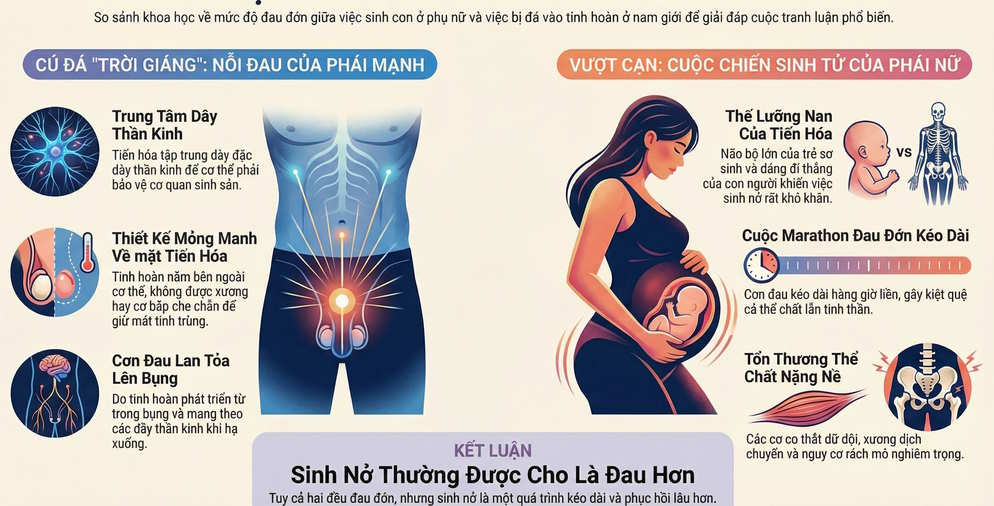
Being kicked in the groin: Evidence of evolutionary, excruciating pain
It may not have happened to you, but you've probably seen, or at least heard, that a blow to the testicles—or more precisely, the testicles—doesn't just make it hard to breathe.
" Being kicked in the testicles can cause excruciating abdominal pain. It can make you feel nauseous, even vomit. And if you're kicked hard enough, you might need to be hospitalized ," WebMD reports.
And it's not just the pain of being kicked in the testicles that hurts between the legs; the pain can radiate all the way up to the abdomen. That's because the testicles initially develop in the abdominal region before descending into the scrotum just before or after birth – and they carry a host of nerves and tissues with them as they move.
But why does such a small area cause so much pain? The answer is two-part, but essentially: testicles are designed almost perfectly to inflict as much pain as possible on their owners.
First of all, there's a simple fact: the testicles are part of the reproductive system. They are used for sex and reproduction, in other words – and that's why evolution has placed so many nerve endings in them.
"At the most basic level, you feel pain because of receptors and nerves ," Nathan Starke, a urologist and director of the Andrology Clinic at Houston Methodist Hospital, told Inverse. " And the reason, from an evolutionary standpoint, why it hurts so much when you get hit in the testicles is because they are key to sperm production ."
Simply put, the body has to generate pain , because otherwise you wouldn't need to defend them from stray soccer balls or angry ex-lovers. And you really do have to defend them, because this is the most important thing: the testicles are inherently quite weak at self-defense.
It's hard to imagine why the ovaries didn't descend during embryonic development and instead appeared outside the female body cavity in a thin, unprotected sac. Due to their vulnerability to damage, adverse effects, and temperature changes, ovaries located outside the body cavity would be a serious disadvantage for fertility.
The same reasoning applies to the testicles. However, for various reasons – primarily revolving around the need to keep sperm cool until fertilization – the testicles remain suspended outside the body, defying fate.
If we look at other species in nature, it might not necessarily be the case – for example, elephants keep their testicles inside their bodies, next to their kidneys. But in humans, we not only decided to keep them external, but also progressed to bipedal locomotion, thus making their position even more precarious.
In short, humans have a very sensitive organ, located within a thin membrane on the outside of the body, and " protected " by a flexible tube and a few pairs of tight-fitting underwear. Evolution has certainly been unfair to men, hasn't it?
Childbirth: A real life-or-death battle for women
It's absurd to try to explain why childbirth is painful. It's a process designed to take one human being out of another, through a tube that's essentially just over 3 cm wide, and historically, it has claimed the lives of about 1 in 25 women worldwide.
But strangely, not all species endure this. On average, humans take nine hours to give birth for the first time – longer than a workday, and about 30 times longer than, for example, a horse. Even compared to our closest relatives in the animal kingdom – the great apes – human childbirth is still considerably more painful and complicated; humans are the only animals that require assistance to give birth. Despite all modern technology and sanitary conditions, maternal and infant mortality rates during childbirth remain far higher than those of their wild counterparts.
" In terms of mother weight and body size, we have the longest gestation periods of any primate, we have the largest offspring, and the largest brains ," Holly Dunsworth, an anthropologist at the University of Rhode Island, told Discover magazine.
Why? While scientists debate the exact weighting for each factor, it generally depends on two elements: the large human brain and upright posture. It's known as the 'obstetric dilemma ' – the evolutionary tug-of-war between the ability to walk and run well, and intelligence.
This hypothesis isn't widely accepted – that human hips could be much wider than they are now without affecting mobility. But the problem is, that's not actually the case.
What are the results? Hours of agonizing labor and delivery, during which a woman's muscles will contract uncontrollably, her cervix and vagina will be stretched to the point of almost breaking, her bones will be pushed out to make room for the moving baby, and there's a real possibility that a woman will have a tear running from her vagina all the way to her anus.
Some women experience uterine contractions so severe that they double over in pain. You may feel tightness and cramping, along with back pain… This could be due to the baby's position, or sometimes it's simply how the woman in labor perceives the pain.
This leads to another important aspect of the experience: the psychological one. Sure, being kicked in the groin isn't pleasant, but it doesn't last for hours or even days, doesn't get worse over time, doesn't exhaust the body and mind, or, to put it bluntly, doesn't torment you for the nine months leading up to it. Nearly two-thirds of women report experiencing a fear of childbirth – it's so common it has its own name: tokophobia – and there's good reason for that, as approximately 33 out of 100,000 people will die during the process.
Even after giving birth, the pain isn't over. Even if you didn't experience vaginal tearing and stitches in one of the most sensitive areas of your body, it's still recovering from a difficult labor, and soreness is understandable. Meanwhile, contractions continue, for some reason to prevent you from dying from excessive blood loss and to allow the uterus to return to its normal size, not to have increased in volume 500 times, but that doesn't mean they aren't uncomfortable.

So, is childbirth or being kicked in the groin more painful? The answer probably depends on each person's pain tolerance. However, many people now believe that childbirth is more painful because it's a longer process and recovery time compared to being kicked in the groin.
Final Thoughts
Understanding is giving birth more painful than being kicked in the groin makes it easier to evaluate the information and apply the most relevant recommendations. Focus on the key points above and verify details that may change over time.
FAQ
What is is giving birth more painful than being kicked in the groin?
Explore is giving birth more painful than being kicked in the groin.
What key points does this article cover?
The article focuses on Being kicked in the groin: Evidence of evolutionary, excruciating pain, Childbirth: A real life-or-death battle for women, with practical explanations and examples.
How can you use this information in practice?
Use the explanations to compare options, verify important details, and make a more informed decision. Apply the recommendations that best match your goals and situation.
Related Articles
 The Advantages and Risks You May Face of Having Children in Your 20s and 30s8 minutes read
 Strange: the Woman 'Gave Birth in the Coffin' After Being Buried3 minutes read
 How Venomous Snakes Give Birth: A Close-Up Look4 minutes read
 HTC Also 'Kicked' iPhone 6: New Products from Apple3 minutes read
 South American Monsters - Spawn Anaconda or Spawn?3 minutes read
 Instructions for Registering Birth Certificates Online6 minutes read
Reader Comments 0
Sign in with email or Google to join the discussion.