Table of Contents
Space resources are a priceless treasure. And humanity is now increasingly accessing them with the aim of opening a new era.
Space resources are a priceless treasure. And humanity is now increasingly accessing them with the aim of opening a new era.
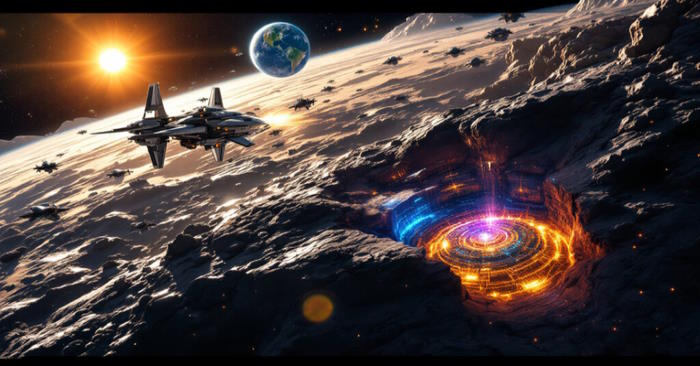
What is asteroid mining and why is it important?
Asteroid Mining Is the extraction of valuable resources from celestial bodies orbiting Earth. These space rocks contain concentrated deposits of metals and minerals, which are increasingly scarce and expensive to mine on our planet. In particular, asteroids contain platinum-group metals at concentrations of 5-15 parts per million – significantly higher than the Earth's crust, which contains just 0.0005 parts per million of platinum.
These platinum-group metals are more than just valuable commodities; they are essential components in renewable energy and fuel cell technologies that power our sustainable future. As accessible deposits on Earth are depleted, the environmental and social costs of land-based mining continue to rise, creating geopolitical tensions around resource-rich regions such as the Democratic Republic of Congo (cobalt) and Chile (lithium).
Asteroid mining Offers a potential solution to these challenges by tapping into the vast resources of the solar system without further depleting our planet. The environmental benefits of this are significant: mining 1kg of platinum from an asteroid generates around 150kg of CO2, compared to a whopping 40,000kg of CO2 for the same amount through activities on Earth.
As astrophysicist Neil deGrasse Tyson once predicted: ' The first trillionaire will come from asteroid mining. ' This is not mere speculation – it reflects the extraordinary potential value hidden in these space resources, which could revolutionize our approach to manufacturing, energy production, and space exploration.
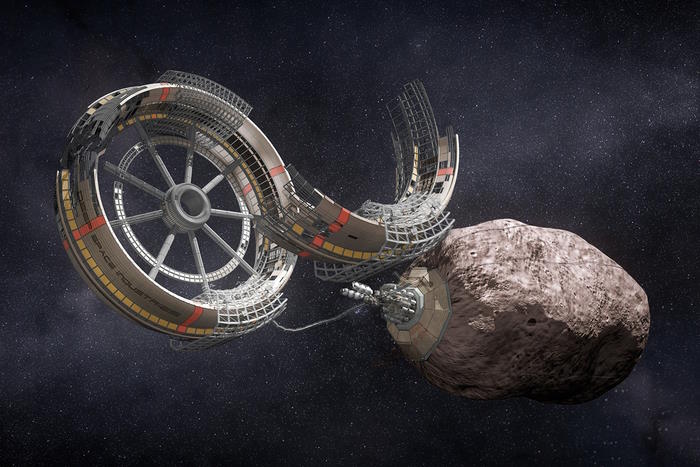
Current asteroid mining capabilities
While the BBC's Tomorrow's World predicted that humans would be mining asteroids by 2025, the reality is that we're making progress but still not at the point where commercial mining is possible. February 2025 marked a major milestone when California-based AstroForge launched its $6.5 million Odin spacecraft on a SpaceX Falcon 9 rocket - specifically designed to test asteroid mining technologies.
The Odin mission is targeting asteroid 2022 OB5, about 8 million kilometers from Earth. Although the spacecraft has had difficulty communicating, AstroForge sees this as a valuable learning opportunity, not a hindrance. As AstroForge founder Matt Gialich has stated: ' We're going to start actually doing it. You have to try. '
Investor Victor Vescovo, who has backed a number of space projects, stressed the importance of progressing step by step: " Bring back a few micrograms to prove that it can be done. scaling up will be easy after proof of concept ." This approach builds on successful sample collection missions by space agencies, including Japan's Hayabusa 1 and 2 and NASA's Osiris-Rex, which demonstrated that collecting material from asteroids is technically feasible.
That said, experts like Ian Lange of the Colorado School of Mines believe that full-fledged commercial asteroid mining operations are still about 30 years away. The focus now is on developing and demonstrating the technology that will eventually enable industrial-scale resource extraction in space.

Technological advances are making asteroid mining possible
Recent technological breakthroughs have dramatically accelerated the pace of asteroid mining. Chief among them is the revolution in launch costs – from around $10,000 (£7,850) per pound to orbit just 15 years ago to hundreds of dollars per pound with SpaceX's Starship. This 90% reduction makes previously uneconomical space projects suddenly feasible.
Improved asteroid detection and characterization is another important step forward. The Vera C. Rubin Observatory in Chile, soon to be operational, will significantly improve the ability to monitor near-Earth asteroids and identify potential mining candidates. Modern spectroscopy can now determine asteroid composition from Earth-based observations, allowing companies to target resource-rich bodies without the need for costly reconnaissance missions.
The miniaturization of electronics and the availability of off-the-shelf spacecraft components have dramatically reduced development costs. Companies can now build operational spacecraft without the huge budgets previously reserved for space missions. These standardized components undergo rigorous testing in the space environment, thereby reducing technical risk.
Advances in computing technology allow for precise orbit calculations and automated guidance systems, which are essential for reaching asteroids millions of miles from Earth. Machine learning algorithms can process spectral data to identify the most valuable asteroids based on mineral composition, size and orbital accessibility.
The iterative approach of modern space companies – starting small and scaling up through successive missions – represents a paradigm shift from traditional ' Go big or go home ' space projects. It also helps to minimize financial risk.
FAQ
What should you know about asteroid mining?
In practical terms, space resources are a priceless treasure. And humanity is now increasingly accessing them with the aim of opening a new era.
Why does asteroid mining matter?
The article highlights that asteroid mining is the extraction of valuable resources from celestial bodies orbiting Earth.
What is the main takeaway?
The main takeaway is that asteroid mining offers a potential solution to these challenges by tapping into the vast resources of the solar system without further depleting our planet.
Related Articles
 Interesting Discoveries About Asteroids in the Solar System4 minutes read
 What Is Data Mining? Data Mining Is It Legal?7 minutes read
 Leading the Trend, Asus Officially Launched a Pair of Video4 minutes read
 The Asteroid Is Similar in Size to the Pyramids of Giza, and Is3 minutes read
 NASA DART Mission Results: Asteroid Deflection Explained5 minutes read
 Spacecraft Crashes into Asteroid5 minutes read
Reader Comments 0
Sign in with email or Google to join the discussion.