Table of Contents
This updated guide explores arcturus - the brightest star in the northern sky with practical details, clear explanations, and useful takeaways. Arcturus is a red giant star, just 36.7 light years away. It is the fourth brightest star in the sky and the brightest star in the northern half of the sky.
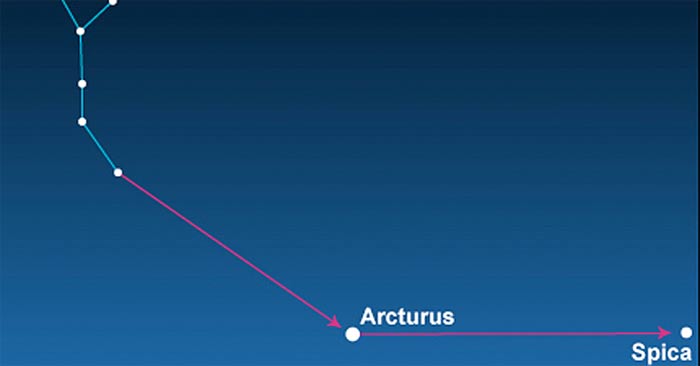
Arcturus is the alpha star of a cone-shaped constellation called Boötes the Herdsman. It is located far enough north in the sky that – for observers in the Northern Hemisphere – it can be seen at some point during the night almost every day of the year. There is an easy way to identify this bright orange star. Just remember the phrase follow the arc to Arcturus and then quickly to Spica.
First, locate the Big Dipper in the northern sky. Notice that the Big Dipper's arm is a curved line or arc. Extend this curve past the end of the Big Dipper's arm, and you will reach Arcturus.
Arcturus Is a Bright Lone Star.
You can see the bright orange star Arcturus fly by on late spring evenings. In the summer, it is in the sky just after dark. Skywatchers in the fall will need to look earlier because it sets in the middle of the evening. In the winter, the best time to observe Arcturus is in the early morning hours before dawn.
Unlike most bright stars in the night sky, Arcturus has no bright neighbors. It dominates the sky in the spring and remains there until the Summer Triangle takes over the eastern sky.
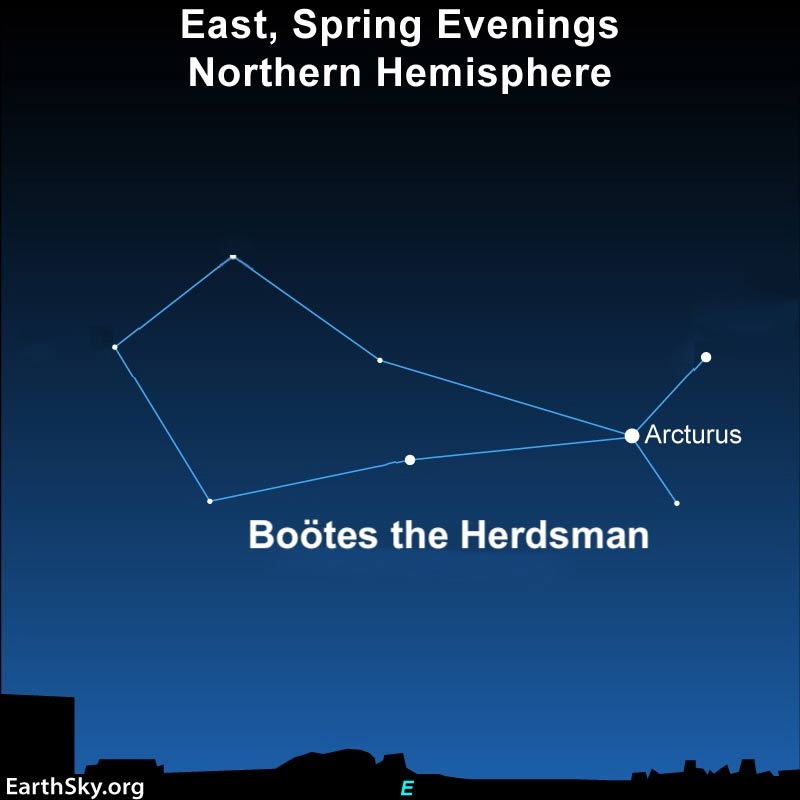
The chart below shows the constellation Boötes as you stand facing east on a spring evening. Seeing a Herdsman in these stars can be difficult, but you can visualize it as a kite.
Arcturus Is the Brightest Star North of the Celestial Equator.
What does this mean? Imagine the Earth's equator projected onto the sky. This line above the Earth's equator is the celestial equator. It divides the sky into the northern and southern hemispheres, just like the Earth's equator. The three brightest stars in the sky—Sirius, Canopus, and Alpha Centauri—lie south of the celestial equator.
Meanwhile, Arcturus is the brightest star in the northern sky. It is only slightly brighter than the second brightest star in the Northern Hemisphere, Vega. Some people believe that Polaris, the North Star, is the brightest star in the sky because of its popularity. But it is quite dim, ranking only 50th.
Visible During the Day
In 1635, less than three decades after the invention of the telescope, Jean-Baptiste Morin of France observed Arcturus in the daytime with a telescope. This was the first time that, aside from the sun and a rare supernova, any star had been visible with a telescope in the daytime.
History and Mythology of Arcturus
The constellation Boötes the Herdsman of Arcturus is sometimes depicted guarding the Great Bear, or Ursa Major, which contains the constellation Big Dipper.
In China, the constellation Arcturus is known as the Dragon. In some classical Greek stories, Boötes is Icarus, who flew too close to the sun. Flying directly over the Hawaiian Islands, this is a particularly important navigational star for the native inhabitants of the islands and other Polynesians.
Arcturus Is Large and Old.
Arcturus may be significantly older than our Sun. When the Sun evolves into a red giant, it will be a star similar to Arcturus today.
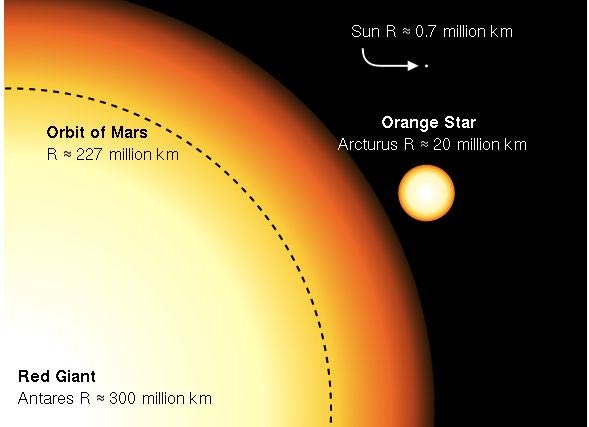
Arcturus is about 25 times larger in diameter than our Sun. Because of its larger size, it emits light that is 100 times brighter than the Sun. If you consider infrared and other frequencies in the electromagnetic spectrum, Arcturus is about 200 times brighter than the Sun. Its mass is slightly larger than the Sun.
Arcturus' red or orange color indicates its temperature, about 7,300 degrees Fahrenheit (4,000 degrees Celsius). That makes it several thousand degrees cooler than the surface of the Sun.
From Earth's perspective, Arcturus is moving rapidly southward at a rate of 3.9 arc minutes per century. It is currently at its closest point to Earth. As it moves away, it will disappear from view when it reaches the Carina-Vela boundary in about 150,000 years.
Arcturus' current position is RA: 14h 15m 39.7s, dec: +19° 10′ 56″
FAQ
What is the main takeaway about Arcturus - the Brightest Star in the Northern Sky?
The key is to understand the core idea, compare the available options, and apply the practical guidance that matches your situation.
What should beginners know about Arcturus - the Brightest Star in the Northern Sky?
Start with the essential steps and terminology. Avoid changing advanced settings until you understand how they affect performance, privacy, cost, or compatibility.
How can I use this information in practice?
Follow the relevant section in order, test one change at a time, and confirm the result before moving to the next step or recommendation.
Related Articles
 10 Brightest Stars in the Sky4 minutes read
 Which Star Lives the Longest, Brightest, Biggest,. in the Universe6 minutes read
 One of the Brightest Stars in the Sky Is About to Explode4 minutes read
 The Brightest Man-made Star in the Night Is About to Enter3 minutes read
 Does the North Star Ever Move Across the Sky?6 minutes read
 Break into the $7 Million Mansion of Jake Paul, the Brightest Star of YouTube Channel5 minutes read
Reader Comments 0
Sign in with email or Google to join the discussion.