Table of Contents
This updated guide explores astronomers capture the sun's striking face in detail with practical details, clear explanations, and useful takeaways. The Sun – the source of life on Earth – can be downright terrifying. The first image taken with the newly installed Visible Tunable Filter (VTF) system at the Daniel K.
VTF's breakthrough technology VTF is an imaging spectro-polarimeter that takes images of the Sun at specific wavelengths. Unlike conventional cameras (which record multiple wavelengths at once), VTF precisely adjusts each wavelength to within a billionth of a meter, then combines hundreds of images taken in seconds to create a 3D image of the Sun's surface.
This image is the result of the VTF's testing process - before it officially goes into operation in 2025. Dr. Stacey Sueoka from the US National Solar Observatory (NSO), a member of the research team, shared:
When I saw the first spectral steps, I was thrilled. This is something no other instrument on this telescope has been able to do. This achievement was the result of months of optical alignment, testing, and teamwork. Even with just one etalon filter installed, the potential of the VTF was already clear. This is just the beginning!
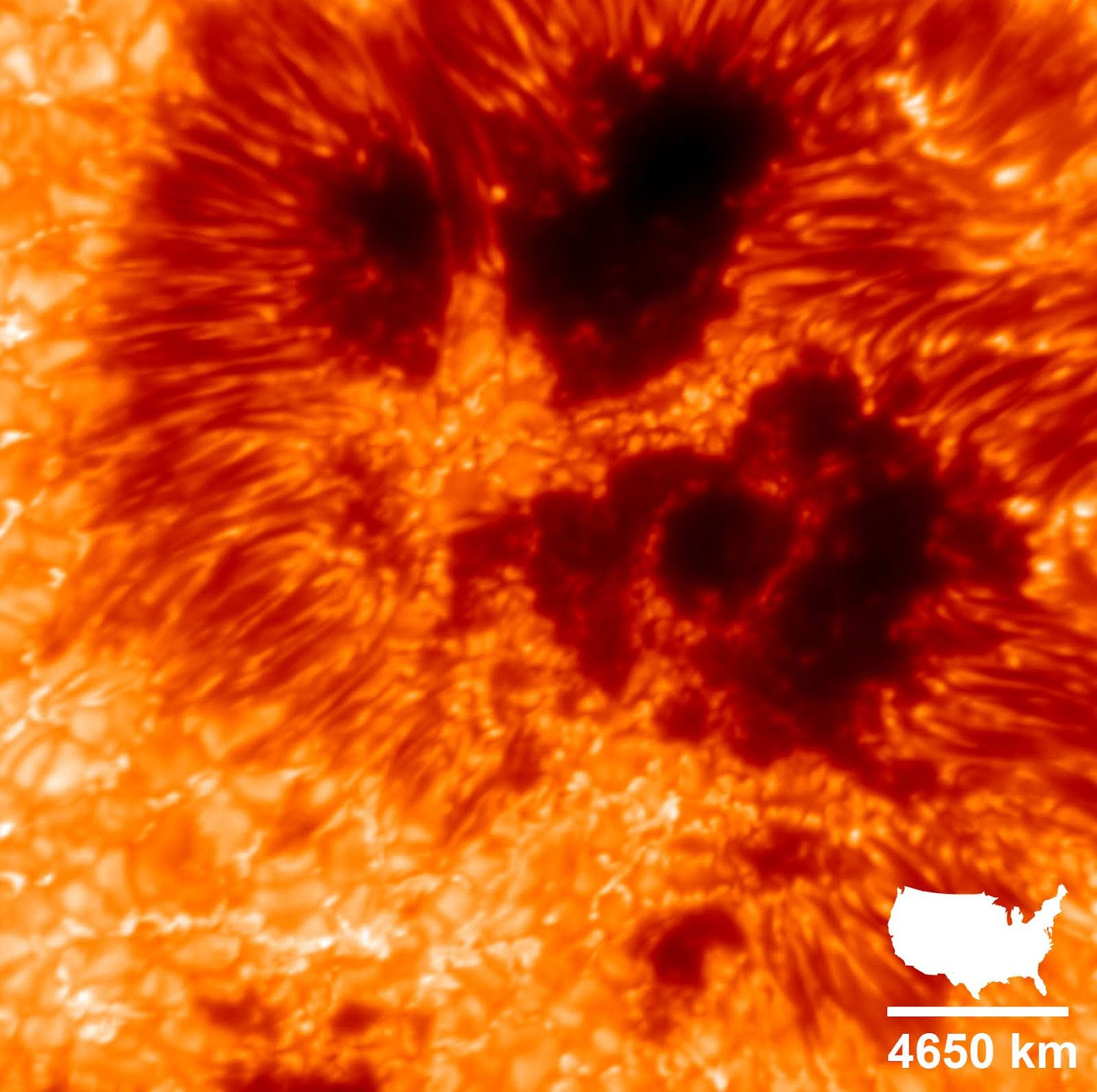
Featured in the image is a cluster of annotated sunspots roughly the size of the United States. These sunspots are associated with solar activity, often resulting in solar flares or coronal mass ejections (CMEs) – powerful bursts of plasma that can directly impact Earth.
When plasma from the Sun interacts with Earth's atmosphere (a phenomenon called "space weather"), it creates brilliant auroras but also causes radio interference, damaging satellites and power grids.
Instruments like the VTF help scientists gain a deeper understanding of solar activity and the mechanisms that cause space weather, thereby improving the ability to predict events that could threaten global technological infrastructure.
The image is not only a technical achievement, but also opens a new chapter in the quest to decipher the mysteries of our nearest star.
FAQ
What is the main takeaway about Astronomers Capture the Sun's Striking Face in Detail?
The key is to understand the core idea, compare the available options, and apply the practical guidance that matches your situation.
What should beginners know about Astronomers Capture the Sun's Striking Face in Detail?
Start with the essential steps and terminology. Avoid changing advanced settings until you understand how they affect performance, privacy, cost, or compatibility.
How can I use this information in practice?
Follow the relevant section in order, test one change at a time, and confirm the result before moving to the next step or recommendation.
Related Articles
 Discover the Most Modern Observatory in the North3 minutes read
 Admire the Rare Moment Venus and Jupiter 'Meet' Each Other in the Sky4 minutes read
 NASA Is Set to Launch Three Rockets to Penetrate the Total Solar Eclipse on5 minutes read
 Admire the Rare and Beautiful 'Astronomical Ring' of the Universe5 minutes read
 Admire the Beautiful Super Moon Image in the Sky of Vietnam and the World5 minutes read
 Close-up of the Faces of 12 Species of Ants in the World3 minutes read
Reader Comments 0
Sign in with email or Google to join the discussion.