Table of Contents
This guide provides a practical overview of Summary of Data in Groups, including its main features, benefits, limitations, and important considerations.

With a large amount of data, statistical data is very complicated. Here, Excel 2013 supports the Subtotal feature, which helps you aggregate data by group, thereby producing a more detailed, complete and accurate report:
Step 1: Click the mouse at any cell in the data range you want to aggregate -> Data -> Outline -> Subtotal:
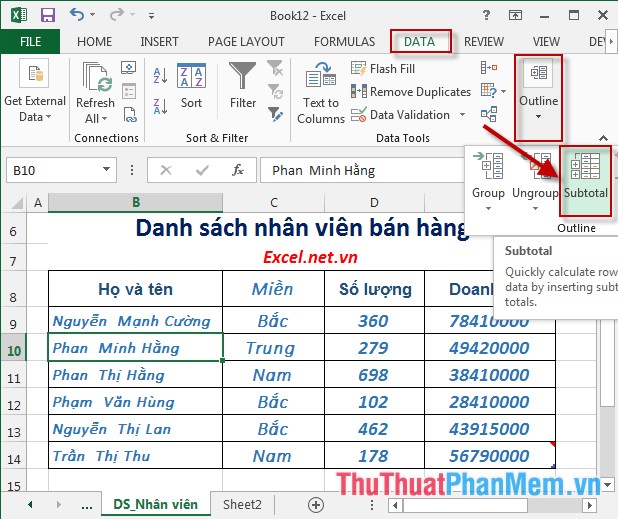
Step 2: The Subtotal dialog box appears as follows:
- Item Add each change in: Select the field to be grouped, for example, here select the group by domain.
- Use Function: Select the function to use for summarizing, for example, use the function to calculate the average value Average -> calculate the average value of the number and revenue of employees.
- Add subtotal to section: Select the data field to sum, here calculate the average value of the number and revenue to be checked in columns D and E:

Step 3: After clicking OK, the result is as shown in the picture:

- You can customize the data more visually:
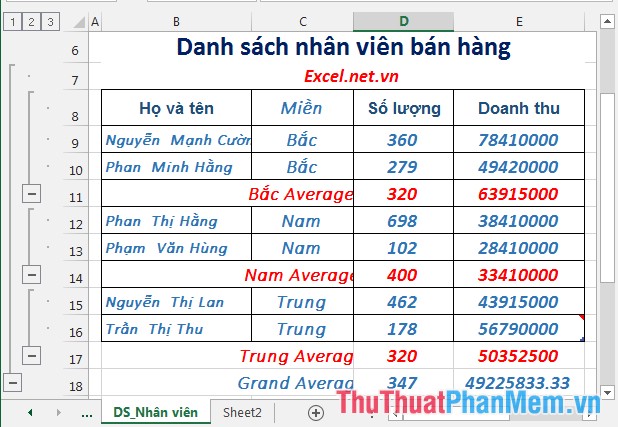
- The data is aggregated by region, ending 3 regions as the aggregate value for the North, Central and South.
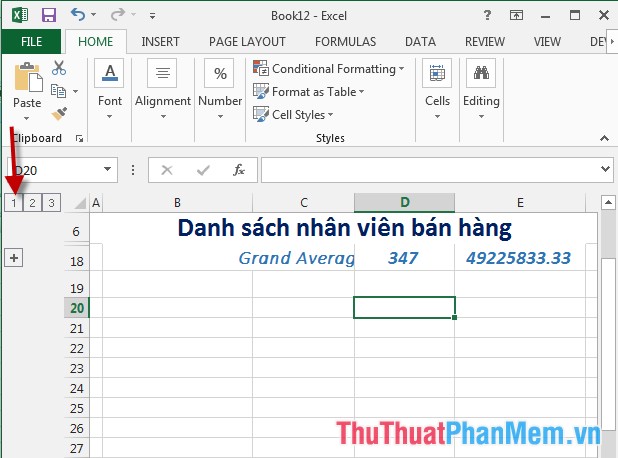
- Excel supports Subtotal 's minimized toolbar in the upper left corner of the screen. With a large volume of data, click No. 1 -> Show the average of the total data of all groups:
- Click the number 2 -> to display aggregated values for each group and the combined total value for all groups:
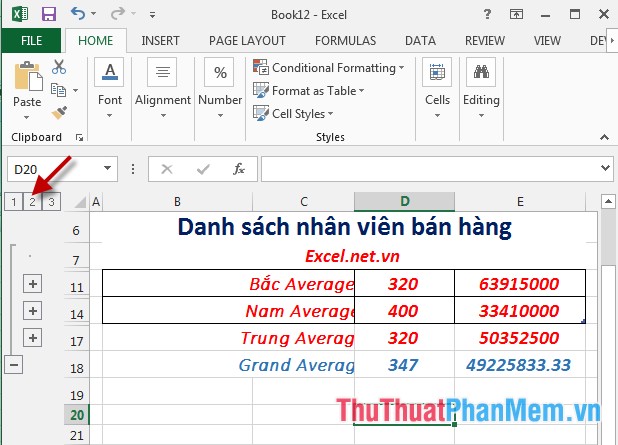
The above is a detailed guide on how to aggregate data in groups in Excel 2013.
Good luck!
FAQ
What should I know about Summary of Data in Groups?
Focus on the key features, requirements, limitations, and practical use cases explained in this guide.
How do I get the best results with Summary of Data in Groups?
Follow the recommended steps, use current software or information, confirm compatibility, and review settings before major changes.
Are there any risks or limitations?
Potential limitations depend on compatibility, data quality, cost, privacy, support, and how the product or method is used.
Related Articles
 Summary of 50 Excel Shortcuts You Should Know by 2023: Main Insights9 minutes read
 Excel 2019 (Part 20): Grouping and Subsummary7 minutes read
 Summary of Data Functions in Excel5 minutes read
 Summary of 50 Most Popular Ctrl-Using Shortcuts in Excel6 minutes read
 How to Use ISEVEN and ISODD Functions in Excel6 minutes read
 Summary of Data from Multiple Sheets in Excel4 minutes read
Reader Comments 0
Sign in with email or Google to join the discussion.