Table of Contents
This guide explains how to calculate Quartiles in Excel, with clear steps, practical tips, and important checks before you begin.
Using "QUARTILE. INC"
-
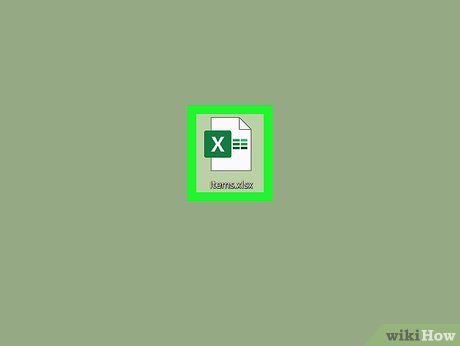 Open your project in Excel. If you're in Excel, you can go to File > Open or you can right-click the file in your file browser.
- This method works for Excel for Microsoft 365, Excel for Microsoft 365 for Mac, Excel for the web, Excel 2019-2007, Excel 2019-2011 for Mac, and Excel Starter 2010.
-
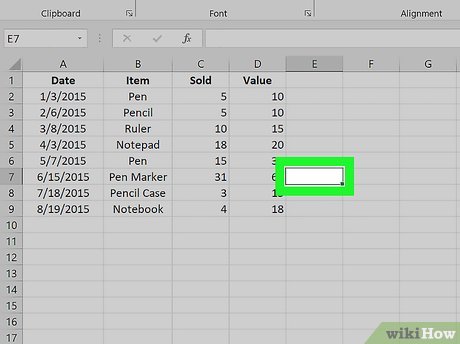 Select an empty cell where you want to display your quartile information. This can be anywhere on your spreadsheet.
- For example, you can select cell E7 even if all your data is located in cells A2-A20.
-
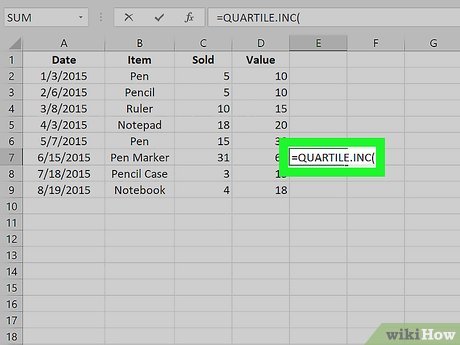 Enter the quartile function: =QUARTILE.INC(. INC stands for "Inclusive," which will give you results that include 0+100.
 -
 Select the cells containing your data. You can drag your cursor to select the entire range or you can select the first cell then press CTRL + SHIFT + Down arrow .
- After you've selected the data set, you'll see it entered into your formula. It'll look something like "=QUARTILE. INC(A2: A20" . Don't add the closing parentheses because you'll need to add more information to the function.
-
 Enter ",1)" to finish the formula. The number after the data range can represent either Q1, Q2, Q3, or Q4, so you can use any number 1-4 in the function instead of 1.
- The function QUARTILE. INC(A2: A20,1) will show you the first quartile (or 25th percentile) of your data set.[1]XResearch source
-
 Press ↵ Enter (Windows) or ⏎ Return (Mac). The cell you have selected will display the quartile function result. You can repeat this process using the other quartile function to see the differences.[2]XResearch source
Using "QUARTILE. EXC
-
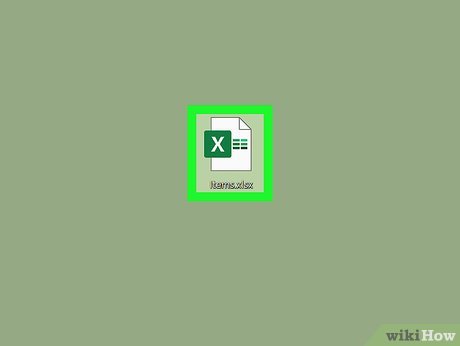 Open your project in Excel. If you're in Excel, you can go to File > Open or you can right-click the file in your file browser.
- This method works for Excel for Microsoft 365, Excel for Microsoft 365 for Mac, Excel for the web, Excel 2019-2007, Excel 2019-2011 for Mac, and Excel Starter 2010.
-
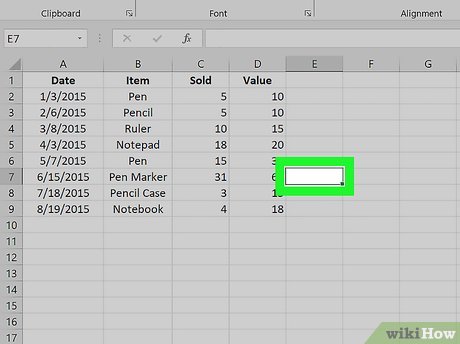 Select an empty cell where you want to display your quartile information. This can be anywhere on your spreadsheet.
- For example, you can select cell E7 even if all your data is located in cells A2-A20.
-
Enter the quartile function: =QUARTILE.EXC(. . EXC displays exclusive results, not showing you the highest and lowest ranges.
-
Select the cells containing your data. You can drag your cursor to select the entire range or you can select the first cell then press CTRL + SHIFT + Down arrow .
- After you've selected the data set, you'll see it entered into your formula. It'll look something like "=QUARTILE. EXC(A2: A20" . Don't add the closing parentheses because you'll need to add more information to the function.
-
Enter ",1)" to finish the formula. The number after the data range can represent either Q1, Q2, Q3, or Q4, so you can use any number 1-4 in the function instead of 1.
- The function QUARTILE. EXC(A2: A20,1) will show you the position of the first quartile in your data set.[3]XResearch source
-
 Press ↵ Enter (Windows) or ⏎ Return (Mac). The cell you have selected will display the quartile function result. You can repeat this process using the other quartile function to see the differences.[4]XResearch source
FAQ
What should I know about Calculate Quartiles?
Focus on the key features, requirements, limitations, and practical use cases explained in this guide.
How do I get the best results with Calculate Quartiles?
Follow the recommended steps, use current software or information, confirm compatibility, and review settings before major changes.
Are there any risks or limitations?
Potential limitations depend on compatibility, data quality, cost, privacy, support, and how the product or method is used.
Related Articles
 The Easiest Way to Calculate the Percentage (%)6 minutes read
 3 Ways to Calculate Totals in Excel: Province Excel Total5 minutes read
 Calculate the Total Value of the Filtered List in Excel4 minutes read
 SUM Function in Excel: How to Use SUM to Calculate Totals in Excel - SUM11 minutes read
 Calculation of Percentages in Excel4 minutes read
 How to Calculate the Sum Horizontally in Excel4 minutes read
Reader Comments 0
Sign in with email or Google to join the discussion.