Which is the better LLM model for enterprise applications: Claude 3 or GPT-4?
Do you know whether to choose Claude 3 or GPT-4 for enterprise use cases? Let's find out! Anthropic's Claude 3 and OpenAI's GPT 4 are two leading large language models (LLMs) for enterprise. While both support advanced inference, tool usage, and API integration, they differ in context window size, security philosophy, multimodal depth, cost structure, and deployment flexibility for enterprise environments.
Quick answer: Which is better for the business?
- Best for handling long context: Claude 3
- Best plugin ecosystem and completeness: GPT-4
- Best for safety and AI compatibility: Claude 3
- Best for integrating Microsoft products and platforms: GPT-4
- Best for tightly regulated industries: Claude 3
- Best for multimodal workflows: GPT-4
- The best LLM for a business in general depends on regulatory needs, infrastructure, and deployment model.
The truth is, most manufacturing businesses in 2026 will be using both, routing tasks based on context, cost, and capability. Let's explore this in more detail in the next section!
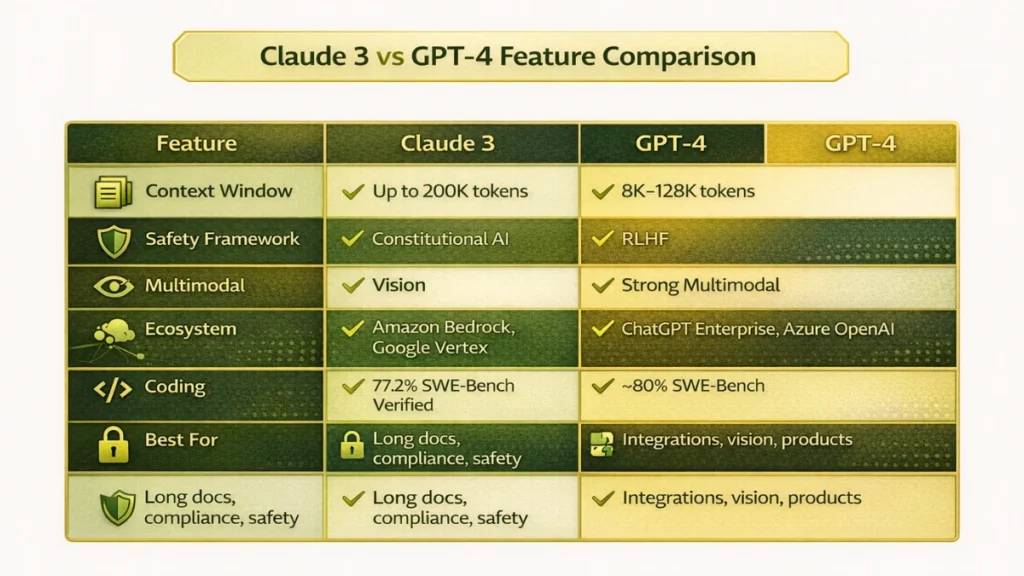
A direct comparison between Claude 3 and GPT-4 for enterprises.
| Features | Claude III | GPT-4 |
| Context window | Up to 200,000 tokens | 8K – 128K (depending on the version) |
| Security framework | Constitutional AI (CAI) | RLHF |
| Multimodal | Opus | Powerful multimedia capabilities (text + images) |
| Enterprise Package | Amazon Bedrock, Google Vertex, API | ChatGPT Enterprise, Azure OpenAI |
| Ecosystem maturation | Under development | Completed, developed by Microsoft |
| Code performance | 77.2% have been verified by SWE-Bench. | ~80% SWE-Bench (GPT-5.2 series) |
| Best for | Long document, compliant with regulations, safe. | Integration, vision, product |
| Pricing model | Calculated token-by-token, hierarchically categorized by variant. | Based on individual tokens, categorized by ability. |
Results from an independent comparative study showed that Claude 3 Opus outperformed GPT-4 in solving control engineering problems for university students, with expert panels rating Claude 3 Opus as the most advanced LLM on ControlBench. However, GPT-4 still maintained an advantage in multimodal tasks and ecosystem integration.
Comparing Claude and ChatGPT for Developers
1. API usability
Claude 3 API:
- The SDK is clean and well-documented through Anthropic's Python and TypeScript clients.
- Available through Amazon Bedrock and Google Vertex AI for enterprise-grade infrastructure.
- Rate limits are tiered by package; enterprise packages support high-throughput deployments.
GPT-4 API:
- Complete documentation with widespread community acceptance.
- Integrate native Azure OpenAI services for businesses already within the Microsoft ecosystem.
- A rich set of tools for fine-tuning, embedding, and calling functions.
In conclusion : If your team is already using Azure or Microsoft 365, the GPT-4 API offers seamless integration. For teams using AWS or GCP, Claude 3 via Bedrock or Vertex is a more suitable option.
2. Call the tool and agent.
Claude 3 tool architecture:
- Use native tools with the ability to call tools in parallel.
- Powerful in multi-step workflows requiring lengthy context.
- Works natively with LangChain, LlamaIndex, and custom agent frameworks.
Call the GPT-4 function:
- Powerful function calls with JSON schema execution
- The extended agent frameworks are built specifically around GPT-4 (AutoGPT, AgentGPT).
- LangChain supports both equally; GPT-4 has more community-built agents.
According to METR's 2025 randomized controlled trial, AI agents can now complete software engineering tasks that would take humans up to 5 hours, with task complexity doubling every 7 months. Both Claude 3 and GPT-4 benefit from this agent transition, but their strengths differ.
3. RAG compatibility
Both Claude 3 and GPT-4 integrate well with major vector databases (Pinecone, Weaviate, Chroma, FAISS). The main differences:
- Claude 3's 200K token window reduces the frequency of necessary accesses, allowing you to include more context in a single call.
- The GPT-4 ecosystem has more integrations and built-in RAG templates through LangChain and LlamaIndex.
Which LLM model works better in enterprise use cases?
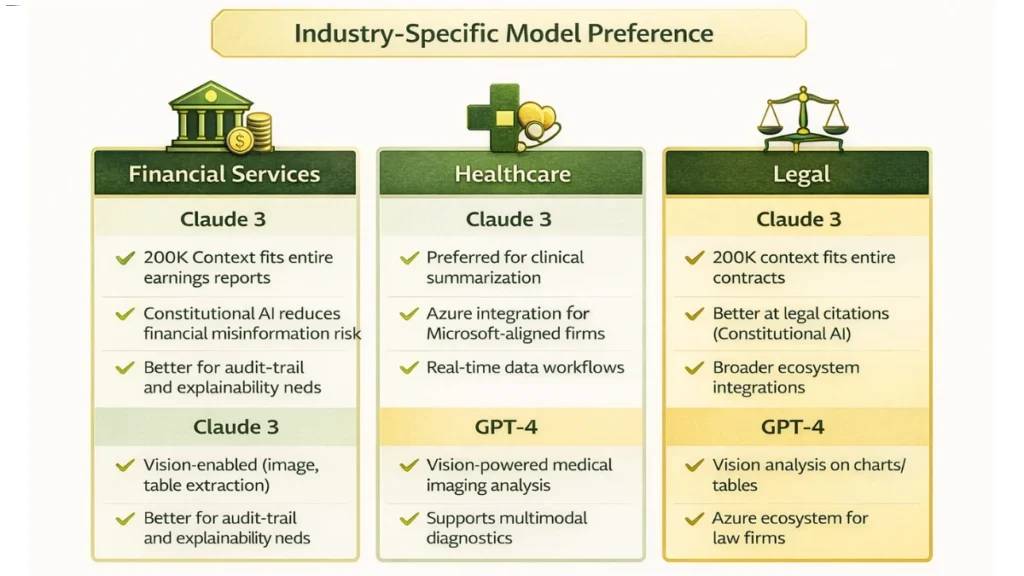
Financial services
Claude 3 demonstrates its superiority in handling financial documents:
- The 200K context is suitable for all income statements, legal documents, and contracts.
- Artificial intelligence (AI) is constitutionally protected against the risk of generating financial misinformation.
- More aligned with audit log requirements and explanatory needs.
GPT-4 excels in:
- Visual processing (charts, tables from scanned documents)
- Integration with Microsoft Azure for banks already using this ecosystem.
- Real-time data processing via function calls
Artificial intelligence in healthcare
Research shows that poorly performing LLM models paradoxically exhibit higher reliability—a significant concern in healthcare. A 2025 study in JMIR Medical Informatics found that poorly performing models had 46% accuracy but 76% reliability, while the best-performing models had 74% accuracy with 63% reliability (JMIR Medical Informatics, 2025). Both Claude 3 and GPT-4 are among the better-calibrated models, but businesses should evaluate based on specific field-specific criteria.
- Claude 3: Preferred for clinical summaries, lengthy patient records, and strict compliance documentation.
- GPT-4: Preferred for medical image analysis, supporting multimodal diagnosis, and integrating into a broader ecosystem.
Legal and compliance
Claude 3 is the preferred choice for most legal applications:
- Suitable for the entire contract (200K context) without needing to be broken down.
- Constitutional AI's suitability reduces the risk of fabricated legal citations.
- It is unlikely to be overly confident in specific legal standards.
According to a 2024 study by Stanford Law School, illusory legal models are inaccurate at least 75% of the time regarding court rulings. This makes model selection crucial; both Claude 3 and GPT-4 perform better than smaller models, but Claude 3's design, which emphasizes integrity and correction, makes it more suitable for high-risk legal work.
When should businesses choose Claude 3?
- Handling large documents : Contracts, financial records, research papers, legal summaries
- Industries with strict compliance : Healthcare, finance, law, government
- Long-contextual workflows : Tasks requiring consistency across more than 50,000 tokens.
- AI security priority : Regulated areas require auditable alignment methodologies.
- AWS or GCP infrastructure : Native integration via Bedrock or Vertex
- Reducing the risk of hallucinations : Where confident, incorrect answers can lead to serious consequences.
When should businesses choose GPT-4?
- Strong multimedia requirements : Visually intensive tasks, image analysis, chart interpretation.
- Microsoft ecosystem : Azure, Microsoft 365, GitHub Copilot integration
- ChatGPT Enterprise currently has : Teams that have used OpenAI's enterprise products.
- Building a startup product : Broader plugin support, a larger community, more third-party tools.
- Agent ecosystem maturity level : Many agentic frameworks are built on GPT-4.
- Refinement process : Refinement infrastructure is more accessible through OpenAI.
How do you decide on the best LLM for your business?
Before going into production, let's evaluate the Claude 3 against the GPT-4 based on the following criteria:
- Infrastructure stack compatibility : AWS → Claude via Bedrock; Azure → GPT-4 via Azure OpenAI
- Compliance requirement : Regulated industries benefit from Claude's CAI transparency.
- Context window requirement : Documents over 32,000 words → Claude 3 has a clear advantage.
- Tolerance to latency : Haiku and GPT-4o in terms of speed; Opus and GPT-4 Turbo for quality.
- Budget constraints : Run a cost model using your actual token volume before making a decision.
- Complexity of the agent's workflow : Multi-step, time-consuming tasks prioritize the contextual advantages of Claude 3.
- Visual requirements : Visually intensive tasks prioritize the multimodal depth of GPT-4.
- Ecosystem dependence : Microsoft's current ecosystem is heavily skewed toward GPT-4.