Table of Contents
Anthropic introduced Claude Haiku 4.5 on October 15, 2025 as a smaller model focused on speed and cost efficiency. Its launch positioning emphasized coding and responsive applications, rather than replacing the company's largest models for every task.
This article explains the launch claims and their limits. Haiku 4.5 is an older model, so developers choosing a model today should check current availability and compare it with the current lineup.
The speed comparison was with Sonnet 4
In its launch announcement, Anthropic compared Haiku 4.5's coding performance with Sonnet 4, saying it offered similar performance at one-third the cost and more than twice the speed. That comparison should not be rewritten as a general claim of parity with Sonnet 4.5.
Speed depends on the workload, response length, and serving environment. A launch comparison does not guarantee the same latency advantage in every application.
Read benchmark results in context
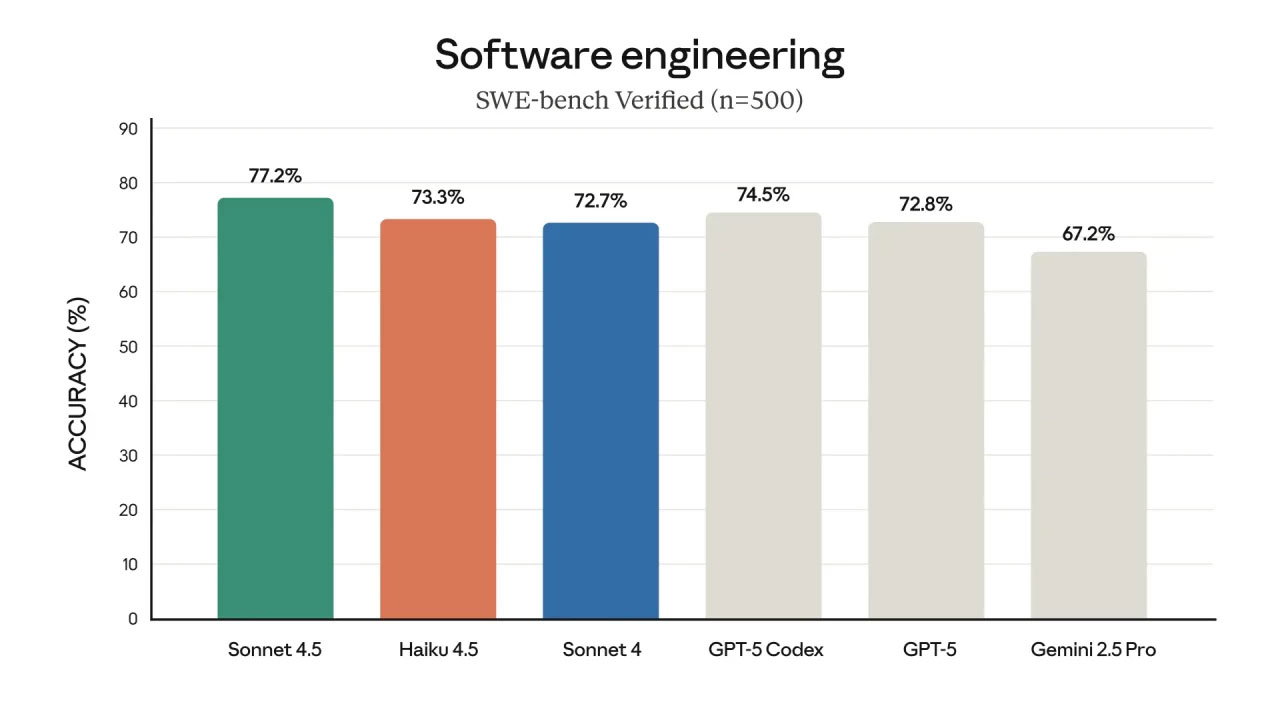
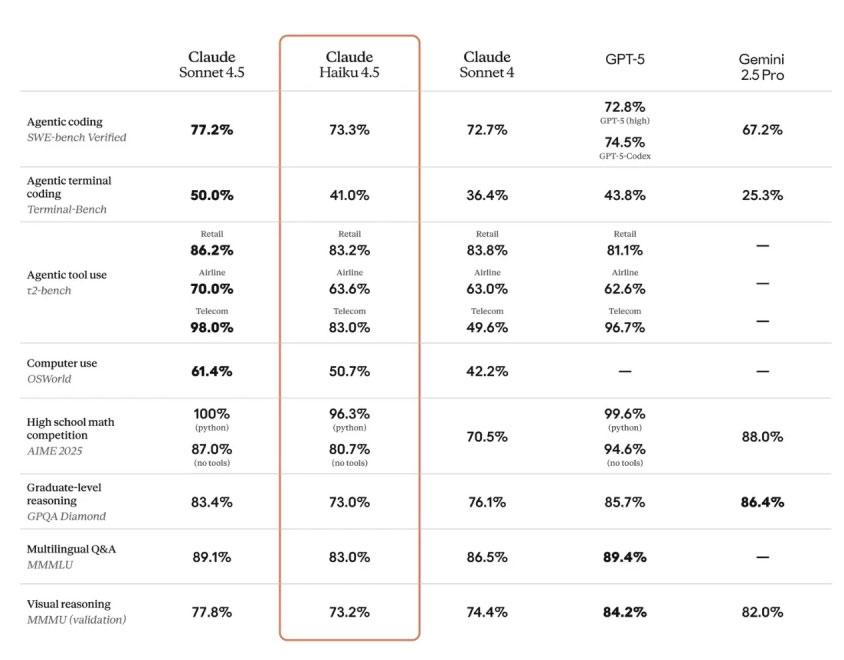
Anthropic reported 73.3% on SWE-bench Verified for Haiku 4.5 using its stated evaluation setup. This benchmark concerns software-issue resolution; it is not a universal accuracy score for chat, customer service, or every coding task.
Before deployment, test representative inputs, tool calls, failure cases, and the amount of human correction required. Compare quality and total task cost together rather than treating a benchmark score as a product guarantee.
Pricing and access
The announced API base pricing was $1 per million input tokens and $5 per million output tokens. Anthropic's Haiku 4.5 model page lists current model IDs, availability, and pricing details. Caching, batch use, and third-party platform terms can affect billing.
The launch included the Claude API, Amazon Bedrock, and Google Cloud Vertex AI. Check the platform you intend to use rather than assuming one provider's identifier or terms apply to another.
What ASL-2 means
Anthropic released Haiku 4.5 under AI Safety Level 2 within its own safety framework after evaluating the model. This is not an independent certification that the model is risk-free.
The company's “safest” wording referred to a particular automated alignment assessment. It should not be interpreted as proof that every response or connected action is safe. Anthropic's transparency materials provide the classification context.
Where a smaller model can fit
Lower-latency chat, classification, bounded coding subtasks, and customer-support assistance are reasonable workloads to evaluate. A larger model can plan or review work while smaller instances handle separate tasks, but that design adds coordination and verification needs.
When replacing an older model, test prompts, output formats, tool use, and error handling. A “drop-in replacement” description does not remove the need for regression checks.
For background on tokens and agents, see common AI terms. For connected-app workflows, see connecting Claude to work apps, checking the current interface and permissions before setup.
Related Articles
 Anthropic launches Claude 3.5 Sonnet, beating ChatGPT 4o
 Claude Fable 5 Explained: Features, Access, Safety, and Pricing
 Claude API Guide: First Request and Production Basics
 Claude Haiku vs. Sonnet vs. Opus: How to Choose
 Claude Opus 4.7: Features, API Changes, and Migration Notes
 Anthropic Launches Claude 2: New Competitor for ChatGPT and Bard
Reader Comments 0
Sign in with email or Google to join the discussion.