Table of Contents
Anthropic introduced Claude Opus 4 and Claude Sonnet 4 on May 22, 2025. Sonnet 4 offered a lower API price for everyday coding tasks, while Anthropic positioned Opus 4 for work that spans multiple files or takes several rounds of investigation and testing. Both supported quick responses and extended thinking.
How the coding models compared at launch
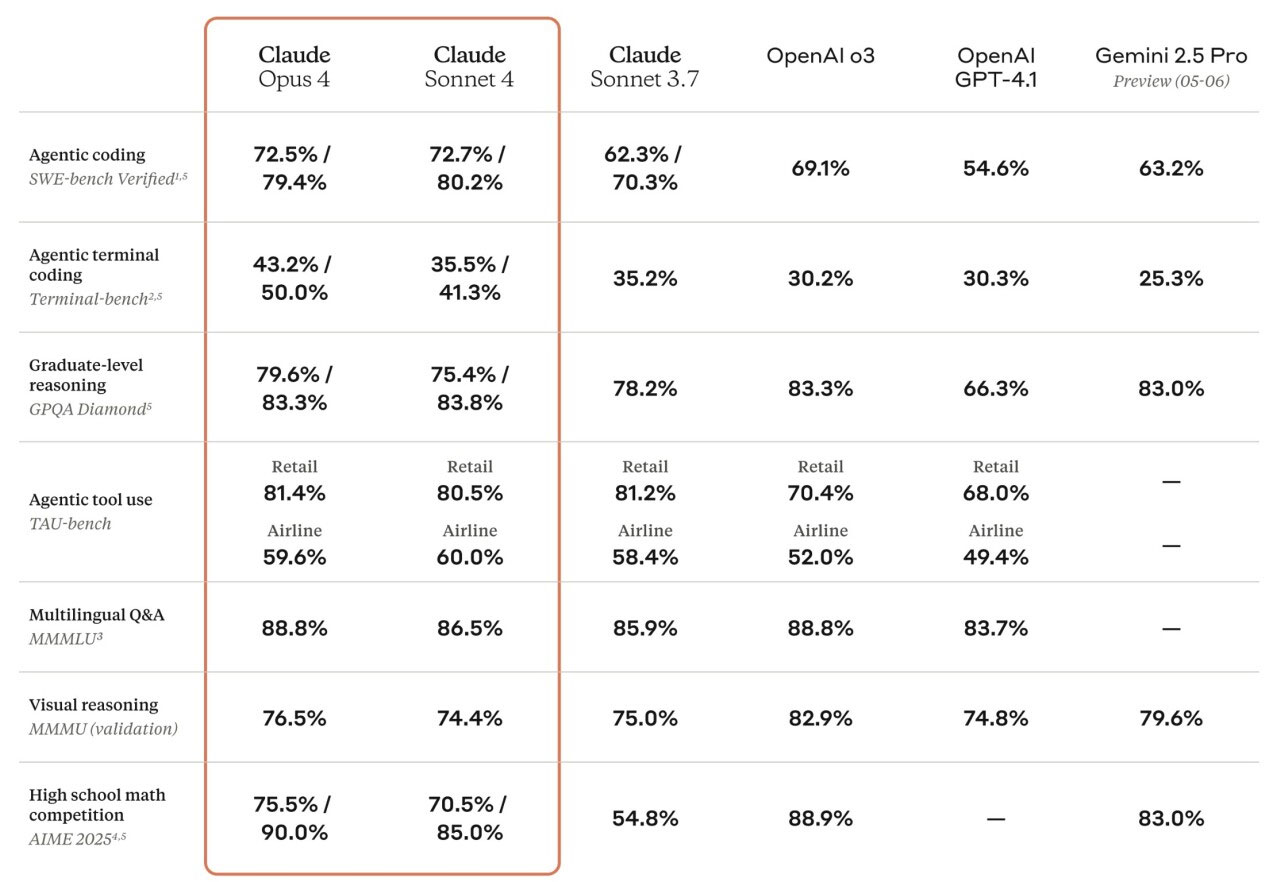
In Anthropic’s launch tests, Sonnet 4 scored 72.7% on SWE-bench Verified and Opus 4 scored 72.5%. The benchmark measures how often an AI system resolves selected software issues. Those close scores tell you how the two models performed on that test. For a project of your own, compare the time each model takes, the tests it passes and the amount of manual cleanup its patches need.
API pricing and availability at launch
| Model | Input | Output |
|---|---|---|
| Claude Opus 4 | $15 | $75 |
| Claude Sonnet 4 | $3 | $15 |
At launch, Anthropic offered both models through its API, Amazon Bedrock and Google Cloud Vertex AI. Free Claude users could access Sonnet 4, and the Pro, Max, Team and Enterprise plans included both models and extended thinking. Check your provider’s current catalog and pricing before building around either release.
What changed in Claude Code
Claude Code became generally available alongside the models, with VS Code and JetBrains integrations and support for background tasks through GitHub Actions. Anthropic also announced API features for code execution, MCP connections, file handling and prompt caching for up to an hour.
If you’re comparing models on a real repository, give both the same issue and acceptance tests. Review the changes on a separate branch and run the tests before merging. TipsMake’s Git and GitHub course covers branches and pull requests, and its guide to reusable skills for coding agents shows how to give an agent consistent project instructions.
Related Articles
 Claude Opus 4.7: Features, API Changes, and Migration Notes
 Learn about Claude Opus 4.6
 Claude App: Features, Limits, and Safe Ways to Use It
 Claude Haiku 4.5: Launch Pricing, Coding Claims, and ASL-2 Explained
 Gemini 3.5 Flash vs Claude Opus 4.7: Speed or Deep Reasoning?
 Claude Fable 5 Explained: Features, Access, Safety, and Pricing
Reader Comments 0
Sign in with email or Google to join the discussion.