Table of Contents
This guide explains how to use SYD Function in Excel, including its syntax, required arguments, practical examples, and common errors.
Description: The function performs depreciation of assets according to the remaining time in the specified period.
Syntax : = SYD (cost, salvage, life, per) .
Inside:
- cost : The initial value of the property, required parameters.
- salvage : The depreciation value of the property, also called the recovery value of the property.
- life : Term of the property, required parameters.
- per : The number of depreciation periods, mandatory in the same unit as the asset's maturity, is the required parameter.
Attention:
- Depreciation formula:

For example:
With investment properties have the following parameters. Calculate the depreciation for the first year, the depreciation for the last year.

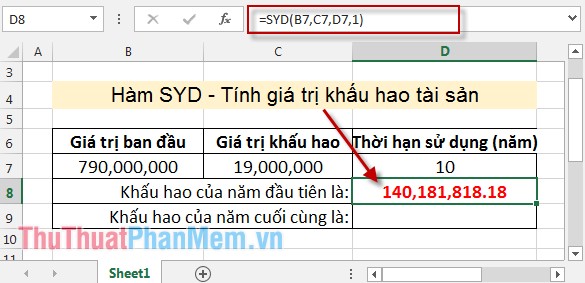
In the cell to calculate enter the formula: = SYD (B7, C7, D7,1) .
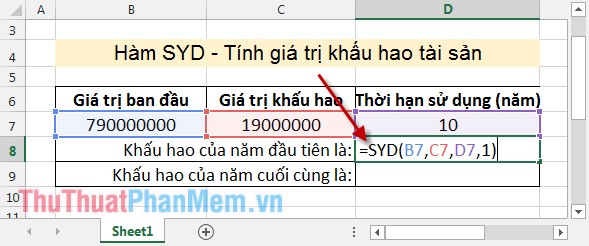
Pressing Enter results as:
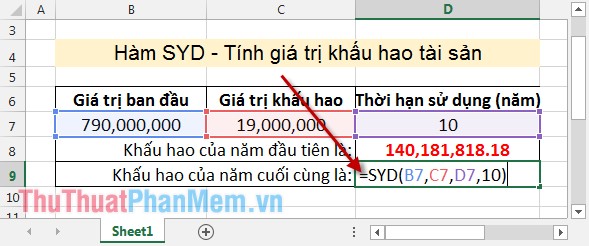
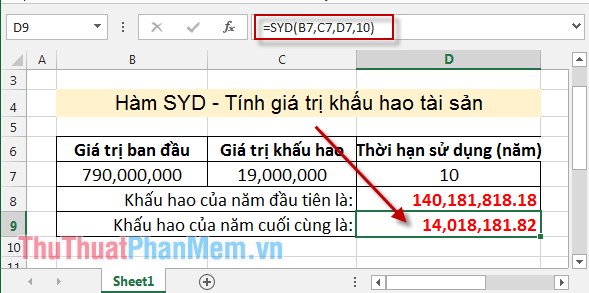
The depreciation for the last year -> the depreciation period is 10.
Press Enter the depreciation value of the property after 10 years:
Above are the uses and cases of the SYD function.
Good luck!
FAQ
What does the SYD function do in Excel?
The SYD function performs the calculation described in this guide. Use the correct arguments and compatible data types for reliable results.
How do I enter the SYD function correctly?
Start with an equals sign, enter SYD, add the required arguments inside parentheses, and confirm that cell references and separators are correct.
Why does the SYD function return an error?
Common causes include missing arguments, invalid data types, incorrect cell references, unsupported values, or regional separator settings.
Related Articles
 How to Use the VDB Function in Excel5 minutes read
 How to Use the DDB Function in Excel3 minutes read
 How to Use the SLN Function in Excel2 minutes read
 How to Use the SUM Function to Calculate Totals in Excel8 minutes read
 How to Use the AMORDEGRC Function in Excel4 minutes read
 How to Use the DB Function in Excel3 minutes read
Reader Comments 0
Sign in with email or Google to join the discussion.