Table of Contents
This guide provides a clear, practical overview of steps to bypass TPM 2.0 requirement when installing Windows, with useful context, important details, and straightforward takeaways for everyday readers.
Bypass TPM 2.0 by editing Registry Editor during Windows 11 installation
During the installation of Windows 11 on a computer without or without TPM 2.0 enabled, you will receive the message "This PC can't run Windows 11" as shown below.
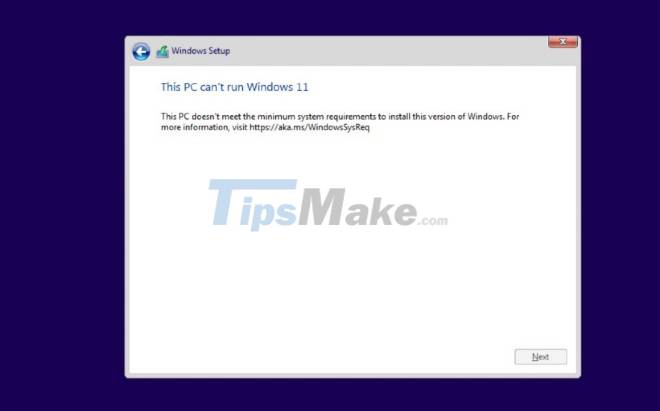
Here you can start editing the Registry Editor to bypass TPM 2.0. Here's how to do it:
Step 1 : Press Shift + F10 to open a command line window (CMD)
Step 2 : On the CMD window, type regedit.exe and press Enter
Step 3 : On the Registry Editor window, go to:
HKEY_LOCAL_MACHINESYSTEMSetupStep 4 : Right-click Setup and select New > Key to create a new key named LabConfig
Step 5 : Create 2 new DWORD values in the newly created LabConfig key by right-clicking on LabConfig and then selecting New > DWORD (32-bit) Value . Name the 2 new values BypassTPMCheck and BypassSecureBootCheck
Step 6 : Double-click the two newly created values and then enter 1 in the Value data box then press Enter

After you save and exit, the error message above will disappear and you can install Windows 11 normally.
Bypass TPM 2.0 and Secure Boot by fixing the Windows 11 installation file
In addition to editing the Registry Editor, you can also edit the Windows 11 installation file to bypass the TPM 2.0 and Secure Boot requirements.
Before you start, you need to prepare the following:
- USB install Windows 10
- Windows 11 ISO file (currently no official file)
Step 1 : Mount the Windows 11 ISO file to the virtual drive by right-clicking the ISO file > Open with > Windows Explorer
Step 2 : Go to the sources folder, find and copy the install.wim file of the Windows 11 installer
Step 3 : Paste the install.wim file into the sources folder of the Windows 10 USB installation. Choose to overwrite the old file ( Replace the file in the destination ). In other words, you replace the install.wim file of the Windows 11 installer with the Windows 10 installer
Note : If there is install.esd file in the source folder of the Windows 10 installer , you must delete it. Then paste the install.wim file of Windows 11 in.
That's it, you can use that USB to install Windows 11 normally, bypassing the TPM 2.0 and Secure Boot requirements.
Above are the two simplest ways for you to bypass the TPM 2.0 requirement and install Windows 11 normally. Good luck!
Key Takeaways
Use the information above as a practical reference for steps to bypass TPM 2.0 requirement when installing Windows. Review each step carefully, confirm any requirements, and choose the option that best fits your situation.
FAQ
What does this guide explain about Steps to Bypass TPM 2.0 Requirement When Installing Windows?
It explains the main concepts, practical considerations, and useful steps related to steps to bypass TPM 2.0 requirement when installing Windows without requiring advanced knowledge.
Who can benefit from learning about Steps to Bypass TPM 2.0 Requirement When Installing Windows?
This information is useful for readers who want a clear overview, practical guidance, and reliable steps related to steps to bypass TPM 2.0 requirement when installing Windows.
What should I check before applying this information?
Review the requirements, confirm that your device, software, or situation matches the instructions, and back up important data before making major changes.
Related Articles
 How to Use Rufus to Bypass TPM and Secure Boot Requirements5 minutes read
 How to Bypass TPM 2.0 Requirement When Installing Windows5 minutes read
 How to Bypass TPM 2.0 Requirement to Install Windows 113 minutes read
 Steps to Enable TPM 2.0 to Install Windows 116 minutes read
 How to Install Windows 11 Using a Local Offline Account Without a Microsoft5 minutes read
 What Is Bypass? Information About iPhone Bypass You Need to Know7 minutes read
Reader Comments 0
Sign in with email or Google to join the discussion.