Table of Contents
This updated guide examines How to Use Ultraviewer to Send and Receive Files and organizes the essential facts, background, and practical takeaways in clear American English.
Previously, Network Administrator instructed you to read how to install Ultraviewer software, as well as how to control the remote computer via Ultraviewer. In this article, readers will learn how to share files between two computers, with a simple and very easy to use method.
- 10 applications to help 'cricket' control remote computers
- How to use ASUS Remote Link to control remote Windows computers
- How to use AnyDesk Remote to control remote computers
- How to use Quick Assist to control a remote computer
Guide to sharing files on Ultraviewer
Step 1:
We proceed to install Ultraviewer according to the link below as usual. The software is very light and supports all versions of Windows operating systems.
- Download UltraViewer software
Step 2:
When the Ultraviewer interface is installed, it will display with your personal ID and password. The user needs to enter the opponent's ID and password and then click the Start control button .

Step 3:
Immediately you will see the screen of the enemy side to proceed with the control.

Then in the right corner of the computer screen you have an arrow icon to open the chat frame.

Step 4:
Display chat frame interface. Here you click on the pin clip icon to send the file to the opponent's computer.

Now show the folder on your computer. We find the file we want to send to the enemy and then click to send the file. Ultraviewer does not limit the type of file sent on the software.

Step 5:
Soon the file will be sent to the opponent's computer.

During the process of receiving files or controlling computers, we can still chat freely.
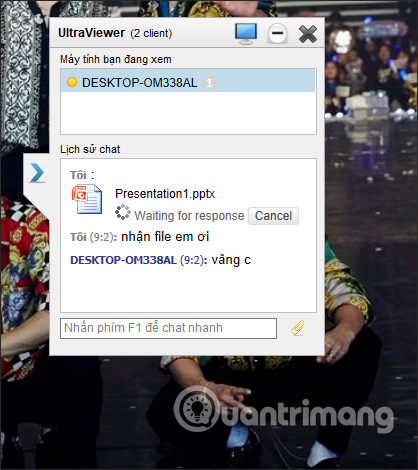
Step 6:
Then the computer side of the opponent needs to press the Save button to accept the file download to the computer.

Also show the folder on your computer to choose where to save the file you send.

Step 7:
The file sharing process on Ultraviewer is conducted shortly thereafter. If the file you send is heavy, the sending process takes a lot of time. When the computer receives the file successfully, the chat frame interface on your computer shows the File Sent message , the file has been sent successfully.
To stop controlling the computer, we click the X icon in the top corner of the computer screen.

The computer control and guidance via Ultraviewer software is much simpler and more convenient. We can easily exchange information with each other via chat frames, or share files quickly on the software interface.
I wish you all success!
FAQ
What is How to Use Ultraviewer to Send and Receive Files about?
It provides a structured overview of remote control software, explains the main context, and highlights practical takeaways for readers.
Why does this topic matter?
Understanding the main concepts helps readers evaluate the issue, avoid common mistakes, and make better-informed decisions.
How should readers use this information?
Use the guidance as a practical starting point, confirm details that may have changed, and follow current product, safety, or security recommendations.
Related Articles
 Link Downlaod Ultraviewer 6.24 minutes read
 Instructions for Fixing Errors Do Not Receive and Send Files in3 minutes read
 How to Install the Latest Version of Ultraviewer for Remote Computer Control4 minutes read
 How to Fix Ultraview Not Being Able to Retrieve ID7 minutes read
 How to Fix the Common Error Ultraviewer When Connecting to a4 minutes read
 Simple UltraViewer Usage Guide for Remote Computer Control5 minutes read
Reader Comments 0
Sign in with email or Google to join the discussion.