Table of Contents
This guide provides a practical overview of FILTERXML - Function That Returns Specified Data from XML Content Using the, including its main features, benefits, limitations, and important considerations.

Description: The function returns specified data from XML content using the specified XPath. Support functions from Excel 2013 onwards.
Syntax: FILTERXML (xml, xpath)
Inside:
- xml: A string in valid XML, is a required parameter.
- xpath: A string in standard XPath form, is a required parameter.
Attention:
- If xml is invalid -> the function returns the #VALUE! Error value
- If the xml contains a namespace with an invalid prefix -> the function returns the #VALUE! Error value
For example:
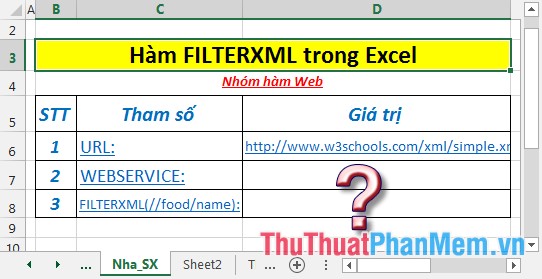
Determining the return value from the XML content returned in the URL string is described in the table below:
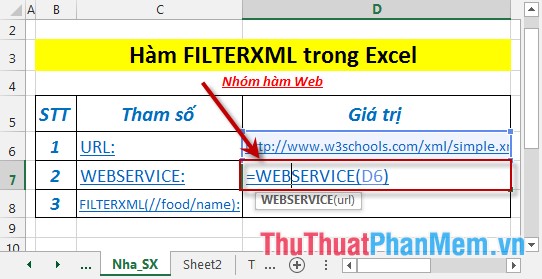
- Find the WEBSERVICE value from the above URL string. Enter the formula: = WEBSERVICE (D6)
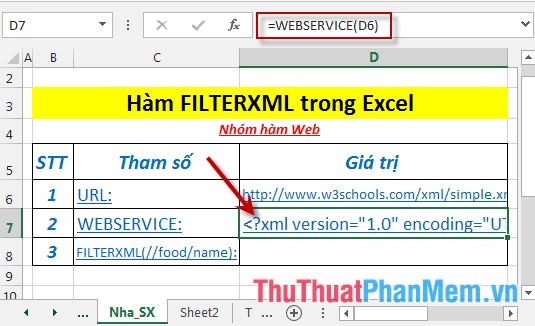
- Press Enter -> return value is:
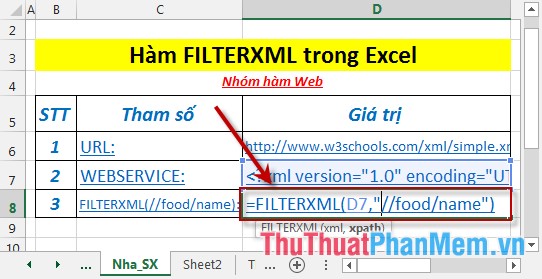
- The value returned from the XML content returned in the URL string. Enter the formula: = FILTERXML (D7, "// food / name")
- Press Enter -> the value returned from the XML content in the above URL string is:
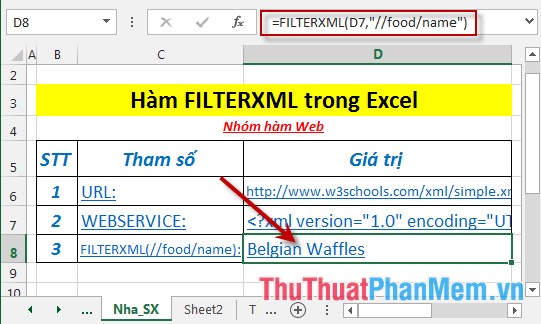
Above are instructions and some specific examples when using the FILTERXML function in Excel.
Good luck!
FAQ
What should I know about FILTERXML - Function That Returns Specified Data from XML Content Using the?
Focus on the key features, requirements, limitations, and practical use cases explained in this guide.
How do I get the best results with FILTERXML - Function That Returns Specified Data from XML Content Using the?
Follow the recommended steps, use current software or information, confirm compatibility, and review settings before major changes.
Are there any risks or limitations?
Potential limitations depend on compatibility, data quality, cost, privacy, support, and how the product or method is used.
Related Articles
 How to Use Webservice and Filterxml Functions to Get Data Directly from The6 minutes read
 How to Use the NORMDIST Function in Excel - Function That Returns4 minutes read
 How to Use the TRIMMEAN Function in Excel3 minutes read
 QUARTILE. EXC Function in Excel3 minutes read
 F. DIST. RT Function in Excel3 minutes read
 How to Use the FTEST Function in Excel3 minutes read
Reader Comments 0
Sign in with email or Google to join the discussion.