Table of Contents
This guide provides a practical overview of Set the AutoCorrect Function, including its main features, benefits, limitations, and important considerations.
To set up the AutoCorrect function in Excel, do the following:
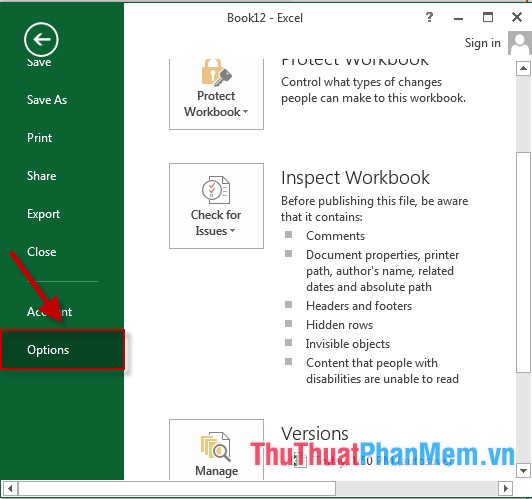
Step 1: On the card File -> Option:
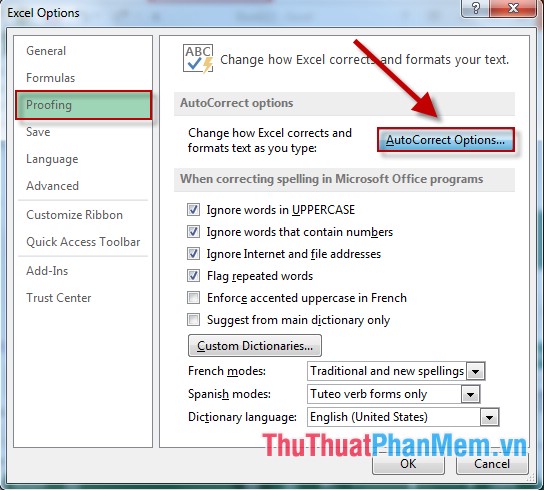
Step 2: The Excel Option dialog box appears -> Choose Proofing -> AutoCorrrect Options.
Step 3: The AutoCorrect Englich dialog box appears in the section:
- Replace: Enter the abbreviation name.
- With: Enter content for the abbreviation.
After you finish typing click Add to put the abbreviation into the dialog box:

Step 4: The abbreviated phrase has been added -> click OK to complete:

- Return to the spreadsheet -> type nv:

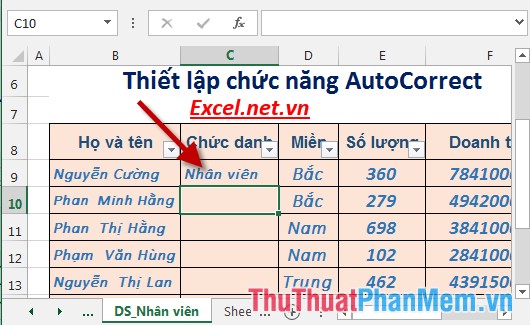
- Press Enter -> nv automatically turns into Employee:
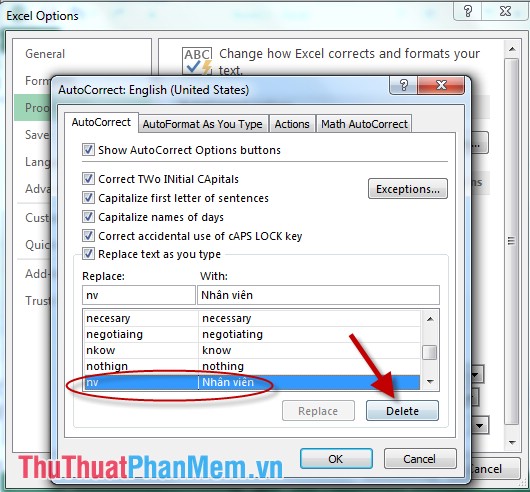
- In case you want to type the normal nv word that is not a substitute for the phrase Staff perform the following: Go back to File -> Option -> Proofing -> AutoCorrect -> AutoCorrect English dialog box appears -> select phrases Words to delete -> Delete:
After deleting the abbreviation, go back to the worksheet and type nv, press Enter -> result:
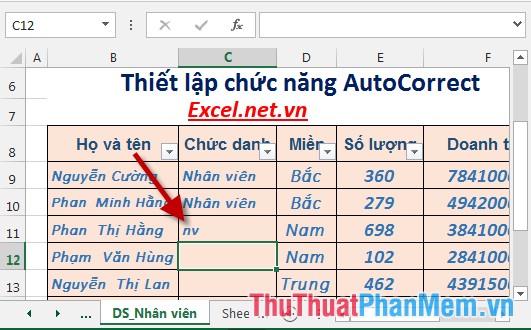
- However, you should use the AutoText feature that Excel supports available to be proactive in using phrases instead of content or not.
The above is a detailed guide on how to set up the AutoCorrect function in Excel 2013.
Good luck!
FAQ
What does the AUTOCORRECT function do in Excel?
The AUTOCORRECT function performs the calculation described in this guide. Use the correct arguments and compatible data types for reliable results.
How do I enter the AUTOCORRECT function correctly?
Start with an equals sign, enter AUTOCORRECT, add the required arguments inside parentheses, and confirm that cell references and separators are correct.
Why does the AUTOCORRECT function return an error?
Common causes include missing arguments, invalid data types, incorrect cell references, unsupported values, or regional separator settings.
Related Articles
 Shortcut Guide, Abbreviated in Excel: Autocorrect Excel4 minutes read
 Backup Autocorrect in Microsoft Office3 minutes read
 Typing, Abbreviation in Word, Excel with AutoCorrect4 minutes read
 The Index Function in Excel: Formulas and Usage9 minutes read
 How to use the VALUE function in Excel - A function to4 minutes read
 Basic Excel Functions That Anyone Must Know20 minutes read
Reader Comments 0
Sign in with email or Google to join the discussion.