Table of Contents
This guide provides a practical overview of Conditional Counting Function, including its main features, benefits, limitations, and important considerations.
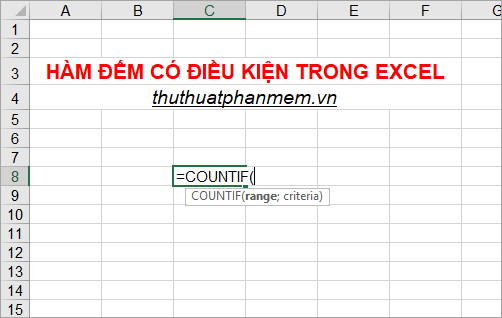
Description
The COUNTIF function is a conditional counting function in Excel, you can count data based on a specified condition.
Syntax
= COUNTIF (range; criteria)
Where range is required, the area where you want to count data. It may contain numbers, arrays, or references that contain numbers. Blank values are ignored.
Criteria (required), this is a condition for counting values in range, it can be numbers, expressions, cell references or text strings.
- If you want to count with multiple conditions then you use the COUNTIFS function. (insert the link http://TipsMake. vn/ham-countifs-in-excel/ into the name of COUNTIFS for me)
Note
- The COUNTIF function returns false results when you use conditions with strings longer than 255 characters.
- The criteria argument is enclosed in quotation marks.
- Criteria is not case-sensitive.
- It is possible to use a question mark (?) And asterisk (*) in criteria (1 question mark corresponds to 1 character, 1 star corresponds to a string of characters). If you want to use a question mark or asterisk not as a wildcard then you need to add the ~ character before it.
For example
Give the following table of data:

1. Count the number of orders with the product name Orange.
To make this request, you enter the CountIf function formula as follows:
= COUNTIF (B6: B14; "Orange")
As a result, you will see that there are 3 orders with items that are Orange.

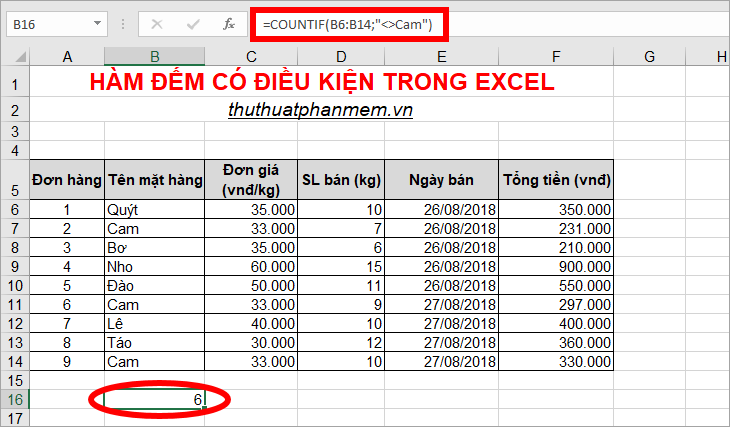
2. Count the number of orders with an item name other than Cam.
You use the function formula provided that it is not 'Cam' <> Cam '
= COUNTIF (B6: B14; "<> Orange")
You will get a result of 6 as follows:
3. Count the quantity of orders with quantity sold> = 10 kg.
You use the condition '> = 10' in the sales SL column and the counting range is the sales SL column, the formula is as follows:
= COUNTIF (D6: D14; "> = 10")
Your result will be 6 orders:

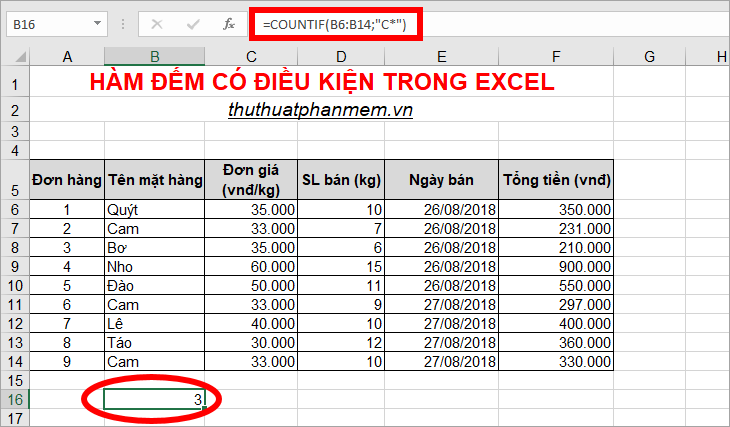
4. Count the order number with the product's name Orange using an alternate character *
Instead of typing Cam in CountIf condition, you can enter C * to count.
= COUNTIF (B6: B14; "C *")
The results you also get 3 orders:
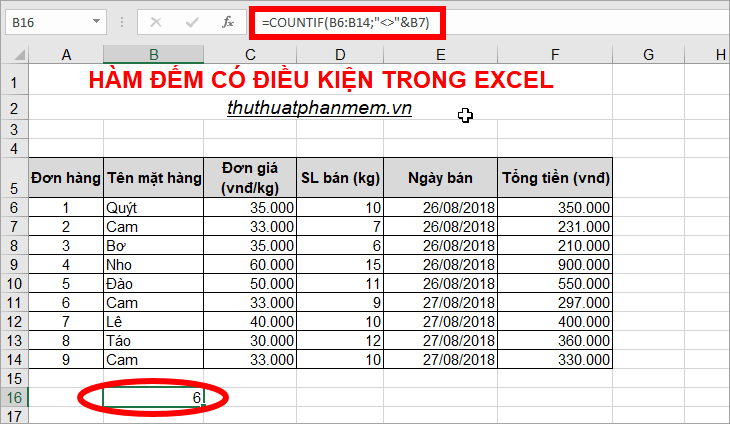
5. Count the number of orders with the names of items other than cell B7 (Orange).
You can use the '&' character before the reference cell in the CountIf function condition as follows:
= COUNTIF (B6: B14; "<>" & B7)
The results you will get are:
So, if you need to conditionally count in Excel, you can use the COUNTIF function. Above the article introduced you to describe, syntax, usage and examples of COUNTIF function in Excel. Hope this article will be helpful to you.
Good luck!
FAQ
What does the Conditional Counting Function function do in Excel?
The Conditional Counting Function function performs the calculation described in this guide. Use the correct arguments and compatible data types for reliable results.
How do I enter the Conditional Counting Function function correctly?
Start with an equals sign, enter Conditional Counting Function, add the required arguments inside parentheses, and confirm that cell references and separators are correct.
Why does the Conditional Counting Function function return an error?
Common causes include missing arguments, invalid data types, incorrect cell references, unsupported values, or regional separator settings.
Related Articles
 COUNTIF Function: Conditional Counting in Excel9 minutes read
 6 Conditional Functions That Make Excel Spreadsheets Smarter10 minutes read
 How to Use Countif Function on Excel: Excel Function5 minutes read
 DSUM Function: How to Sum with Complex Conditions in Excel5 minutes read
 The IF Function in Excel: Syntax and Specific Examples of the IF Function5 minutes read
 COUNT Excel Counting Function8 minutes read
Reader Comments 0
Sign in with email or Google to join the discussion.