Table of Contents
This guide provides a clear overview of notepad error, including 1. Use Alternative Methods to Open Notepad, 2. Set Notepad as Default Text Editor. Use it to understand the topic, compare the available options, and make a more informed decision.
1. Use Alternative Methods to Open Notepad
Before you try any of the advanced solutions, see if you can open Notepad with the Run tool. Press Win + R to open the Run dialog box. Type notepad in the Open field and press Enter.
If that doesn't work, try opening Notepad through a command line tool. Open the search menu to launch Command Prompt or PowerShell. In the console, type notepad and then press Enter.

You can also ask Cortana to open Notepad. However, if none of these methods work, move on to the next solution.
2. Set Notepad as Default Text Editor
If Notepad is not set as the default text editor application on Windows, your text files may open in another application. If you don't want that, use the following steps to set Notepad as the default text editor application.
1. Open the Start menu and click the gear icon to launch the Settings app.
2. Navigate to the Apps tab.
3. Select Default apps from the right pane.
4. Scroll down to the Related settings section.
5. Click Choose defaults by file type .
6. Type .txt in the search box and click the current default app.
7. Select Notepad and click the Set default button.

Try opening a few text files and see if they open with Notepad.
3. Repair or Reset the Notepad Application
The built-in repair tool on Windows is quite effective when it comes to fixing minor application-related problems. Microsoft recommends using this tool when an application doesn't open or doesn't work as expected on a Windows computer.
To fix the Notepad application on Windows:
1. Right-click the Start icon or press Win + X to open the Power User menu.
2. Select Installed apps from the list.
3. Scroll down or use the search tool to find Notepad in the application list.
4. Click the three-dot menu icon next to Notepad and select Advanced options.
5. Scroll down to the Reset section and click the Repair button.

You will see a check mark next to the Repair button once the process is complete. Then try opening the Notepad application again.
If repairing the Notepad application doesn't make any difference, you can try resetting the application. Windows will return the Notepad application to its default version, which will resolve any problems with the application.
4. Reinstall Notepad App
You can also try uninstalling and reinstalling the Notepad application on your computer. Proceed as follows:
1. Press Win + I to launch the Settings application.
2. Navigate to Apps > Optional features .
3. Click Notepad to expand it.
4. Click the Uninstall button.

5. Wait for Windows to uninstall Notepad from your computer.
6. Next, click the View features button at the top.
7. Type Notepad in the search box.
8. Tick the Notepad (system) checkbox and click Next.
9. Click Install.
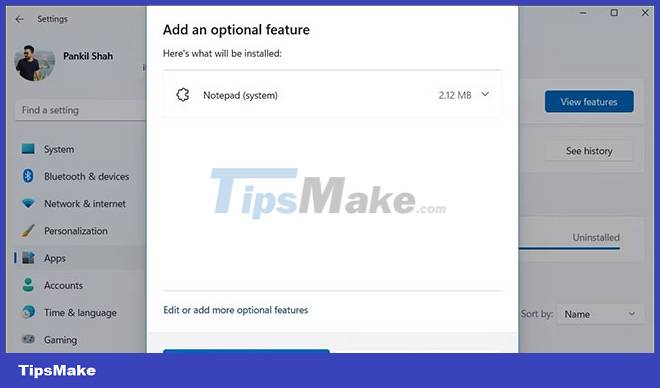
Wait for Windows to install Notepad on your computer and then try to open it using the search menu.
5. Run SFC and DISM. Scans
Corrupt system files can also interfere with system processes and prevent Notepad from opening. System File Checker (SFC) is a built-in utility that can help you repair system files on Windows. Basically, it scans your system for corrupted system files and replaces them with cached versions.
After running the SFC scan, continue to run the DISM (Deployment Image Servicing and Management) scan. It will try to detect and repair any problems with the system image.
Once the scan is complete, restart your PC and see if you can access Notepad.
6. Perform a Clean Boot
Sometimes, third-party background apps and services can conflict with Windows processes and cause problems like the one discussed here. One way to verify this is to start your computer in a clean boot state, when it runs only with essential applications and services.
If you do a clean boot and Notepad opens normally, it means that the culprit causing the problem has been disabled.
7. Create Another User Account
If some files in your user account are corrupted, you may have trouble performing simple tasks like opening apps. If that's the case, your best option is to create and switch to a new user account.
Conclusion
Understanding Notepad Error makes it easier to compare options, avoid common mistakes, and apply the information in this guide more effectively. Review the relevant requirements before making changes or choosing a solution.
FAQ
What is Notepad Error?
Set Notepad as Default Text Editor If Notepad is not set as the default text editor application on Windows, your text files may open in another application.
Why is Notepad Error important?
Understanding Notepad Error helps you evaluate features, compatibility, performance, and potential limitations before you choose a product or follow a procedure.
What should you consider when using or choosing Notepad Error?
Consider your specific goal, compatibility requirements, available features, cost, security, and the practical recommendations described in this guide.
Related Articles
 How to Open Notepad with Admin Rights: Step-by-Step Guide8 minutes read
 Fix the Display Error and Cannot Save Vietnamese in Notepad2 minutes read
 Reset Notepad to the Initial Default Setting State3 minutes read
 Summary of Useful Shortcuts When Using Notepad3 minutes read
 How to Replace Notepad with Another Text Editor on Windows3 minutes read
 What Is Notepad ++? Compare Notepad ++ and Regular Notepad4 minutes read
Reader Comments 0
Sign in with email or Google to join the discussion.