Table of Contents
This guide provides a practical overview of Practical Exercises on Notebook Price List, including its main features, benefits, limitations, and important considerations.
The example has the following data table:
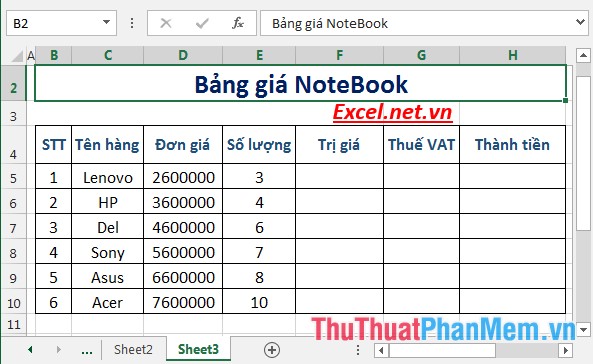
Calculate the total amount payable by guests including VAT 5%.
To calculate the amount the tenant must pay: The value of the item, the amount of VAT payable.
Step 1: Calculate the item value -> Enter the formula: = D5 * E5 -> press Enter the item value is:
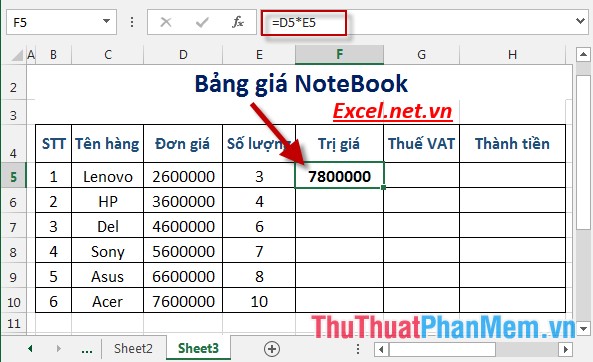
Step 2: Similarly copy the remaining values to result:

Step 3: Calculate the VAT is payable by each value items -> enter the formula: = 5 * F5 / 100 -> press Enter -> tax VAT is payable is:

Step 4: Similarly copying the formula to the remaining values results:

Step 5: Calculate the total amount the customer must pay including VAT -> enter the formula: = G5 + F5 -> press Enter -> the total amount to be paid is:

Step 6: Similarly copying the formula to the remaining values results:
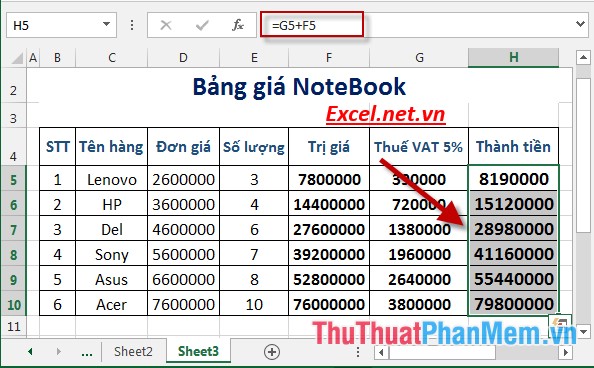
Step 7: Calculate the total value of items sold -> enter the formula: = SUM (F5: F10)
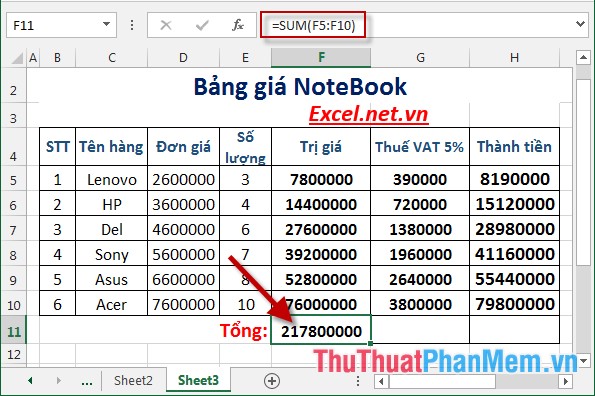
Step 8: Similarly, calculate the total VAT amount and the total amount payable by the customer:
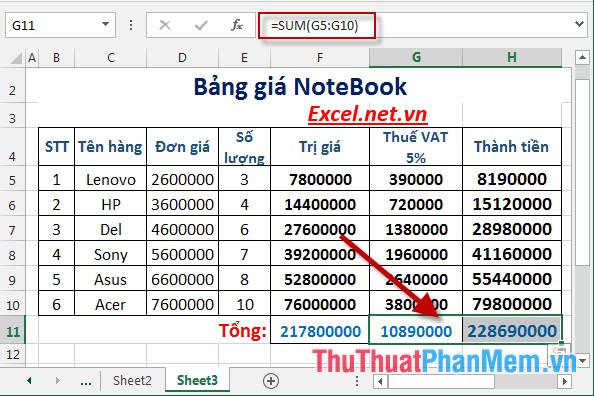
Above is a detailed guide on how to implement NoteBook price list in Excel 2013.
Good luck!
FAQ
What should I know about Practical Exercises on Notebook Price List?
Focus on the key features, requirements, limitations, and practical use cases explained in this guide.
How do I get the best results with Practical Exercises on Notebook Price List?
Follow the recommended steps, use current software or information, confirm compatibility, and review settings before major changes.
Are there any risks or limitations?
Potential limitations depend on compatibility, data quality, cost, privacy, support, and how the product or method is used.
Related Articles
 Review Notebook 9 Pro: Performance, Battery Life and Good8 minutes read
 Practical Exercise on Computer Rental List in Excel3 minutes read
 Practical Exercise on Production Statistics Table in Excel3 minutes read
 Summary of Excel Exercises from Basic to Advanced2 minutes read
 How to Use the DCOUNT Function in Excel4 minutes read
 12 Exercises to Have Strong Legs for All Ages6 minutes read
Reader Comments 0
Sign in with email or Google to join the discussion.