Table of Contents
This guide provides a practical overview of Practice Exercises on Payroll, including its main features, benefits, limitations, and important considerations.
The example has the following data table:
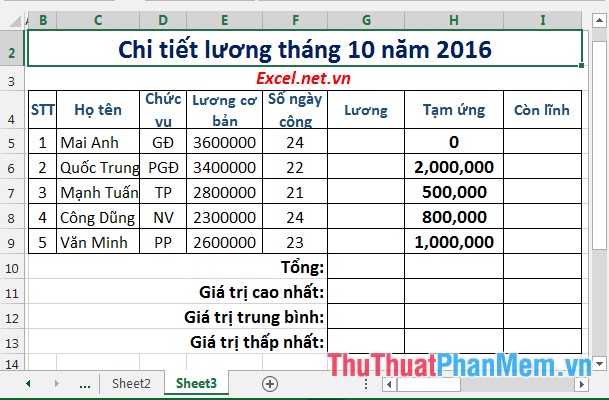
Calculate employee's gross salary, calculate the maximum value of salary, advance and remaining, average and minimum value.
Step 1: In the cell to calculate the salary enter the formula: = E5 * F5 -> press Enter -> salary of the employee is:
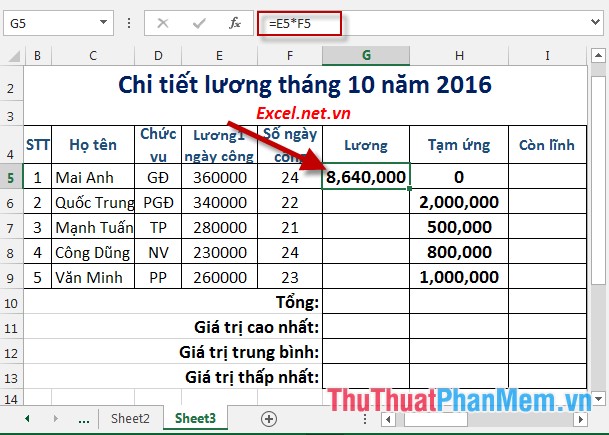
Step 2: Similarly copy the remaining values to result:
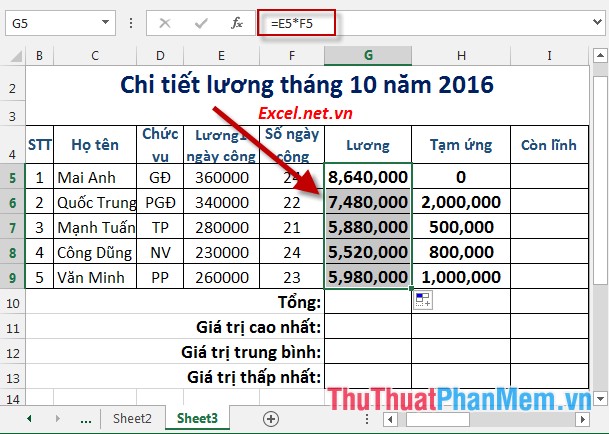
Step 3: To calculate the remaining salary, the employee enters the formula: = G5 - H5 -> press Enter -> the remaining salary is:

Step 4: Similarly copying the formula to the remaining values results:

Step 5: To calculate the total salary payable to the employees entering the formula: = SUM (G5: G9) -> press Enter -> total salary to be paid is:

Step 6: Similarly, enter the formula for the total advance salary and the total remaining salary:
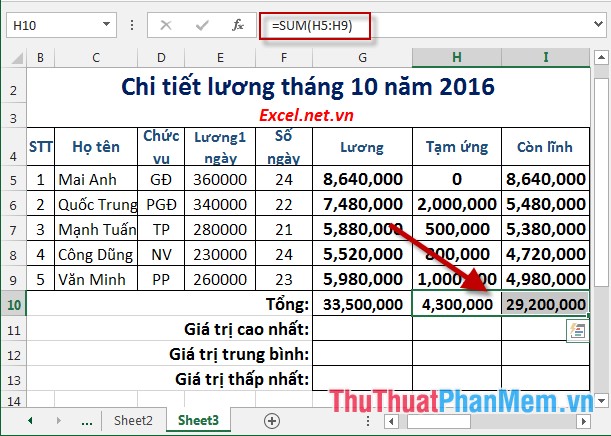
Step 7: Calculate the largest salary value in the company -> enter the formula: = MAX (G5: G9) -> press Enter -> the return value is:
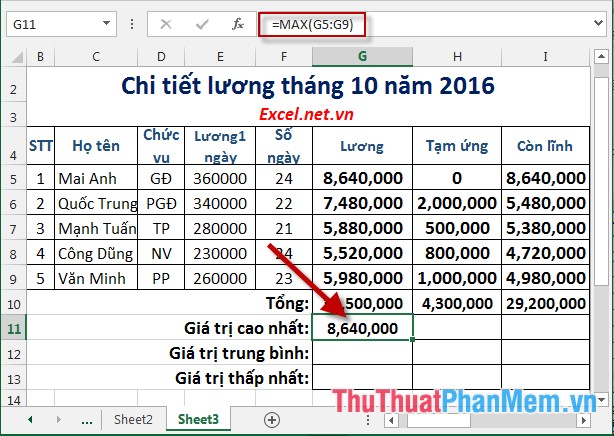
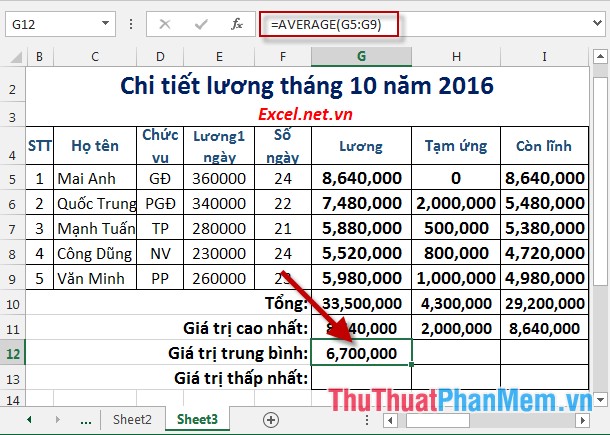
Step 8: Similarly, calculate the average value: = AVERAGE (G5: G9)
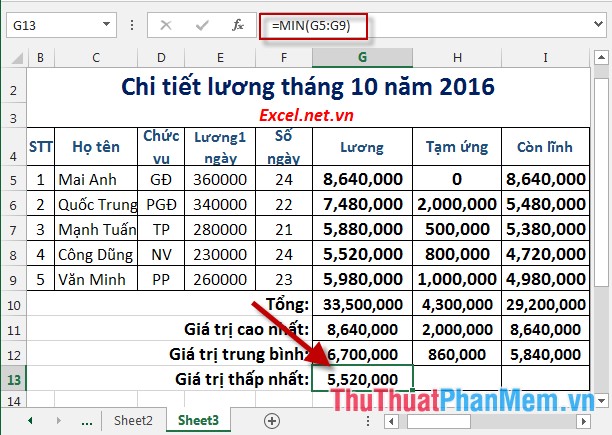
Step 9: Calculate the minimum value: = MIN (G5: G9)
- After calculating, there is a complete salary table. In this data sheet you can easily read and find the most frequently searched information:
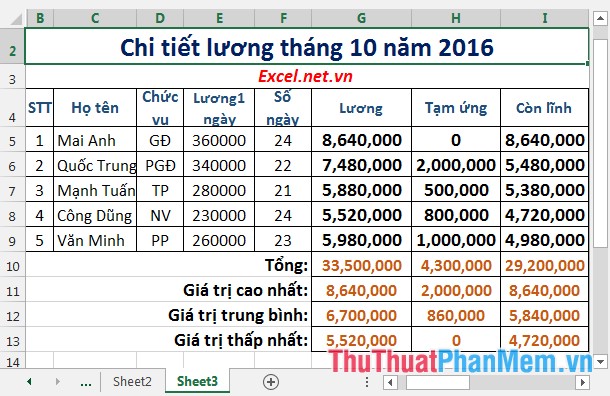
Above is a detailed guide of practical exercises on payroll in Excel 2013.
Good luck!
FAQ
What should I know about Practice Exercises on Payroll?
Focus on the key features, requirements, limitations, and practical use cases explained in this guide.
How do I get the best results with Practice Exercises on Payroll?
Follow the recommended steps, use current software or information, confirm compatibility, and review settings before major changes.
Are there any risks or limitations?
Potential limitations depend on compatibility, data quality, cost, privacy, support, and how the product or method is used.
Related Articles
 How to Make Payroll on Excel in the US: Complete Guide7 minutes read
 Employee: How to Prepare Payroll in Excel6 minutes read
 12 Exercises to Have Strong Legs for All Ages6 minutes read
 Top Site with Many Good JavaScript Exercises to Practice4 minutes read
 C ++ Exercises About IF ELSE: Explained2 minutes read
 Guide to Designing Writing Practice Exercises in Canva4 minutes read
Reader Comments 0
Sign in with email or Google to join the discussion.